
Watch: Report: Biden ‘building rail lines that connect mines so African kids can dig up the minerals we need for the Green New Deal’
The media won’t tell you this, but here’s the REAL reason @JoeBiden is in Africa. He’s building rail lines that connect mines so African kids can dig up the minerals we need for the Green New Deal. All so we can have windmills that pockmark our coastlines and subsidize electric… pic.twitter.com/Aequ25QgzI — Jesse Watters (@JesseBWatters) […]
Biden’s Green Colonialism Sends Billions To Africa As Americans Suffer At Home – NC residents freeze in tents, Biden pledges billions for ‘green energy’ abroad
Biden during his trip to Angola: “Investing in solar energy projects can help Angola generate 75% of its clean energy by next year.” … “My administration alone has invested over $3 billion in Angola thus far.”
Is Australia copying Pakistan’s electricity grid? ‘The absurdity of power shortages in a first-world, resource-rich nation’ – ‘The public should be utterly furious that ‘cheap’ ‘green’ energy has plundered our grid’
#GreenScam @realDonaldTrump @DOGE “[T]he absurdity of power shortages in a first-world, resource-rich nation when the truth is the Australian public should be utterly furious that ‘cheap’ ‘green’ energy has plundered our grid.”https://t.co/vI1E9apAaf — Darren Brady Nelson (@DarrenBNelson) December 3, 2024 https://www.spectator.com.au/2024/12/is-australia-copying-pakistans-electricity-grid/ Paul Lindwall In the quiet residential enclaves of Islamabad, my wife and I […]
Black Friday: Activists launch a movement for degrowth – ‘Economic growth doesn’t bring happiness’
1/ On Black Friday, 29th of November 2024, the Global Degrowth Campaign put forward a series of actions. ✨ In Brussels, activists adbusted the facade of a big shopping center with a 7-metre ladder. They sprayed a 13-metre billboard and stuck a series of posters. pic.twitter.com/qC750GYg7k — Scientist Rebellion (@ScientistRebel1) November 30, 2024 6/ […]
Peer-Reviewed Study: ‘Climate change is encouraging unsanitary toilet practices among vulnerable communities’ – ‘Climate change makes toilets more likely to break, which leaves people more likely to ‘go’ outside’
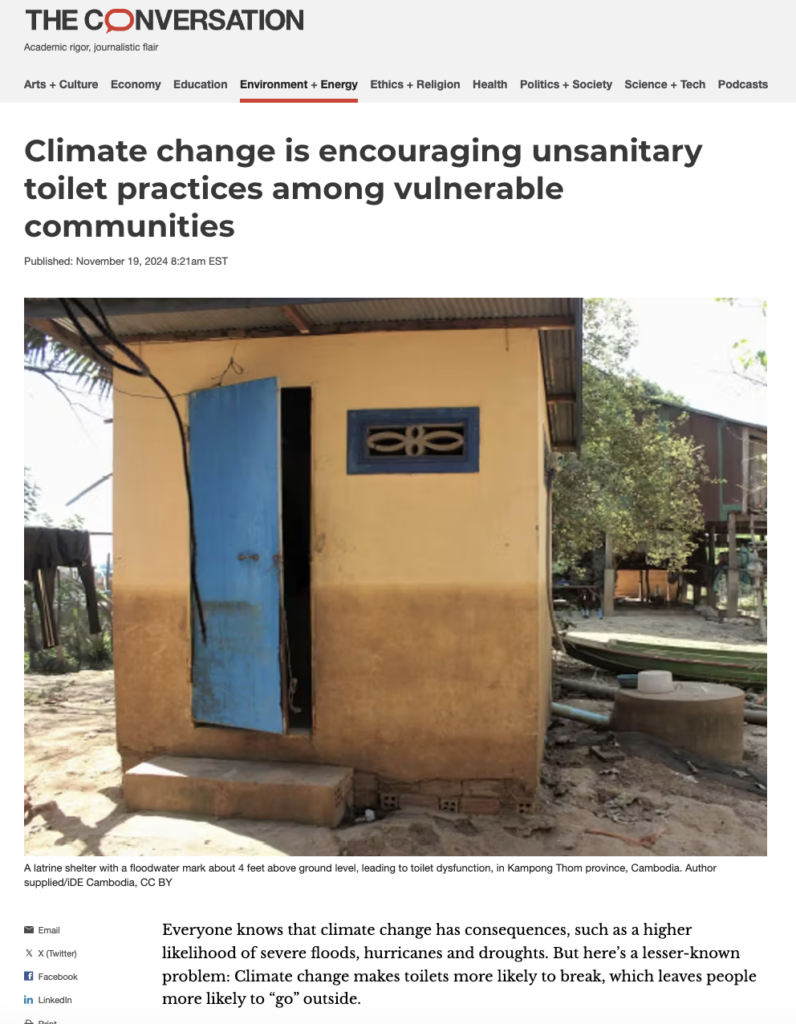
Everyone knows that climate change has consequences, such as a higher likelihood of severe floods, hurricanes and droughts. But here’s a lesser-known problem: Climate change makes toilets more likely to break, which leaves people more likely to “go” outside.
That’s what colleagues and I found when we studied households across six rural Cambodian provinces, focusing on their access to proper toilets and when people decide to abandon sanitary systems in favor of open defecation, or “going” outside.
We analyzed sanitation behavior surveys that were given to about 200,000 households every two years from 2013 to 2020. These questionnaires looked into how households maintained access to sanitary toilet systems, when these facilities were abandoned, and why. It also inquired about the poverty status of the households.
…
The key result of our study, which was published in the peer-reviewed journal Environment, Development and Sustainability, was clear: In regions where climate change makes heavy storms and floods more common, households more frequently stop using and maintaining their toilets.

UN COP29 climate summit ups ‘climate finance’ target from 2009’s goal of $100 billion a year to ‘a more ambitious goal’ of ‘$1.8 trillion by 2030’ – Seeks ‘a just transition towards sustainability’
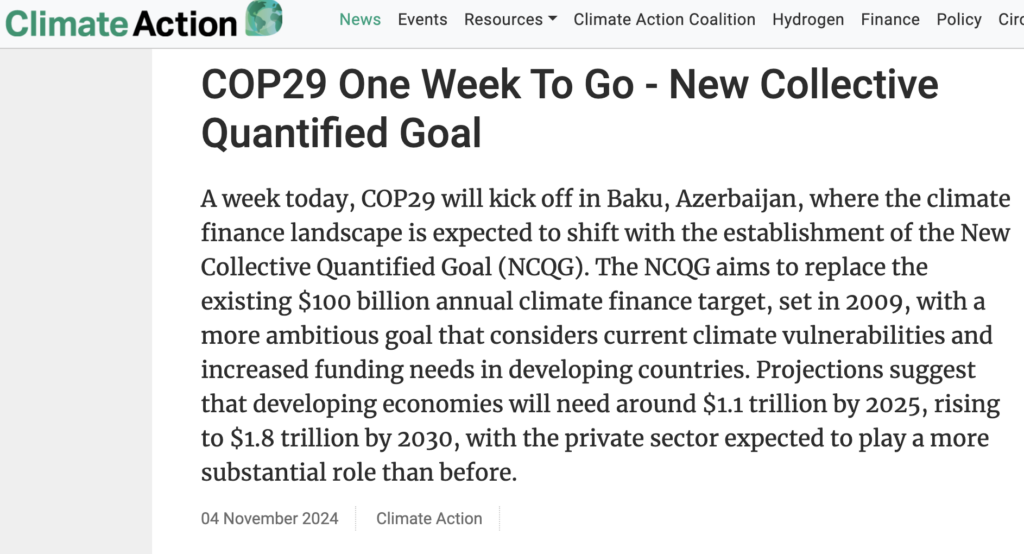
Last week, UN Trade and Development (UNCTAD) published its report on the quantitative and qualitative elements of the NCQG. It conveys a strong message that global climate finance needs a boost in both quantity and quality to address developing economies’ needs for a just transition towards sustainability and resilience.
“Ultimately, the goal of the NCQG (New Collective Quantified Goal) on climate finance must be to transform the climate finance landscape and herald a new era of mutual trust, cooperation and climate action,” the UN Trade and Development (UNCTAD) report urges.
World Bank ‘Misplaces’ $41 Billion in Climate Change Funds – Oxfam Investigation finds: ‘No clear public record showing where this money went or how it was used’
https://pjmedia.com/rick-moran/2024/10/24/world-bank-misplaces-41-billion-in-climate-change-funds-n4933604 By Rick Moran The World Bank was created, in part, to help alleviate the extreme poverty in about 10% of the world’s population. That’s 700 million people living on less than $2 a day. The bank gets its funding from contributions made by rich nations. However, a recent decision to divert 45% of its […]
Climate Colonialism Starves Africa of Energy
Climate Colonialism Starves Africa of Energy By Vijay Jayaraj European colonialism that methodically extracted wealth from Africa until the system’s collapse in the last century has been replaced by a climate colonialism that stifles the economic development that the Dark Continent desperately needs. A highly political climate industrial complex enables Western governments and international bodies […]
Spiked Online: ‘The elitism of electric cars’: ‘EVs are still only viable for the well-off, urban-dwelling, laptop class’ – This is hardly a ‘movement… powered by people’
Hugo Griffiths: No invention has done more to liberate society than the mass-produced car. It has become as democratized as such a complex piece of machinery can be. … Electric cars upend much of this, bringing greater expense and requiring a host of well-documented sacrifices from drivers. Unsurprisingly, most are unwilling to make the switch. This issue has become so pronounced that manufacturers are now restricting sales of petrol and diesel models to avoid the gargantuan government fines (£15,000 per car over quota) that will be imposed on brands if they don’t shift enough EVs. Such threats wouldn’t be needed if the product were in demand. …
All this pro-EV legislation has been drawn up by people who tend to be isolated from the population at large. … EV advocates often blame poor sales of electric cars on ‘misinformation’.
Charging is so stacked against the poor as to be an ideal subject for fans of class analysis. If your home has a driveway (a feature that makes a house more valuable), then an EV can make a great deal of sense. Each morning, you come down to a car conveniently filled with cheap overnight electricity, priced at as little as seven pence per unit and taxed at a liberal five per cent VAT.
Not so the individual who has to park on the street. He must not only pay a commercial rate of perhaps 85 pence per unit of electricity, but is also hit with 20 per cent VAT. This means that while filling an EV at home can be as cheap as £3.50, the same amount of electricity going into the same car can easily cost £42.50 on the open road.
Our ideal EV driver has, therefore, a nice job, can work from his phone and has a house with a driveway. This is hardly a ‘movement… powered by people’, as one pro-EV publication was bold enough to call it.
The truth is this: electric cars and their policies favor the fortunate.
Bloomberg News touts new green villain: Refrigeration! YOUR fridge ‘has wide-ranging climate implications’ using ‘more than 8% of global electricity…at a time when ice caps are melting’ – ‘You really don’t need to have a tomato in December…Just don’t do it’

Bloomberg Climate Reporter Akshat Rathi: “The US alone boasts around 5.5 billion cubic feet of refrigerated space. That’s like 150 Empire State buildings worth of freezers, and developing countries are starting to catch up…At a time when ice caps are melting faster than ever, the number of walk-in refrigerators is also expanding. This cold rush has huge implications for the planet. At a time when ice caps are melting faster than ever, the number of walk-in refrigerators is also expanding. This cold rush has huge implications for the planet.”
Nicola Twilley, author of Frostbite: How Refrigeration Changed Our Food, Our Planet, and Ourselves: “The power to run cooling equipment is more than 8% of global electricity usage right now…Like you really don’t need to have a tomato in December, it’s going to taste like nothing anyway, just don’t do it.”
#
Related:
Flashback: Global deal reached to limit greenhouse gases from fridges and air conditioners
Now the UK government wants to control your kitchen fridge or send you to jail – Jo Nova: Are they your appliances or the state’s? If you don’t control the power switch you know the answer.
I feed my daughter crickets for protein — it saves hundreds on grocery bills

BBC: ‘What would a flying-free world look like?’ ‘Fresh fruits & veggies…would disappear from supermarkets in winter’ – ‘Huge adjustments’ in ‘supply chains’ – ‘It’s about when — not if’ – Highly perishable fresh fruits and vegetables like grapes, mangoes and avocados would disappear from supermarkets in the winter, with a rise in the consumption of frozen fruits instead.