By ZACK COLMAN
Excerpt: The Iran war is leading to lower carbon emissions globally.
The Iran war is leading to lower carbon emissions globally.
Why energy markets are watching the Trump-Xi summit closely.
The U.S. Energy secretary applauded China’s expansion of EVs. Huh.
President Donald Trump’s war in Iran may accelerate the arrival of peak fossil fuel demand — and help the climate.
The conflict has hobbled oil and gas supply, and with no end in sight, countries are beginning to pivot from short-term measures — like subsidies and tax holidays — to policies that could curb their fossil fuel use into the future.
The result could permanently ding the world’s thirst for crude and gas.
“We’ve only started to see over the summer more and more incidences of countries saying, ‘OK, well, how do we advance EVs in our country?’” said Joseph Majkut, director of the energy security and climate change program at the Center for Strategic and International Studies. “That’s where I think you will start to see some structural changes.”
The long-term effects of the war won’t be known for years. An S&P Global report last week forecasts that oil, gas and coal may provide only half of the world’s energy by 2060 — down from today’s 80% — without considering the effects of nearly closing the Strait of Hormuz.
“Whether the effective closure, and the associated longer-term risks, results in permanent demand destruction for oil and gas, or simply shorter-term demand repression, will become apparent over the next few years,” the report said.
Signs of flagging demand are emerging. Carbon dioxide emissions from energy are down by 0.5 percent this year, according to recent estimates. That defies a century-long trend of rising energy emissions with occasional decreases, the last of which came in 2020 during the pandemic.
…
Changing the curve: But the shift in some countries is beginning to pop up in data.
Electric vehicle sales spiked in nations like Brazil, India, Indonesia and the Philippines this year, BloombergNEF data showed.
Southeast Asia solar investment nearly tripled in the first half of this year compared to 2025, according to Rhodium Group and the Massachusetts Institute of Technology’s Global Clean Investment Monitor.
The jumps come with qualifiers. Electric vehicles still comprise only 10% of new sales in India and Brazil, far below the 25% global average. But both countries have seen fast gains, with India’s EV sales doubling on a monthly basis compared to last year. Brazilian sales are tripling.
Changing the curve: But the shift in some countries is beginning to pop up in data.
Electric vehicle sales spiked in nations like Brazil, India, Indonesia and the Philippines this year, BloombergNEF data showed.
Southeast Asia solar investment nearly tripled in the first half of this year compared to 2025, according to Rhodium Group and the Massachusetts Institute of Technology’s Global Clean Investment Monitor.
The jumps come with qualifiers. Electric vehicles still comprise only 10% of new sales in India and Brazil, far below the 25% global average. But both countries have seen fast gains, with India’s EV sales doubling on a monthly basis compared to last year. Brazilian sales are tripling.
#
Who would have guessed that Trump policies would have done something that decades of climate policy has never achieved 😉
“The current crisis, therefore, has the potential to not only lower fossil-fuel use and emissions in the short term, but also on a more lasting basis” https://t.co/X8v4myUv1G
— The Honest Broker (@RogerPielkeJr) September 18, 2026
Analysis: Global fossil-fuel emissions set to fall in 2026 amid Hormuz crisis
Dr Simon Evans
Excerpt:
Global fossil-fuel emissions are set to fall by around 0.5% in 2026 amid the fallout from the Hormuz crisis, according to Carbon Brief analysis.
The US-Iran war has severely disrupted trade through the strait of Hormuz, causing a spike in oil and gas prices that continues to ripple around the global economy.
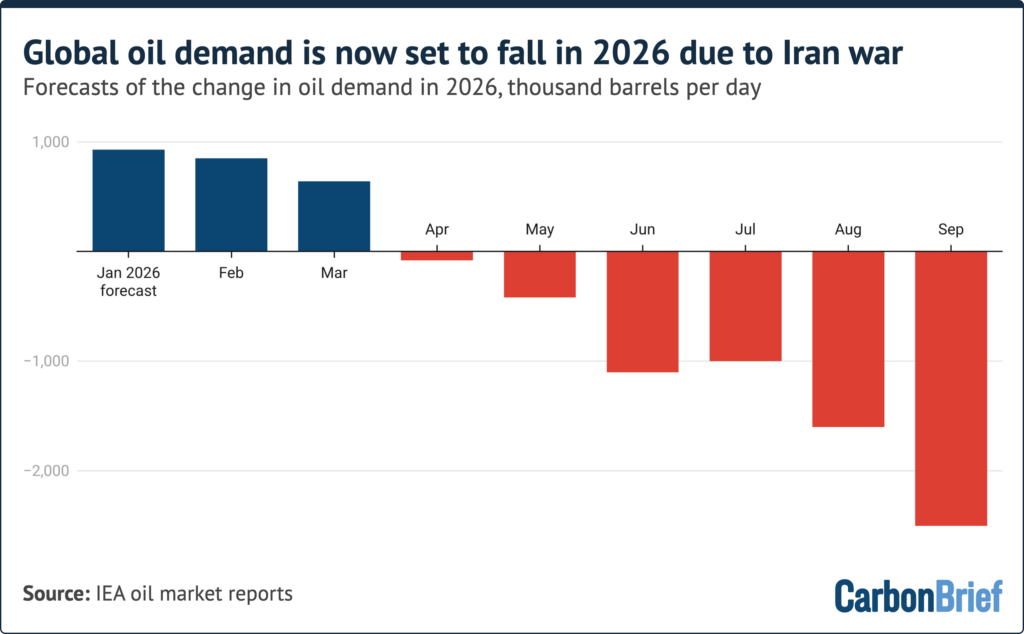
Each month of disruption – and each new flashpoint, such as in Yemen – is increasing the incentive to switch to alternatives.
Those alternatives include coal, with the latest forecasts pointing to a 1.2% rise in coal demand this year – apparently supporting media claims of a “return to coal” in the wake of the crisis.
Yet Carbon Brief’s analysis shows the rise in emissions associated with this increased coal use, much of which is unrelated to Hormuz, is set to be more than offset by declines for oil and gas.
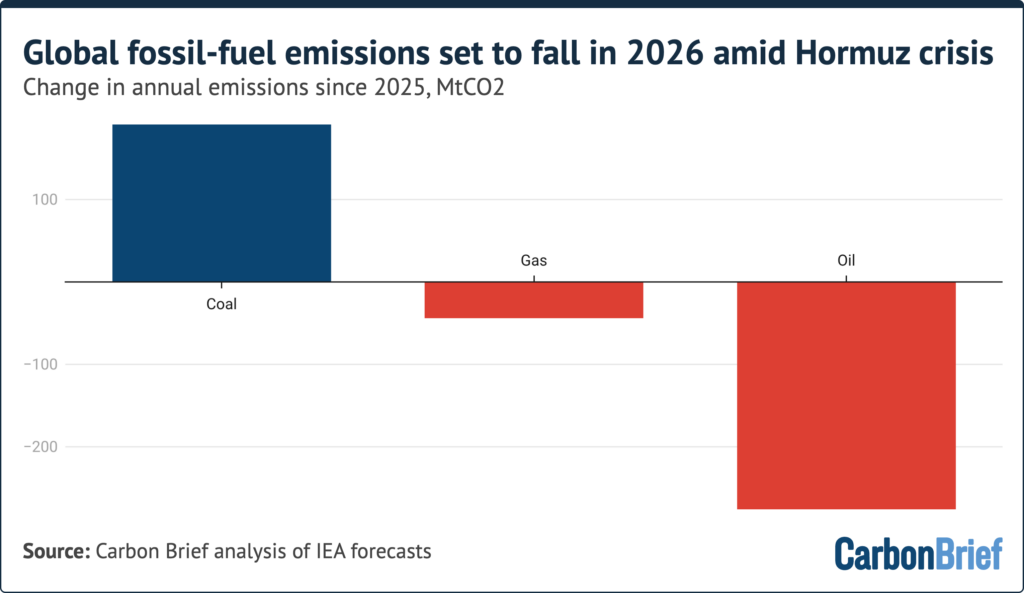
(Fossil fuels account for two-thirds of global greenhouse gas emissions.)
The IEA says the 2027 outlooks for coal and gas are interdependent, with coal demand potentially increasing again if gas prices remain elevated – or dropping back if gas prices ease.
At the same time, governments in countries that had planned to rely on imports of liquefied natural gas (LNG) have been signalling shifts towards favouring domestic clean energy instead – or continuing to use coal for longer.
The current crisis, therefore, has the potential to not only lower fossil-fuel use and emissions in the short term, but also on a more lasting basis.
#
The Street: ‘The Hormuz crisis just did what climate summits couldn’t’ – ‘The war wrecking your fuel budget is quietly moving a number nobody expected to move this decade.

Excerpt: Every energy shock teaches the same lesson, and nobody enjoys learning it. When fuel stays expensive long enough, people stop buying it. Not because a rule told them to, but because the math at the pump stopped working. That math broke in late February, when strikes on Iran began, and tanker traffic through the Strait of Hormuz seized up. Brent crude settled at $104.82 a barrel on Sept. 17, according to CNBC. The national average for a gallon of regular reached $4.4386 that same day, and diesel in California averaged $8.3496, according to AAA. …
The International Energy Agency (IEA) now expects global oil consumption to shrink by 2.5 million barrels per day in 2026, a 2.4% drop from 2025 levels. Which brings us to a figure published Sept. 16 that the market barely registered. Global emissions from fossil fuels are set to fall by roughly 0.5% this year, according to Carbon Brief. That would be the first annual decline since the pandemic year of 2020. No treaty produced it. …
How the Hormuz shutdown rewired global fuel demand: About a fifth of the world’s oil trade moves through a 21-mile-wide channel between Iran and Oman, along with a similar share of seaborne liquefied natural gas (LNG). Close it, and everything downstream reprices within weeks. …
The International Energy Agency (IEA) now expects global oil consumption to shrink by 2.5 million barrels per day in 2026, a 2.4% drop from 2025 levels.
Which brings us to a figure published Sept. 16 that the market barely registered. Global emissions from fossil fuels are set to fall by roughly 0.5% this year, according to Carbon Brief.
That would be the first annual decline since the pandemic year of 2020. No treaty produced it.
…