Europe is flipping its stance on cow emissions, now deeming livestock critical after years of climate fearmongering. @ClimateDepot: “This is honestly one of the most significant developments in two decades.” | @dagenmcdowell @brianbrenberg pic.twitter.com/onhh8lqxpH
— The Bottom Line (@BottomLineFBN) July 8, 2026
The Bottom Line – Fox Business – Broadcast July 8, 2026
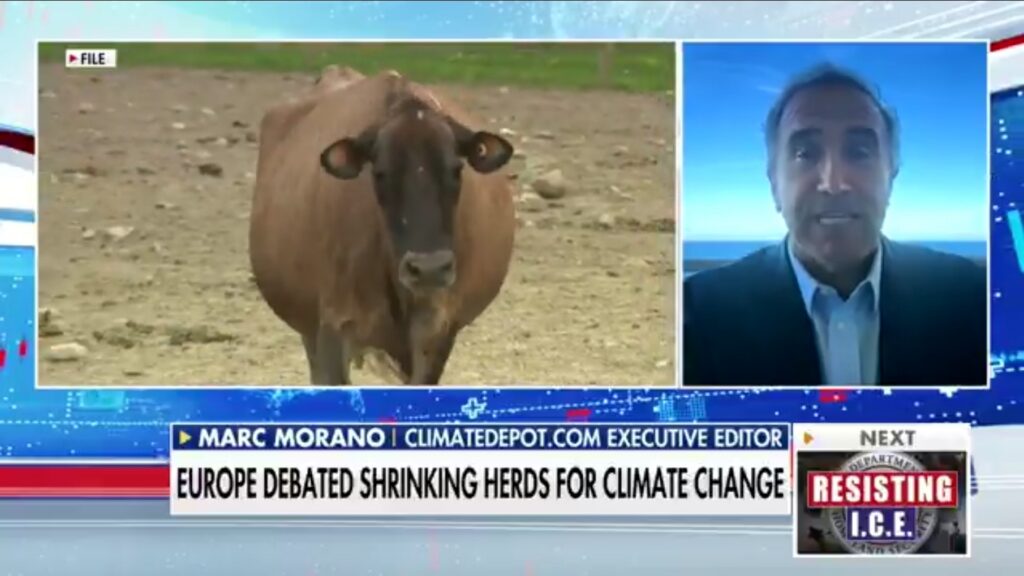
Climatedepot.com executive editor Marc Morano criticizes ‘insanity’ over Europe’s meat restriction policies on ‘The Bottom Line.’ –
Europe is flipping its stance on cow emissions, now deeming livestock critical after years of climate fearmongering.
@ClimateDepot
: “This is honestly one of the most significant developments in two decades.” – See Politico: The EU’s paradigm shift on cows: Europe’s plan to support livestock farmers recasts a climate problem as a strategic asset.

Selected Excerpts:
Fox Host: Europe is ready to make cow flatulence great again. After years and years of causing a whole big stink about cow emissions and livestock emissions contributing to climate change, the European Commission is changing its tune. They were really serious about it once upon a time in 2024. Denmark instituted the tax on cow poop. A handful of years ago, Europe was debating whether or not to shrink its herd on purpose for the climate. Now that they are recognizing livestock infrastructure, its new official livestock strategy is deeming it critical for food security.
Joining us now is Marc Morano of Climate Depot. I don’t even know what question to ask you. They went from being obviously stupid to starting to live in reality. I guess good for them, but what do you make of all of this?
Marc Morano: This is honestly one of the most significant developments in two decades. I was working in the U.S. Senate Public Works Committee when the UN came out with the watershed report in 2006 declaring ‘cow emissions’ more damaging to the planet than trains, planes, and automobiles combined.
See: 2006 UN report: Cow ’emissions’ more damaging to planet than CO2 from cars

Morano: The entirety of Europe lost their minds. And as you mentioned, we went from then-Prince Charles trying to fund a company to put face masks on cows to prevent methane. They had devices for the rear ends of cows to capture methane because it was so dangerous. Ireland declared they were going to cull 200,000 cows to reduce emissions. The World Economic Forum has been pushing eating insects and lab-grown meat —led by Bill Gates—and all that insanity is collapsing now. This is a significant development.
It is collapsing chiefly for two reasons: first, President Trump is leading the way from America overturning the climate agenda, and second, the grassroots rebellion of European farmers which began in the Netherlands and then spread throughout Europe. I don’t condone violence, but farmers protested EU agricultural policy by spraying manure over the headquarters building in Brussels—the Brussels headquarters of the EU. This is so significant. They are saying cow production and agricultural production is preparedness and access to defend security. This is actual sanity coming from Europe on climate and agricultural policy. I am blown away right now. This is the best news I’ve been able to deliver. We were delivering great news in America the last year and a half, and we can finally start delivering it now in Europe.
We had Biden Climate Envoy John Kerry saying we have to go after agricultural emissions in the U.S. Those restrictions are coming from the EU and the World Economic Forum. The goal was to make meat a rare, stable treat.

Meat will be a special treat. Read more: https://t.co/RiQP6tpkfp pic.twitter.com/7BcRHgnWTx
— World Economic Forum (@wef) April 9, 2018
The UN climate chief talked about meat eaters being relegated to small sections of the restaurant like smokers used to be. 
This is a huge win for grassroots activism, for standing up to the powers that be, and for Donald Trump resetting the entire global climate plate. Win-win.
#
End Morano excerpts
#
Europe is flipping its stance on cow emissions, now deeming livestock critical after years of climate fearmongering. @ClimateDepot: “This is honestly one of the most significant developments in two decades.”https://t.co/McvY5NVxGQ pic.twitter.com/cWQxYN7t0h
— Kent Nielsen Denmark (@Kentfrihedniels) July 14, 2026
AI Summary of Morano’s Fox segment:
This video from Fox Business discusses a significant shift in the European Union’s agricultural policy, where the EU has begun prioritizing livestock farming as a form of critical infrastructure and a key element of food security (0:44–0:57).
Key takeaways from the discussion:
- Shift in Perspective: The EU’s new official livestock strategy marks a departure from previous climate-focused initiatives that often targeted livestock reduction and methane emissions (0:36–0:57).
- Guest Perspective: Marc Morano, executive editor of ClimateDepot.com, frames this as a victory against what he terms the “insanity” of previous policies, such as proposed meat consumption limits and herd culling, which he claims were driven by climate alarmism (1:15–2:12).
- Drivers of Change: Morano attributes this policy reversal to two primary factors: sustained grassroots activism and protests by European farmers, and a broader shift in the global political climate influenced by leadership such as that of Donald Trump (2:14–2:42).
- Food Security: The conversation highlights that the EU is now reframing meat production and agricultural self-sufficiency as essential strategic assets, rather than primarily as environmental liabilities (2:51–3:06).
Recent official reports confirm the EU’s adoption of a new Livestock Strategy and Protein Action Plan aimed at bolstering resilience, autonomy, and sustainable production standards.
#
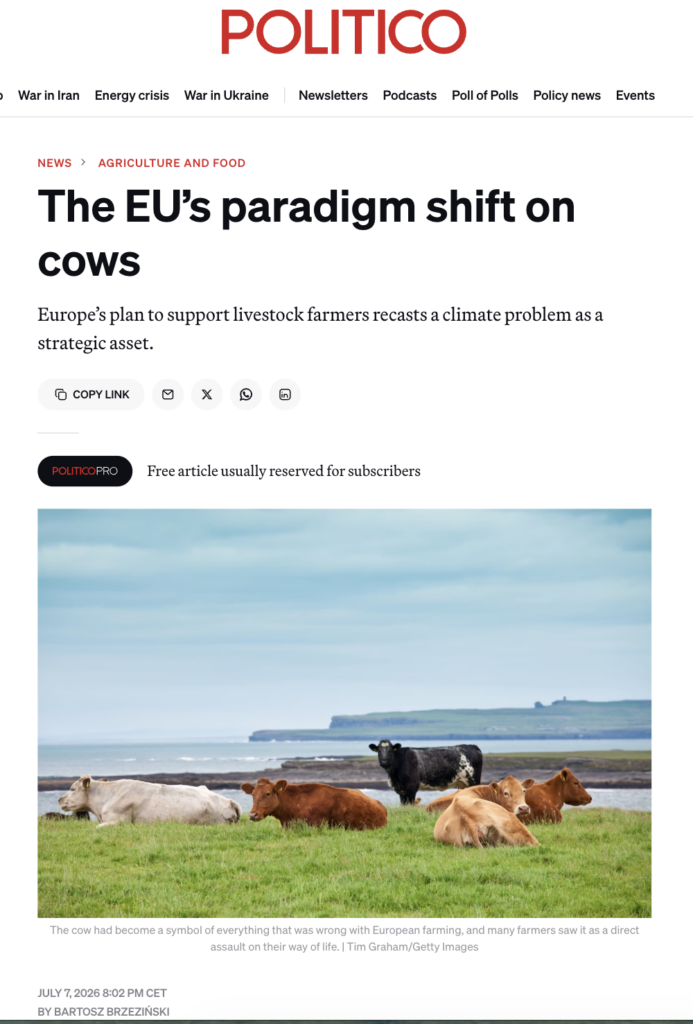
Politico: For years, the EU treated its cows, pigs and chickens mainly as a source of emissions to be reduced. On Tuesday, the European Commission gave them a new job title. Livestock, it now says, is critical infrastructure. … Herds underpin “strategic autonomy.” Grazing animals guard against land abandonment on the eastern flank. Food production is “preparedness.” … A sector responsible for around two-thirds of EU farm emissions and that uses a third of its land is no longer a problem to manage but an asset to defend. …
“Livestock is not only about agriculture,” Raffaele Fitto, the Commission’s executive vice president for cohesion and reforms, told reporters. “It is about competitiveness, it is about food security … and it is about Europe’s future.” …
On Tuesday, the Commission applied that promise to the most contested corner of European farming. The strategy does not ask whether Europe has too many animals. It treats having too few as the threat. …
The [farmers’] protests that clogged European capitals in 2024 and 2025 broke the political will behind the Green Deal, the EU’s flagship climate agenda. The Commission shelved much of its farm work and promised to steer policy from conditions toward incentives.