https://www.politico.eu/article/eu-livestock-strategy-food-security-climate-policy/
For years, the EU treated its cows, pigs and chickens mainly as a source of emissions to be reduced. On Tuesday, the European Commission gave them a new job title. Livestock, it now says, is critical infrastructure.
Its official livestock strategy, presented in Strasbourg, runs on the vocabulary of security policy. Herds underpin “strategic autonomy.” Grazing animals guard against land abandonment on the eastern flank. Food production is “preparedness.” A sector responsible for around two-thirds of EU farm emissions and that uses a third of its land is no longer a problem to manage but an asset to defend.
“Livestock is not only about agriculture,” Raffaele Fitto, the Commission’s executive vice president for cohesion and reforms, told reporters. “It is about competitiveness, it is about food security … and it is about Europe’s future.”
Agriculture Commissioner Christophe Hansen said the sector is”still a success story,” supporting 7 million jobs and generating €400 billion a year (not to mention €37 billion more in exports than imports). But it’s one now “at risk.” Livestock numbers are going down, Hansen said. Empty farmland, “especially at the eastern border, is a security liability.”
The cull that never was
Half a decade ago, Europe was debating whether to shrink its herds on purpose, in the name of nature and climate.
In the Netherlands, court rulings on nitrogen pollution pushed the government toward buying out farms. Early plans floated a cut of up to a third. In Ireland, a leaked government paper considered culling 200,000 cows to meet climate targets.
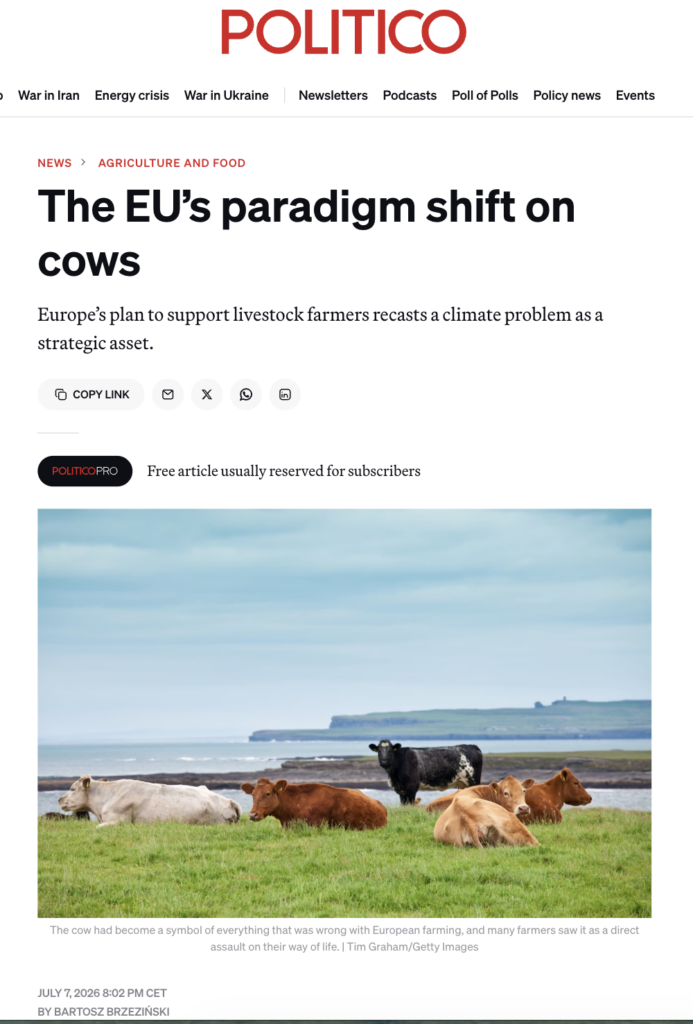
For farmers, nitrogen rules, methane targets and pesticide cuts blurred into a single attack. The cow had become a symbol of everything that was wrong with European farming, and many farmers saw it as a direct assault on their way of life. Then came the tractors.
The protests that clogged European capitals in 2024 and 2025 broke the political will behind the Green Deal, the EU’s flagship climate agenda. The Commission shelved much of its farm work and promised to steer policy from conditions toward incentives.
On Tuesday, the Commission applied that promise to the most contested corner of European farming. The strategy does not ask whether Europe has too many animals. It treats having too few as the threat.
Take methane, the bulk of the livestock sector’s farm emissions. How you count it has been contested for years.
Methane traps far more heat than carbon dioxide but disappears within a decade, while CO2 lingers for centuries. Livestock lobbyists argue that a steady herd adds little new warming, and that the usual way of counting overstates its impact. Ireland and New Zealand, two dairy and beef powerhouses, have pushed the case in international fora.
The strategy leans their way. Its answer to methane is not a target but a measurement project: emissions counted at farm level in enough detail to reward the farmer who switches feed additives or breeds lower-emitting cattle. The strategy talks of the “biogenic” nature of livestock methane, the idea that gas from a cow’s gut is part of a natural carbon cycle rather than a fossil-fuel emission, which is the lobbyists’ argument. Officials insist this is accuracy, not an accounting trick.
But green groups disagree, and more than 30, including Greenpeace and the European Environmental Bureau, wrote to Hansen last month against approaches that “downplay” livestock’s impact, citing scientists who say methane heats the planet equally whether it comes from a cow or a pipeline.
Marco Contiero, Greenpeace’s EU agriculture policy director, said the Commission looks set to embrace the same accounting favored by Ireland and New Zealand, branding methane from farmed animals as natural to avoid the deep cuts the sector has long resisted. He cast “this kind of wishful thinking” from the Commission as “a scandal.”
…
“We are not imposing diets,” Hansen said, “we are promoting choice.”