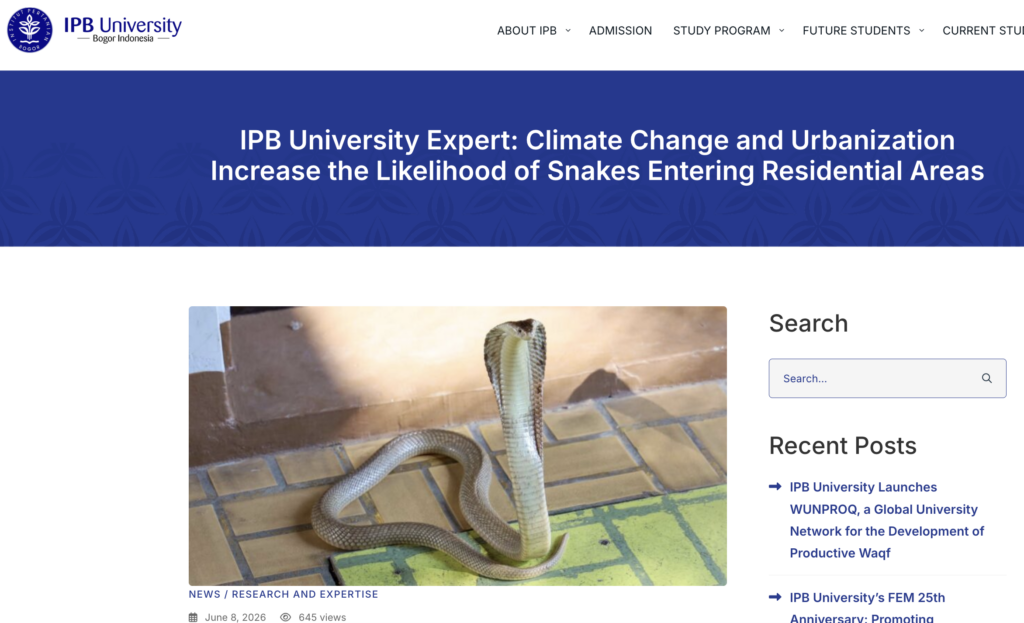
Excerpt: Climate change and land use conversion have the potential to increase the frequency of encounters between snakes and humans. This situation arises due to changes in temperature and rainfall, the loss of natural habitats, and shifts in food sources, which drive snakes to move into areas closer to human activity.
Prof Mirza Dikari Kusrini, a lecturer in the Department of Forest Resource Conservation and Ecotourism, Faculty of Forestry and Environment (Fahutan) at IPB University, explained that climate change affects snakes’ behavior, distribution, and movement patterns.
“As ectothermic animals, snakes are highly dependent on environmental conditions to regulate their body temperature. Rising average temperatures can alter snakes’ daily and seasonal activity patterns, including hunting times, reproduction, and habitat use,” she said.
According to Prof Mirza, who is also a wildlife ecology expert, changes in rainfall patterns, floods, prolonged droughts, and extreme weather events can also degrade the quality of natural habitats. As a result, snakes seek alternative locations that still provide shelter and food sources.
Human settlements often become targets because they provide rats, chickens, ponds, drainage channels, and various shelters. Additionally, when prey populations such as rodents and amphibians shift due to environmental changes, snakes tend to follow the distribution of their prey.
…
“Snakes commonly found in agricultural landscapes and residential outskirts such as cobras, welang snakes, and weling snakes, whose diet consists of rodents, have the potential to move into residential areas and increase the risk of human encounters,” she explained.