What could change Atlantic currents? Windmills, says new study. Not emissions.https://t.co/vF9T9FCLML pic.twitter.com/iLarhEIk6s
— Steve Milloy (@JunkScience) February 16, 2026
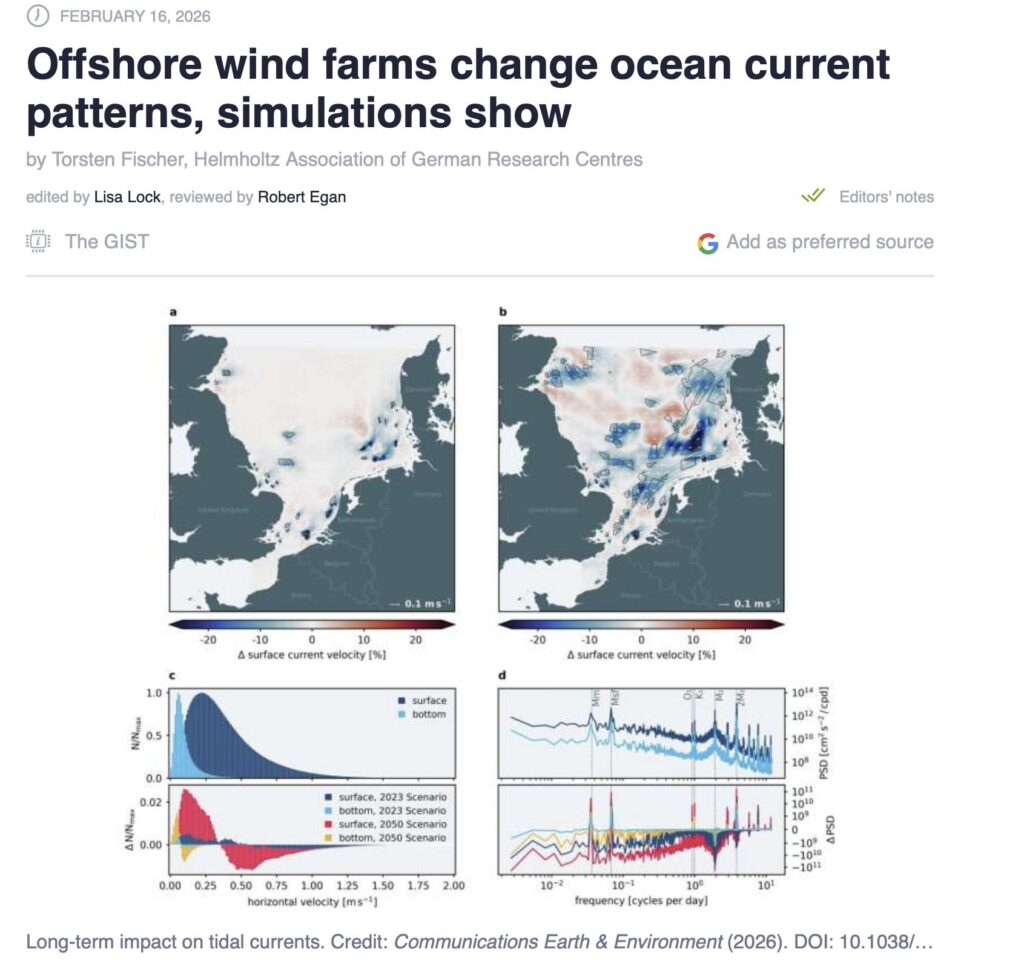
Offshore wind farms change ocean current patterns, simulations show
By 2050, offshore wind power capacity in the North Sea is set to increase more than tenfold. Researchers at the Helmholtz Center Hereon have analyzed the long-term overall impact of this large number of wind farms on the hydrodynamics of the North Sea for the first time. They found that the current pattern could change on a large scale. The study highlights approaches for minimizing potential risks to the environment at an early stage. The work was recently published in the journal Communications Earth & Environment.
Offshore wind turbines change the air and ocean currents. The rotors extract wind energy and influence surface currents, while the turbine pillars underwater act as obstacles and slow down tidal currents. These wake structures, known as wake effects, interact with each other and determine the complex physical impacts of offshore wind farms. A research group led by geophysicist Dr. Nils Christiansen from the Hereon Institute for Coastal Systems—Analysis and Modeling has now analyzed the effects of both phenomena together for the first time and calculated their extent for the expansion scenario up to 2050.
A new current pattern
The study shows that the interaction of wake effects leads to reductions in peak speeds and changes in flow frequencies in the German Bight. “Our simulations paint a new, finely structured flow pattern that is not only evident within the wind farms but can also spread across the North Sea—with surface speeds slowing by up to 20% in an expansion scenario for 2050,” says Christiansen. This can lead to large-scale changes in sediment transport or the mixing of seawater. These factors also shape the marine ecosystem.
In addition, the changes in the flow pattern also have consequences for the accuracy of flow predictions, which are relevant for shipping traffic, for example, but also for disaster management, environmental protection, and fisheries.