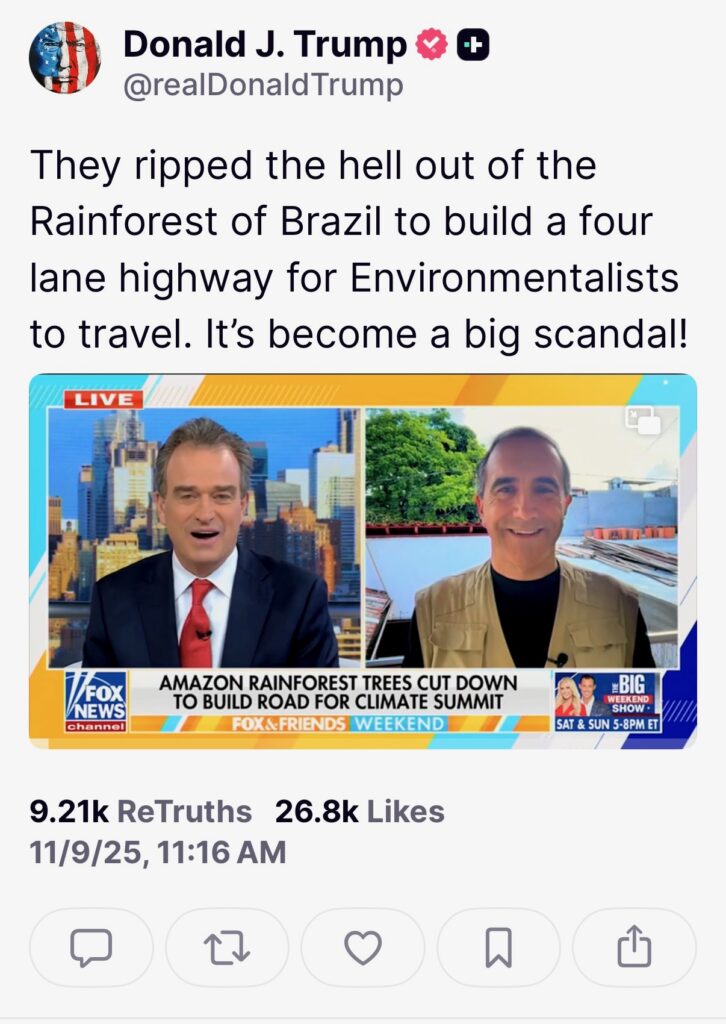
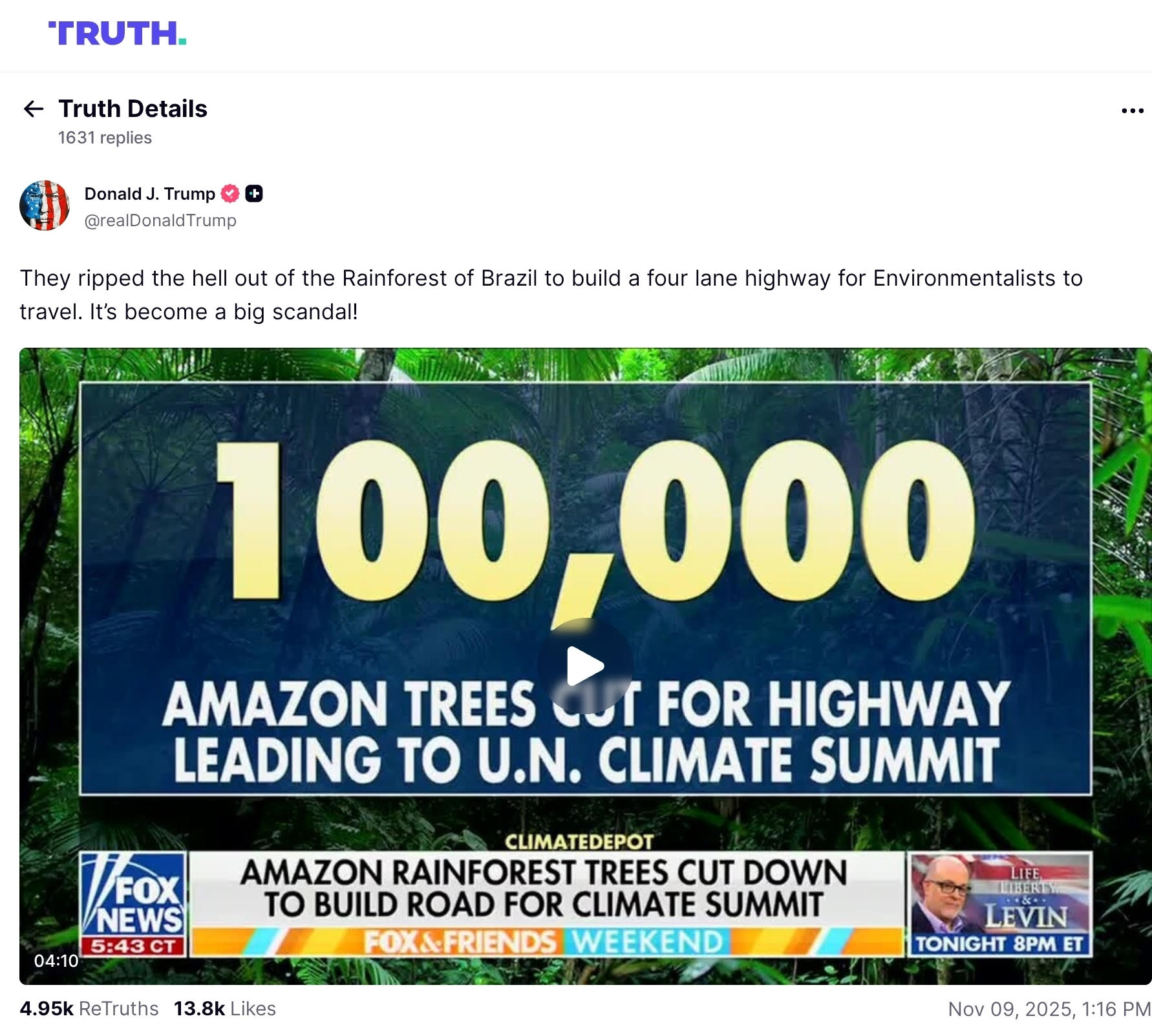
Trump posted on Truth Social with an embedded video of my Fox and Friends interview from today live from Brazil at COP30 – AKA Clear-Cut30. https://t.co/aYAhqfYDIo pic.twitter.com/WfPh3zBB6g
— Marc Morano (@ClimateDepot) November 9, 2025

Background:

CFACT’s Marc Morano added urgency to the call: “Withdrawing from the 1992 United Nations Framework Convention on Climate Change would be the most significant step the Trump administration could take to shatter this 33-year climate stranglehold on America. No Republican president has ever dared attempt it. This would etch Trump’s agenda in stone — making Trump 2.0’s climate legacy truly permanent and a nightmare for any future President AOC or Gavin Newsom to reverse.”
The Trump administration needs to officially withdraw the U.S. from the 1992 Rio Earth Summit Treaty, signed by then-President George H.W. Bush and ratified by the U.S. Senate.
An analysis by Dr. Matthew M. Wielicki’s revealed: “It was written into U.S. law when President George H. W. Bush signed the United Nations Framework Convention on Climate Change (UNFCCC) at the Rio Earth Summit on June 12, 1992, and the U.S. Senate gave its advice and consent on October 7, 1992. Bush then signed the instrument of ratification on October 13, 1992, making the U.S. the first industrialized nation to ratify the treaty.” …
The treaty explicitly provides a withdrawal mechanism: a country may notify the U.N. and, one year later, the exit takes effect. If the Paris executive pledge could be reversed, this Senate-ratified foundation can be lawfully revisited as well.”
And a potential U.S. withdrawal from the 1992 treaty is no idle threat to the entire global climate agenda. As POLITICO reported on May 14, 2025:
“During his first term, Trump declined to exit the UNFCCC, which the Democratic-led Senate had ratified during George H.W. Bush’s presidency following the “Earth Summit” in Rio de Janeiro.” …
“If Trump does pull the country out of the framework, it could be difficult for a new president to undo. Joining a treaty requires a two-thirds Senate vote — a high hurdle even in less polarized times…”
#