https://www.nytimes.com/2025/09/16/magazine/climate-politics-us-world-paris-agreement.html
By David Wallace-Wells
Sept. 16, 2025
Ten years ago this fall, scientists and diplomats from 195 countries gathered in Le Bourget, just north of Paris, and hammered out a plan to save the world. They called it, blandly, the Paris Agreement, but it was obviously a climate-politics landmark: a nearly universal global pledge to stave off catastrophic temperature rise and secure a more livable future for all. Barack Obama, applauding the agreement as president, declared that Paris represented “the best chance we have to save the one planet we’ve got.”
Paris wasn’t just a brief flare of climate optimism. To many, it looked like the promise of a whole new era, not just for the climate but also for our shared political future on this earth. Back then, the United Nations secretary general, Ban Ki-moon, liked to talk about how sustainability would be for this century what human rights was for the previous one — the basis for a new moral and political order. His successor, António Guterres, turned out to be an even more emphatic climate advocate, treating the Paris Agreement as though its significance approached, if not exceeded, that of the U.N. charter itself.
By design, the treaty wasn’t a one-shot solution, just a first step. Other steps, it was broadly assumed, would follow — toward faster climate action, yes, but also toward greater global cooperation, mutual obligation and solidarity. High off the success of its Millennium Development Goals, the U.N. had just released its far more ambitious Sustainable Development Goals, which brought the rich nations of the world into its lasso of responsibility. Diplomats talked optimistically about an emergent partnership they called the G2, with the United States and China cooperating on the world’s biggest challenges, as they had in Paris.
A decade later, we are living in a very different world. At last year’s U.N. Climate Change Conference (COP29), the president of the host country, Azerbaijan’s Ilham Aliyev, praised oil and gas as “gifts from God,” and though the annual conferences since Paris were often high-profile, star-studded affairs, this time there were few world leaders to be found. Joseph R. Biden, then still president, didn’t show. Neither did Vice President Kamala Harris or President Xi Jinping of China or President Ursula von der Leyen of the European Commission. Neither did President Emmanuel Macron of France, often seen as the literal face of Western liberalism, or President Luiz Inácio Lula da Silva of Brazil, often seen as the face of an emergent movement of solidarity across the poor and middle-income world. In the run-up to the conference, an official U.N. report declared that no climate progress at all had been made over the previous year, and several of the most prominent architects of the whole diplomatic process that led to Paris published an open letter declaring the agreement’s architecture out of date and in need of major reforms.
This year’s conference, which takes place in Brazil this November, is meant to be more significant: COP30 marks 10 years since Paris, and all 195 parties to the 2015 agreement are supposed to arrive with updated decarbonization plans, called Nationally Determined Contributions, or N.D.C.s. But when one formal deadline passed this past February, only 15 countries — just 8 percent — had completed the assignment. Months later, more plans have trickled in, but arguably only one is actually compatible with the goals of the Paris Agreement, the climate scientist Piers Forster recently calculated, and more than half of them represent backsliding.
The most conspicuous retreat, of course, has been the United States under President Trump, who first announced his intention to withdraw from Paris way back in 2017 with a ceremony in the Rose Garden. Trump has celebrated his return to office by utterly dismantling his predecessor’s signature climate bill, the Inflation Reduction Act, and vowing to stop all approvals for new renewable projects (not to mention paving over that same garden). But this is not just a story about Trump. When Paris was forged, the United States was a trivial exporter of natural gas, and it was still illegal to ship American oil abroad. Even before Trump’s second inauguration, the country had become the world’s largest producer and exporter of refined oil and liquid natural gas.
And neither is it a story particular to America. The retreat from climate politics has been widespread, even in the midst of a global green-energy boom. From 2019 to 2021, governments around the world added more than 300 climate-adaptation and mitigation policies each year, according to the energy analyst Nat Bullard. In 2023, the number dropped under 200. In 2024, it was only 50 or so. In many places — like in South America and in Europe — existing laws have already been weakened or are under pressure from shifting political coalitions now pushing to undermine them
To our north, the former central banker Mark Carney — whose 2015 warnings about the financial risks from climate change helped set the stage for Paris by alarming the world’s banking elite — became prime minister of Canada in March and as his very first act in office struck down the country’s carbon tax, before storming to a landslide victory in the April election. To our south, President Claudia Sheinbaum of Mexico, a former climate scientist, has invoked the principle of “energy sovereignty” and boasted of booming oil and gas production in her country — and enjoys one of the highest approval ratings of any elected leader anywhere in the world. Almost everywhere you look, the spike of climate alarm that followed Paris has given way to something its supporters might describe as climate moderation but which critics would call complacency or indifference. “You can’t walk more than two feet at any global conference today without ‘pragmatism’ and ‘realism’ being thrown around as the order of the day,” says Jason Bordoff, a former Obama energy adviser who now runs Columbia University’s Center on Global Energy Policy. “But it’s not clear to me that anyone knows what those words mean other than this whole climate thing is just too hard.”
The world hasn’t actually abandoned green energy, with global renewable rollout still accelerating and investment doubling over the last five years. But climate politics is in undeniable withdrawal, and far from ushering in a new era of cooperative global solidarity, Paris has given way to something much more old-fashioned: an atavistic age of competition, renewed rivalry and the increasingly naked logic of national self-interest, on energy and warming as with everything else. In the wake of America’s presidential election, Alex Trembath of the Breakthrough Institute declared that “the era of the climate hawk is over.” Perhaps, at least for now, the age of climate statesmen, too.
It was in the heady aftermath of Paris that I first began writing about warming. In retrospect, it was a strange time to come of age, climate-wise.
By any simple measure, the treaty looked like a breakthrough — in a representative tribute, The Guardian called it “the world’s greatest diplomatic success.” But frustrated advocates were still filled with rage, sure that not enough was being done and armed with the scientific reports to prove it. Remarkably, the world’s leadership class mostly embraced the critique, inviting activists on stage at Davos and the U.N. General Assembly in performances of collective self-laceration designed, it seemed, to inspire yet more climate concern. What is perversely striking today is that those years do not look now like a low point for political commitment to climate action but the opposite — at least when it comes to rhetoric, which is, of course, free.
At the time, trying to raise concern about warming, I found myself again and again in conversation with world leaders of one kind or another — presidents and prime ministers, treasury secretaries and environmental ministers and climate diplomats, among others. Most were a bit less alarmed than I was and a bit more mindful of the obstacles to a rapid transition. But in those conversations and in public speeches and commentary, their concern was nevertheless palpable. In fact, they were often proud to showcase it as a totem of good faith, and to invoke the ambitious Paris goal of limiting warming to 1.5 degrees — which many scientists had already concluded was a lost cause — as a necessary objective.
It helped that climate activism in the aftermath of Paris — Fridays for Future and the climate strikers, Extinction Rebellion and Sunrise — looked like a generational uprising, made more intense, of course, by the new powers of social media. Even those in power who weren’t moved felt they had to respond, and high-profile scientific reports gave them extremely short timelines on which to do so.
…
Polls show that voters don’t actually prioritize decarbonization and, crucially, aren’t willing to pay much to bring it about.
…
End excerpt:
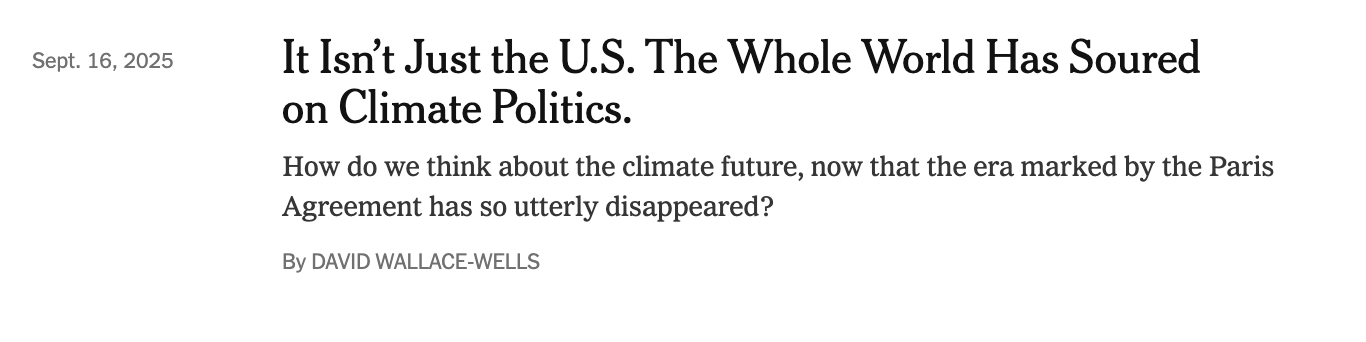
The New York Times admits that the Paris Agreement stage of the climate hoax has been defeated. On behalf of cancelled and smeared climate skeptics everywhere, you are welcome. https://t.co/z9D1fAg0gF pic.twitter.com/eSm1El5GW2
— Steve Milloy (@JunkScience) September 16, 2025
NYT Mag on the implosion of the climate scam:
“The Whole World Has Soured on Climate Politics…the era marked by the Paris Agreement has so utterly disappeared…[the climate scam was supposed to be] the basis for a new moral and political order”
At COP29 “Joseph R. Biden,…
— Tom Nelson (@TomANelson) September 17, 2025