Climate Change Weekly # 554 — My Recommendations for the Upcoming NAS Climate Report
By H. Sterling Burnett – Climate Change Weekly # 554
Despite Rising CO2, Arctic Sea-Ice Melt Declines Dramatically
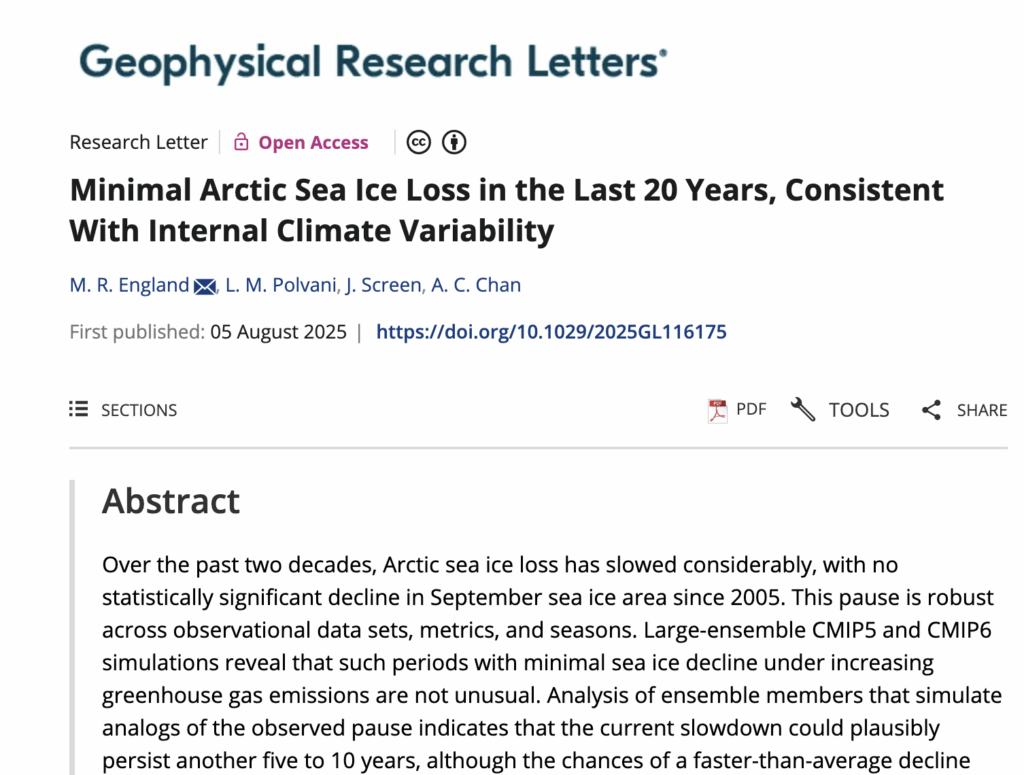
A new study published in the journal Geophysical Research Letters finds that contrary to many mainstream media reports, the amount of sea ice in the Arctic has not changed appreciably over the past two decades.
After the significant decrease in 2012, many researchers studying climate change claimed it was a harbinger of a permanent decline in Arctic sea ice due to climate change. Of course, sea ice waxes and wanes each year, but beginning in 1995, sea ice began a general, relatively steep decline, reaching its nadir in 2012 and then stabilizing amid yearly ups and downs.
This new research indicates that the popular reading of the situation was wrong. The measured decline slowed as early as 2005 and annual losses remained low or even flat, with the exception of 2012. If this research is correct, over the entire 20-year period arctic sea-ice loss has been slow and minimal. As the international team of mathematicians and physicists from the Universities of Exeter in the U.K. and Columbia in the United States write,
Over the past two decades, Arctic sea-ice loss has slowed considerably, with no statistically significant decline in September sea-ice area since 2005. This pause is robust across observational data sets, metrics, and seasons. … The modeling evidence suggests that internal variability has substantially offset anthropogenically forced sea-ice loss in recent decades.
Despite the authors’ claims that barely measurable sea-ice loss, a loss that is not statistically significant, is consistent with climate model projections for short periods of time, 20 years is a significant period of time, and relatively stable sea-ice is not what the Intergovernmental Panel on Climate Change or the National Oceanic and Atmospheric Administration say is occurring (or should) be occurring in their recent reports—reports generating hundreds of press releases from climate alarmist organizations and stories in the mainstream media pointing to Arctic ice loss as among the strongest physical evidence that human CO2 emissions are causing dangerous climate change.
As polar bear populations have stubbornly refused to decline and hurricanes, contrary to alarmist forecasts, have not played ball by becoming more frequent or hitting harder when they appear, the alarmists always fall back and say, “Oh yeah, but what about the disappearing Arctic sea ice, well ahead of model projections?” The problem is they extrapolated from a single year’s sharp ice loss and ignored what little we know about the history of the Arctic and its large swings in ice gain and loss. They also assumed that CO2 is the main driver of Arctic ice trends, which this study rebuts.
Since 2005, humans have emitted approximately 600 billion metric tons of CO2 into the atmosphere, much of which has lingered. Yet, if this research is correct, the needle on Arctic sea ice has hardly budged or has not moved at all.
“Scientists report that the melting of sea-ice in the Arctic has slowed dramatically in the past twenty years, surprising climate experts,” reports The Express about this study, which most media outlets ignored. “According to the UK-based researchers, these results are unexpected because carbon emissions from fossil fuel burning have been rising, trapping even more heat over that time.”
So much for settled science. This research underscores the fact scientists still don’t have a clear understanding of the drivers of a phenomenon as narrow or limited as the causes of Arctic sea ice expansion and contraction. If that’s true for our understanding of Arctic sea ice, how much more true is it of our understanding of the drivers of the much more complex phenomena of local, regional, hemispheric, and global climate change?
Sources: The Express; Geophysical Research Letters