| Our newest state report, Montana and Climate Change: Carbon Dioxide on Trial, refutes claims made by plaintiffs in Held v. State of Montana that the government’s support of fossil fuel use has exacerbated a climate crisis.
Using data from NOAA, NASA, the U.S. Environmental Protection Agency, U.S. Department of Agriculture, universities, and peer-reviewed literature, the CO₂ Coalition report asks a straightforward question: Is there a climate crisis in Montana?
The answer is clear: No.
A summary of our conclusions follows:
- Agriculture in the state is thriving, aided by modest warming that has lengthened growing seasons by more than three weeks in the western United States since 1895, elevated atmospheric CO₂, and greater nitrogen availability.
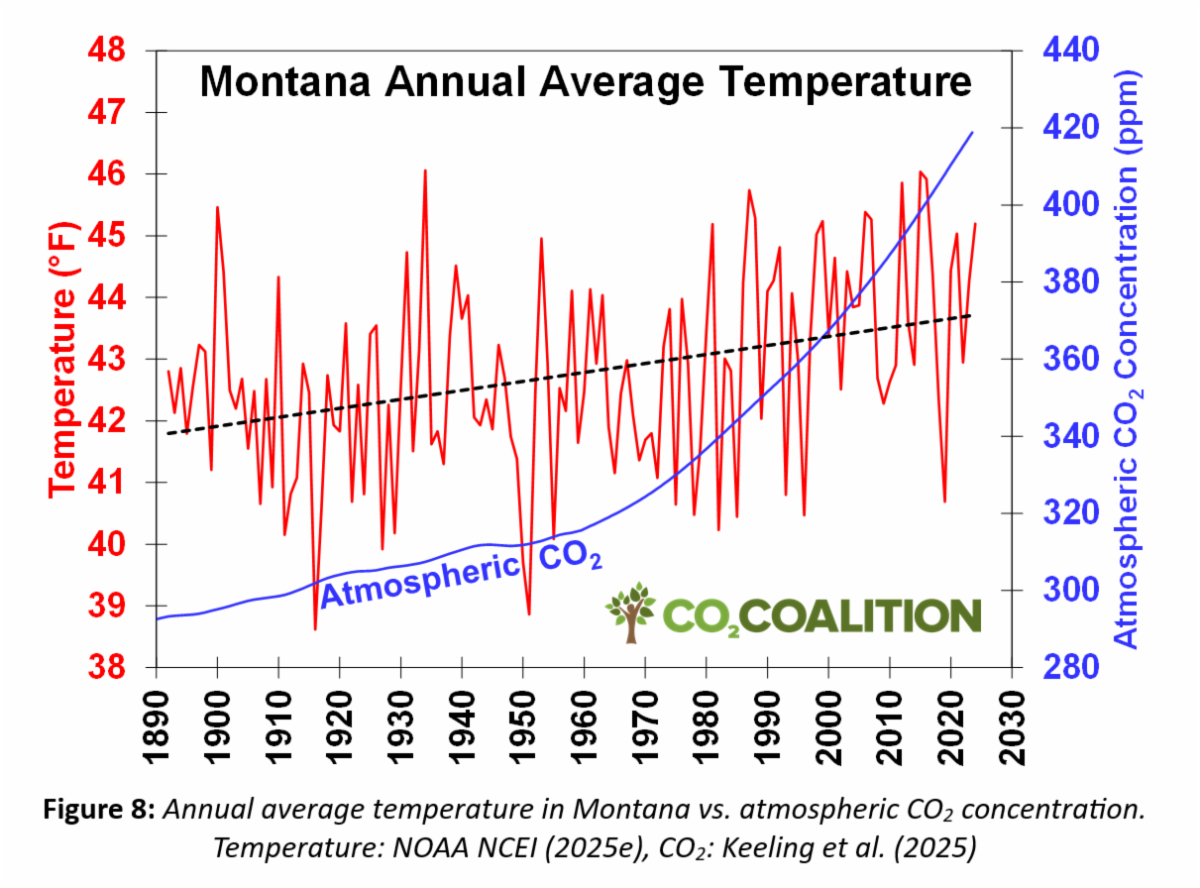
- Annual average temperatures in Montana have risen only about 1.9 °F since the late 1800s, with the warmest year still recorded in 1934—when CO₂ levels were more than 100 parts per million (ppm) lower than today. Climate models relied upon in the court findings overpredict tropical warming by roughly 2.5 times the observed rate.
- Snowfall at Kalispell shows no long-term decline since 1980.
- Glacial retreat began in the early-to-mid 1800s, well before significant human CO₂ emissions.
- Heat waves across the contiguous United States peaked during the Dust Bowl of the 1930s and have remained more moderate since.
- Precipitation records reveal no trend of increase or decrease over 140 years. The Palmer Drought Severity Index confirms that droughts are neither more frequent nor more severe.
- Wildfire acreage burned in the United States has fallen more than 80% since its 1930 peak.
- Floods and flash floods show no rising frequency.
- Reported tornadoes in Montana have declined since 1991.
- Air quality has improved markedly, with major pollutant concentrations now well below National Ambient Air Quality Standards.
Satellite data document widespread greening of Earth and of Montana itself, driven largely by CO₂ fertilization. Plants grow larger, produce more food, and use water more efficiently at today’s CO₂ levels, which remain far below concentrations of multi-thousand ppm concentrations common through most of geologic history.
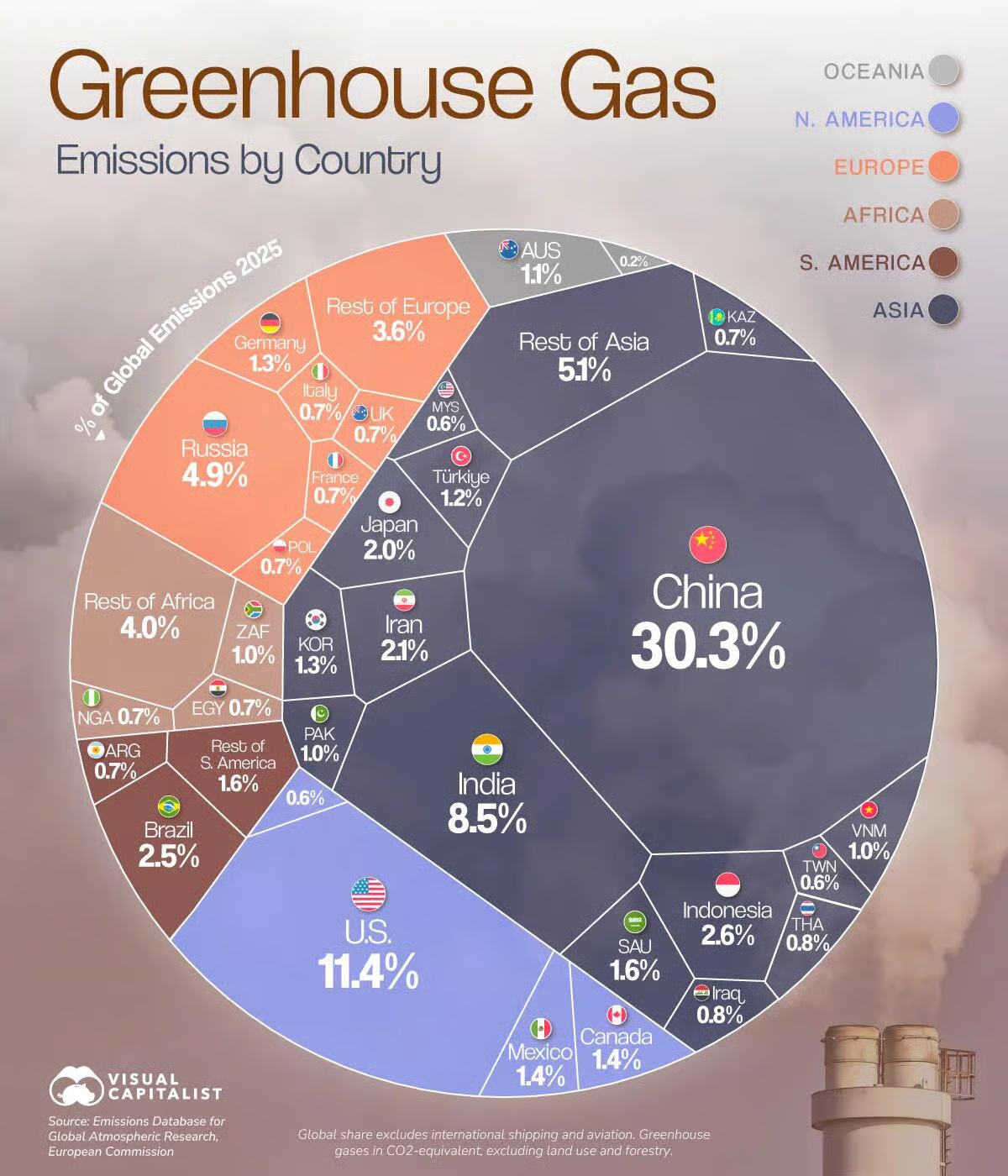
Montana’s own energy-related CO₂ emissions average only about 31 million metric tons annually—roughly 0.6 percent of the U.S. total—and eliminating them entirely would avert an unmeasurable 0.0011 °F of warming by 2100.
The full report presents dozens of graphs, tables, and citations so readers can evaluate the evidence for themselves. We strongly encourage you to examine the science carefully rather than accept alarming projections that diverge from the observational record.
Measures aimed at sharply reducing CO₂ emissions would impose real economic costs on Montana families while delivering no measurable climate benefit.
The Montana State Supreme Court has upheld a legal finding in favor of the plaintiffs. Nonetheless, the scientific facts are that ecosystems and people of Big Sky Country are prospering. Carbon dioxide is not a pollutant; it is essential plant food that helps sustain life on Earth.
Thank you for your continued support of rigorous, data-driven analysis.
Read the complete Montana and Climate Change publication here. |