By Kevin Killough
In 2025, fossil fuels provided 86.3% of the world’s total energy. That’s down from 83.6% the previous year. Renewables showed large year-over-year gains, but one researcher estimates that at the current pace, it will take centuries for the world to reach net-zero emissions.
Excerpt:
Climate advocates for years have been promising a “clean energy transition” was just on the horizon. The globe has spent $10 trillion in the past decade on the effort, and that was backed up by government mandates.
Despite all that support, an annual benchmark report shows yet again that coal, oil and natural gas continue to dominate the global energy picture.
The 2026 “Statistical Review of World Energy” finds that 86.3% of primary energy consumption was derived from fossil fuels last year. This is down from 86.6% the previous year.
Driven by subsidies and government mandates, wind and solar energy saw the greatest year-over-year growth, according to the report, with solar accounting for 71% of the increase in renewable energy from 2024.
The report is considered a benchmark source for data on energy trends around the globe. It was originally produced by BP, but in 2022, the British energy company passed off the task to the Energy Institute, a United Kingdom-based energy nonprofit that advocates for a transition away from fossil fuels.
Centuries to net-zero
This year, the institute partnered with Ember, a think tank that advocates for the wind and solar industry. The lead authors’ statements in the report’s foreword reflect the authors’ commitment to net-zero emissions, focusing on increases in renewable energy while downplaying the lack of any evidence of a transition away from fossil fuels.
“The 75 years of energy history documented in this Review have largely been a fossil-powered growth story,” Phil MacDonald, Ember CEO, said in his forward foreword.
“Today, the data show that supply growth is increasingly renewable and electric. Electricity continues to outpace total energy supply growth, particularly in Asia. For the first time, renewables – driven largely by solar – were the largest source of new energy supply.”
Nuclear, hydroelectric and other carbon-free generation technologies reached their highest level ever in 2025. Their share of the global energy picture stood at 14% in 2025, climbing steadily over the past decade.
However, as Dr. Roger Pielke Jr., a climate researcher and senior fellow at the American Enterprise Institute, points out in his “The Honest Broker” Substack, the figures shouldn’t get net-zero emissions proponents too fired up.
With respect to climate policies, the pace of change is agonizingly slow. Based on the growth in the past 10 years, Pielke wrote, it would take centuries to reach net-zero.
Coal is still king
The report finds that people are using more energy than ever, which is a sign that they are getting wealthier.
The globe’s total energy supply in 2025 was over 600 exajoules, a measurement of energy used for extremely large numbers, which was an increase of 1.7% over the previous year.
Global oil consumption increased by 1.3% in 2025, a higher rate than the 1.1% increase seen in 2024. Alongside this increase in hydrocarbon consumption was an increase in emissions of 1.1%, a third of which was from the U.S.
Coal was the largest source of global energy, taking up nearly one-third of the total, a decrease from the 33.7% in 2024. Natural gas was the next largest source of energy at 21.9%, and hydroelectric accounted for just under 14% last year.
…
Wind, solar and batteries
Global solar power rose by 30% in 2025 over the previous year, and its share of total generation reached 8.7%, which surpassed wind, at 8.4%. Solar’s share nearly matches nuclear power’s share at 8.8%.
#
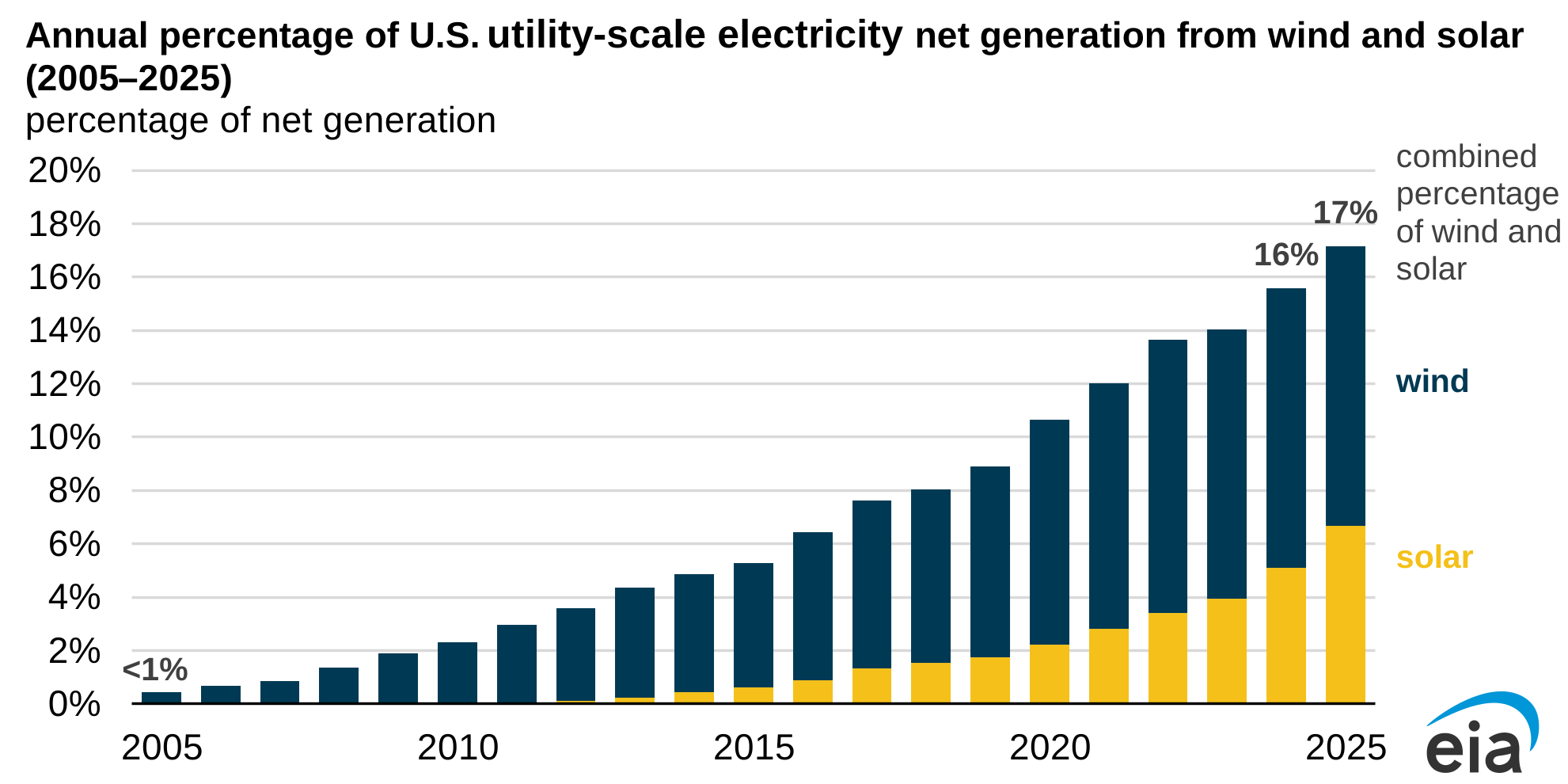
EIA – March 20, 2026: Wind and solar generated a record 17% of U.S. electricity in 2025 –
Over the past 20 years, electricity from wind power and utility-scale solar power has increased to 17% of generation in the United States compared to less than 1% in 2005. In 2025, net generation of wind and solar together accounted for 760,000 gigawatthours (GWh) of electricity, 88,000 GWh more than in 2024, according to data from our Electric Power Monthly. We classify a power plant as utility-scale if it has at least 1 megawatt of generating capacity.
In 2025, wind power generated 464,000 GWh of electricity, 3% more than in 2024. In 2025, utility-scale solar power generation totaled 296,000 GWh, 34% more than in 2024. Electricity generation from utility-scale solar has increased every year since 2006. According to our Electricity Data Browser, small-scale solar generation, which we began estimating in 2014, has also grown, and in 2025 totaled 93,000 GWh, 11% more than in 2024. Combining utility-scale and small-scale solar generation in 2025 increases the share of wind and solar to 19% of total net generation.
Wind and solar are considered intermittent electricity sources, meaning they only produce electricity when the resource (wind or sun) is available, unlike dispatchable power plants. Dispatchable sources, such as natural gas, coal, and nuclear power, can operate as base-load generating units, and combined, they accounted for 75% of U.S. utility-scale electricity generation in 2025.