BY KYLE KOHLI
The National Academies of Sciences, Engineering, and Medicine (NAS) is preparing to release a major report on the state of climate attribution science – and once again, the fingerprints of climate litigation activists and plaintiffs’ attorneys are all over the process.
The people involved in the report’s development include Michael Burger, an academic and attorney for climate plaintiffs’ firm Sher Edling, as well Delta Merner, who leads the Union of Concerned Scientists’ Climate Accountability Campaign and served on the NAS committee guiding the report’s development until January 2025. Both Burger and Merner have publicly discussed the critical relationship between attribution science and climate litigation.
If that sounds familiar, it should. The report comes on the heels of another NAS controversy involving the Federal Judicial Center’s Reference Manual on Scientific Evidence – the guidebook federal judges use to evaluate scientific testimony. The manual’s climate chapter imploded when it emerged that its authors and reviewers, including Burger, were plaintiff-friendly scholars supporting the very climate lawsuits the chapter was supposed to help judges referee.
The FJC ultimately removed the chapter from its version of the manual. NAS, notably, continues to host it.
Now, the same institution is preparing to release a long-awaited report on climate attribution science, which will be unveiled alongside a July 16 webinar reviewing the findings.
The Plaintiffs’ Lawyer in the Room
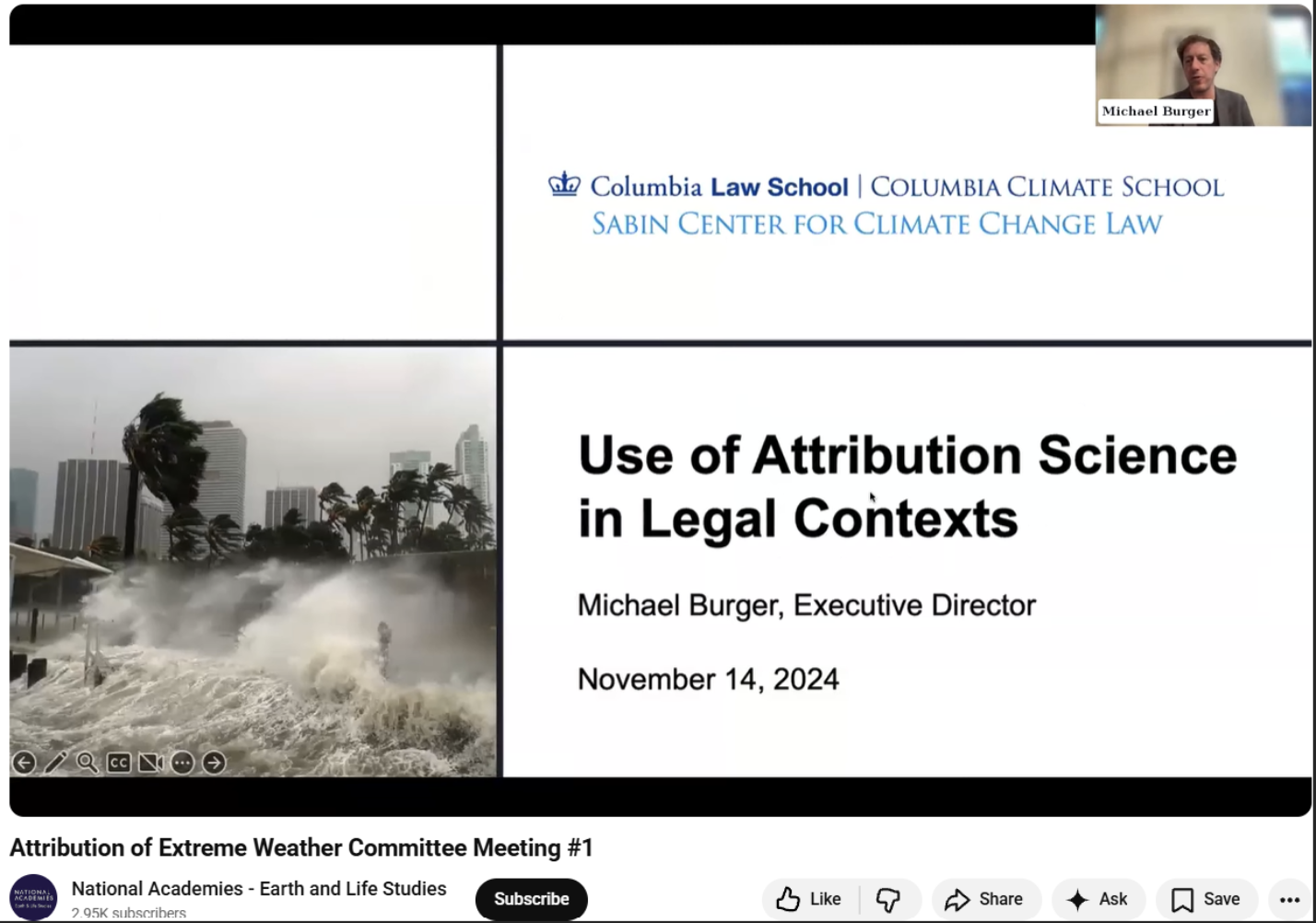
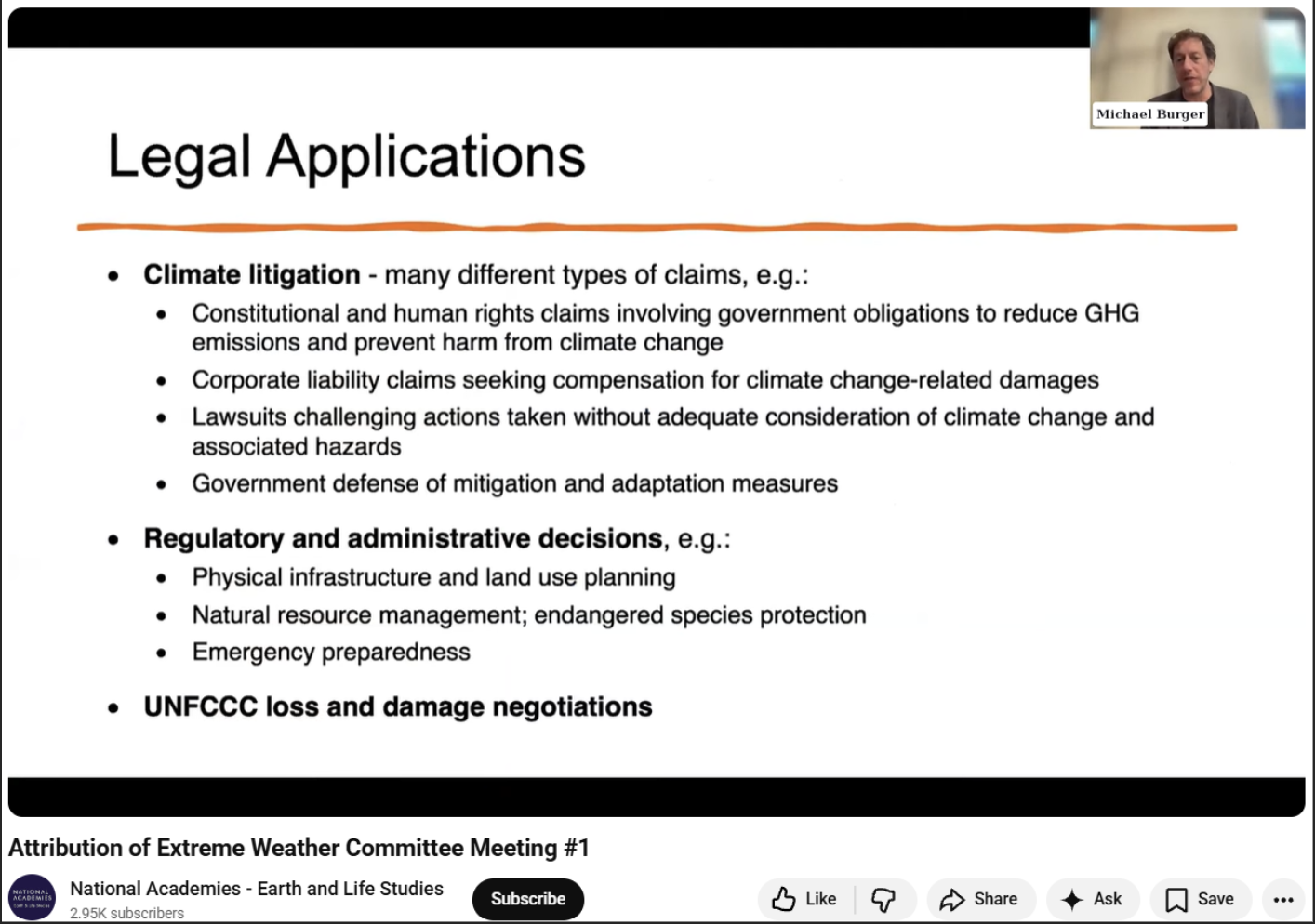
In November 2024, the NAS Attribution Committee heard a presentation titled “Use of Attribution Science in Legal Contexts” from Michael Burger, Executive Director of the Sabin Center and Of Counsel to Sher Edling, the firm representing more than two dozen states and municipalities in climate lawsuits. During his presentation, Burger disclosed that he was “actively involved” in Sher Edling’s cases:
Burger has hardly been shy about where he stands. During a 2020 Union of Concerned Scientists webinar, he described litigation “a key part of the overall solution” and called lawsuits against fossil fuel companies “vital.”
The Union of Concerned Scientists, where Merner also works, along with the Climate Accountability Institute, both Rockefeller-funded, hosted the 2012 La Jolla conference where the entire climate litigation campaign was mapped out.
Burger has also helped shape litigation-focused academic work. A 2022 article – “Liability For Public Deception: Linking Fossil Fuel Disinformation to Climate Damages” – by Sabin Center scholar Jessica Wentz and Oxford University’s Benjamin Franta thanked Burger for “identify[ing] the need for this research” and providing “extensive feedback.”
That makes Burger’s role before the committee difficult to square with NAS’s stated commitment to develop and communicate its advice “free from undue influence from sponsors, donors, or other interested parties.”
Notably, no one on the committee raised a red flag about this conflict of interest. Instead, a committee member explicitly asked Burger how future attribution science studies could be designed to better support litigation:
“In all of these cases that you’ve been involved with, are there issues that come up with the way that attribution science is done? Perhaps questions that have been asked that studies are not necessarily answering that we could potentially do better at in terms of designing our studies in the future to better inform litigation?” (emphasis added)
That was not a general question about how existing research has been used in court. It asked an attorney involved in pending climate cases how future studies might be designed to better serve the plaintiffs.
Keep in mind: Sher Edling operates largely on contingency fees. The firm therefore has a direct financial interest in litigation outcomes that could be affected by research connecting emissions, companies, climate change and alleged damages. The NAS must explain why an interested party – a plaintiffs’ lawyer, not a scientist – was invited to brief the committee on this issue.
Sher Edling has also been the target of a years-long congressional investigation because of the web of financial consulting networks the firm has built to advance climate litigation.
Sher Edling Had Already Linked Attribution Research to Legal Strategy
This was not the first time Sher Edling has linked attribution research to the practical demands of a lawsuit.
In a 2017 talk at UCLA’s Emmett Institute, Sher Edling founder Vic Sher described working with emissions researcher Richard Heede, who leads the Rockefeller-backed Climate Accountability Institute, to identify companies that could be sued in the United States and tied to a large enough share of historical emissions to support a case.
Sher said he asked Heede how many companies subject to U.S. jurisdiction would be needed to reach 25 percent of global carbon dioxide and methane emissions between 1965 and 2015:
“I asked him how many companies that are either U.S. companies or do sufficient business in the United States that we can sue them here would it take to get to 25 percent of all of the global emissions. …Rick identified 28 such companies.” (emphasis added)
Sher explained that he chose 25 percent because he believed “one in every four tons of carbon emissions during this period … would unquestionably satisfy the substantiality requirement” for causation in court. After concluding that California courts likely lacked jurisdiction over eight of the 28 companies, the firm sued the remaining 20 on behalf of the city of San Mateo.
In other words, the legal test came first, and the first “source attribution” research was reverse-engineered to meet it. That is precisely the dynamic NAS should have been guarding against when it invited one of the same law firm’s attorneys to discuss how research could better inform lawsuits.
Attribution Science Was Developed with Litigation In Mind
Sher Edling’s approach fits a broader pattern.
Climate attribution research seeks to connect greenhouse-gas emissions to specific climate impacts and, increasingly, to particular industries or companies. That makes it especially valuable to climate plaintiffs attempting to overcome one of their biggest legal obstacles: proving causation.
The field’s connection to litigation is not incidental. Friederike Otto, a prominent academic with direct ties to the climate litigation campaign, admitted as much in a 2021 interview with E&E News:
“Unlike every other branch of climate science or science in general, event attribution was actually originally suggested with the courts in mind,” (emphasis added)
Some background: climate attribution science generally takes two forms. Event attribution examines whether, and to what extent, climate change may have made a specific event more likely, more intense, or more damaging. Source attribution purports to trace historical greenhouse gas emissions back to specific sectors and companies.
Both were specifically designed to aid in litigation efforts to pin the costs of climate change on a handful of U.S. energy companies. After cap-and-trade legislation died in 2010, activists regrouped at a Rockefeller-funded conference in La Jolla to map out a litigation strategy – and identified climate attribution as a key missing piece. The conference report was candid about the road ahead:
“Many challenges are involved in these kinds of linkages, from getting the science right to communicating it effectively.”
Years later, those challenges still persist. In a 2021 paper, Otto and co-authors admitted that climate attribution science continues to confront “real challenges” in “satisfying causation” requirements.
That history makes the NAS report especially consequential. If attribution science was developed in part to overcome litigation barriers, NAS must show that its assessment was not shaped by the same advocates, attorneys, and researchers seeking to use it against American energy companies.
Questions NAS Should Answer
Before presenting the attribution report as an independent scientific assessment of the state of attribution science, NAS should answer the following questions:
- Why did NAS allow Burger to brief the committee on how attribution science can be used in litigation, and were his conflicts of interest evaluated?
- Did the committee consider that Sher Edling has a financial interest in climate cases that could benefit from the report’s findings?
- Why was Union of Concerned Scientists activist Delta Merner permitted to serve on the committee after publicly identifying research priorities intended to advance climate litigation?
- Is taxpayer-funded NAS research being used to strengthen contingency-fee lawsuits that could generate major payouts for plaintiffs’ attorneys and their partners?
- Why does NAS still host the disputed climate science chapter that the FJC removed from the Reference Manual on Scenic Evidence?
- Why is this report being released in the middle of a congressional investigation into changes to the committee’s conflict-of-interest policies and membership?
- Why should courts, policymakers, or the public treat this report as independent when individuals working to advance climate litigation were involved in shaping the process?
Bottom Line: NAS is entitled to examine climate attribution science, legal applications included. But an institution that presents itself as an independent scientific authority must do more than disclose affiliations in passing. It must show that people with a direct interest in climate litigation did not shape an ostensibly neutral scientific assessment for use in the courtroom.
Until NAS answers these questions, its attribution report shouldn’t be treated as independent science. It should be treated as what the evidence suggests it is: the latest deliverable in a well-funded litigation campaign.