By Ezra David Romero
Apr 19, 2024
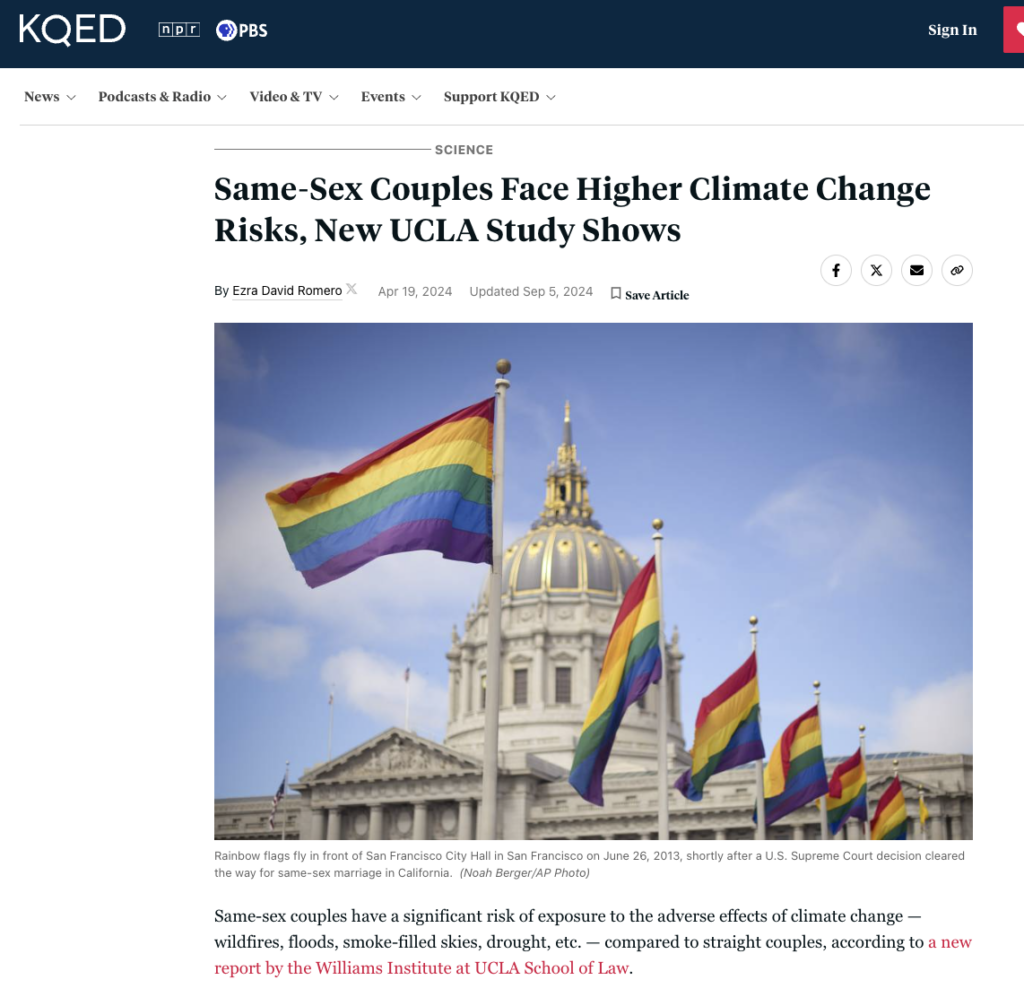
Same-sex couples have a significant risk of exposure to the adverse effects of climate change — wildfires, floods, smoke-filled skies, drought, etc. — compared to straight couples, according to a new report by the Williams Institute at UCLA School of Law.
“Our research cuts against the narratives that LGBT people often live in safe pockets of coastal cities where they have access to all the resources that they need,” said Ari Shaw, study co-author, senior fellow and director of International Programs at the Williams Institute.
LGBTQ same-sex couples who live together frequently reside in coastal areas, large cities and places with infrastructure ill-equipped for climate-related disasters. All of this makes queer couples more vulnerable to climate hazards, Shaw said.
The authors found that San Francisco County, behind the District of Columbia, has the second-highest proportion of same-sex couples in the country and a relatively high risk of national hazards complicating life.
“San Francisco ranks among the highest in terms of its risk exposure to the effects of climate change,” Shaw said. “The experience of folks living in parts of the city that are more prone to flooding and these sorts of natural disasters is borne out in the data as well.”
Knowing that LGBTQ people often live in concentrated urban areas like San Francisco is essential because Bay Area climate scientists recently found that human-caused climate change will cause atmospheric rivers to become 37% wetter by the end of the century. These storms can cause significant flooding, and KQED reporting from 2023 found that San Francisco’s infrastructure isn’t prepared for future storms.
…
‘Our findings probably understate the true impact’
…
“This study helps to shine a light on what is likely a much larger and more complicated picture,” he said. “Our findings probably understate the true impact that climate change is having on LGBTQ people.”
…
…
Because the study found that LGBTQ people often live in areas with poor infrastructure and lack resources to respond to climate change, the researchers suggest cities expand green spaces and enhance structural resilience.
…