Global Warming reduces domestic violence!
New Economic Research – Why “Cold Shocks” Trigger Domestic Violence
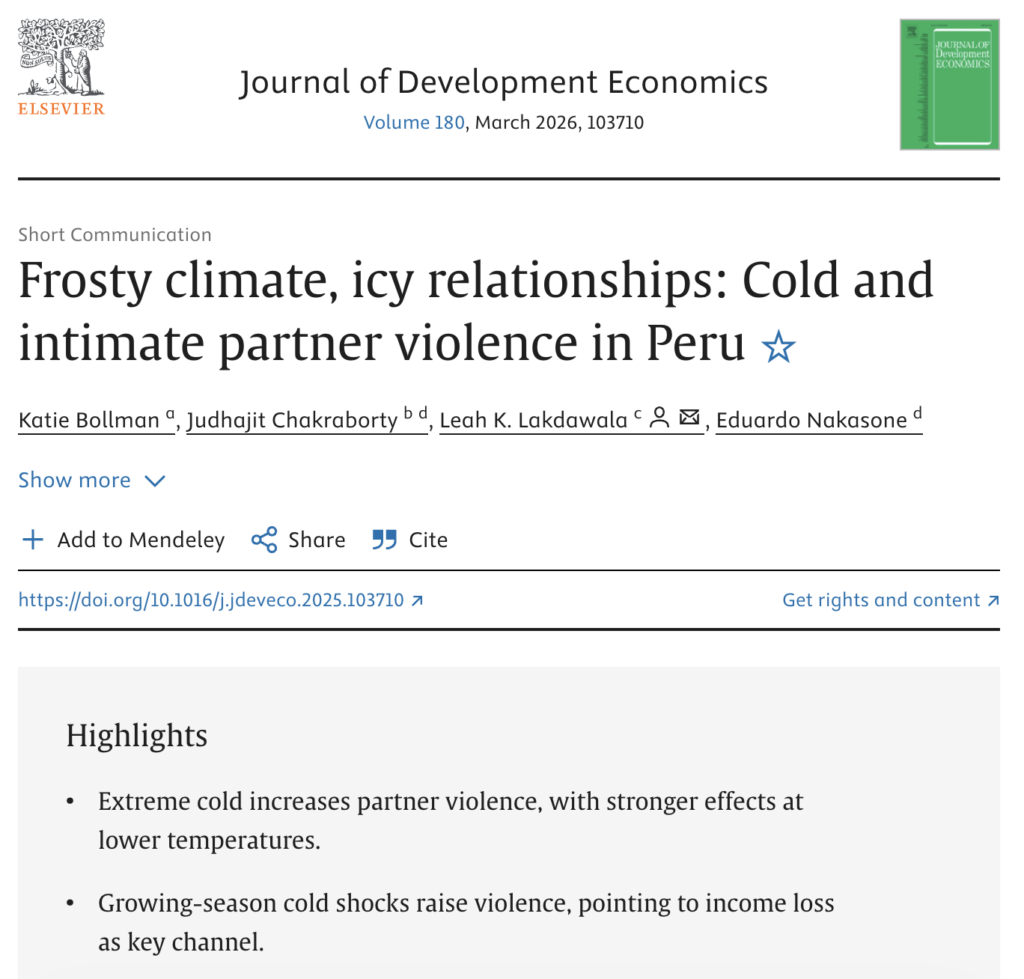
“Extreme cold increases partner violence, with stronger effects at lower temperatures.” https://t.co/vjoo3QzJKH
— Marc Morano (@ClimateDepot) March 17, 2026
https://www.sciencedirect.com/science/article/abs/pii/S0304387825002615#fn16
Frosty climate, icy relationships: Cold and intimate partner violence in Peru☆
Highlights
•
Extreme cold increases partner violence, with stronger effects at lower temperatures.
•
Growing-season cold shocks raise violence, pointing to income loss as key channel.
•
Farming households are most vulnerable to cold shocks that raise IPV risk.
•
Cold reduces agricultural revenue, increasing economic stress.
•
Cold also reduces time spent outside the home, increasing partner exposure.
•
Social program coverage blunts cold-driven IPV; low-coverage areas remain exposed.
Abstract
Violence against women – in particular, Intimate Partner Violence (IPV) – is a health concern for women across the world. We study the effect of cold exposure on IPV among Peruvian women. Using a dataset that matches women to weather exposure, we find that cold shocks increase IPV: 10 degree hours below -9 °C increases the probability of experiencing domestic violence by 0.5 percentage points. These effects are larger for more extreme temperature thresholds. We provide evidence that cold influences IPV through two main channels. First, extreme cold reduces income. Second, extreme cold limits time spent outside of the household, potentially increasing exposure of women to violent partners. To our knowledge, we are the first to measure relative significance of these two channels by using variation in cold timing to distinguish shocks that affect IPV through changes in income from those that act through time spent indoors. We find that the effect of cold on IPV is mostly driven by low temperatures that occur during the agricultural growing season, when income is most affected; 10 degree hours below -9 °C during the growing season increases the probability of experiencing IPV by 1.6 percentage points. In contrast, we find that cold exposure outside of the growing season has no statistically significant effect on IPV.