By BENJI JONES
Excerpt:
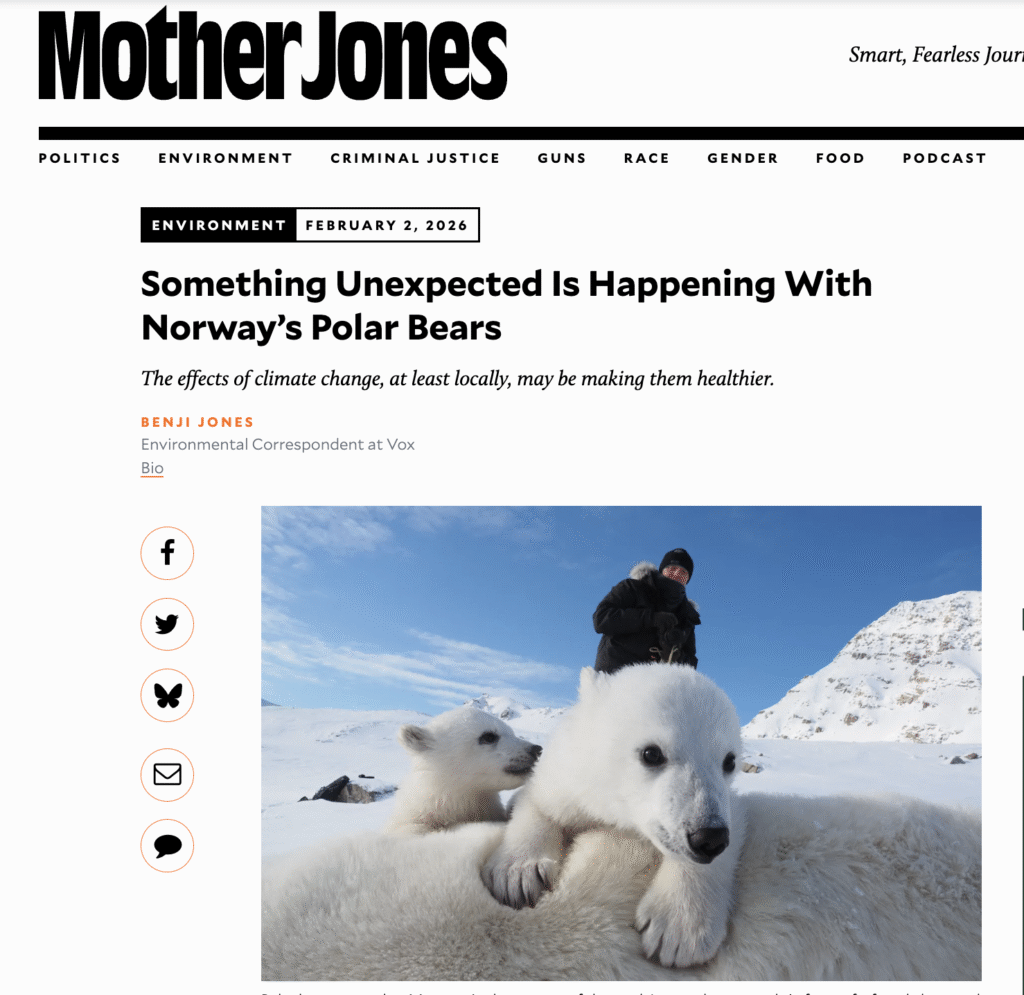
Polar bears became the poster child for the peril of climate change for obvious reasons: They hunt seals from the ice, and as fossil fuels warm the planet, the ice where these bears live is melting.
For more than three decades, scientists have been warning that climate change could drive polar bear populations extinct. That message infiltrated the public psyche, perhaps more than any other about the scourge of global warming.
But as scientists are continuing to learn, the reality for these iconic bears is more complicated.
In 2022, scientists published a study showing that polar bears in southeastern Greenland were able to use glacial ice instead of sea ice to hunt, sheltering them from some of the impacts of warming. And a study published late last year revealed some changes in polar bear DNA that may help them adapt to hotter weather.
Now, research in the journal Scientific Reports adds yet another wrinkle of hope for the species. The study, an analysis of hundreds of polar bears in the Norwegian archipelago of Svalbard, found that declining sea ice is not causing polar bears to starve. They actually appeared healthier in the last two decades of the analysis, from 2000 to 2019. The overall population, meanwhile, is either stable or growing, according to Jon Aars, the study’s lead author and a scientist at the Norwegian Polar Institute.
“I was surprised,” Aars told Vox from Svalbard. “I would have predicted that body condition would decline. We see the opposite.”
…
Between 1992 and 2019, scientists in Svalbard darted hundreds of polar bears from helicopters and measured their bodies. Then they compared those measurements to sea ice conditions, such as the number of ice-free days, and other climate variables.
Remarkably, the number of days with no ice in the region increased by roughly 100 during that period. And yet, as the authors found, the body condition of both male and female polar bears—i.e., how fat and healthy they are—increased from 2000 onward. Female bears were actually in worse condition when the sea ice lasted longer.
Often, the message about polar bears is “100 percent doom,” said Kristin Laidre, a polar bear researcher at the University of Washington, who was not involved in the study. “But that’s not true,” Laidre told me.
…
No other animal has been so closely tied to climate change as the polar bear. It was on the cover of TIME’s 2006 global warming issue. It was featured in Al Gore’s seminal documentary An Inconvenient Truth, which premiered the same year. It was used in funding campaigns for environmental groups. (One year, I even dressed up as a drowning polar bear for Halloween with a friend who went as a melting ice cap.)