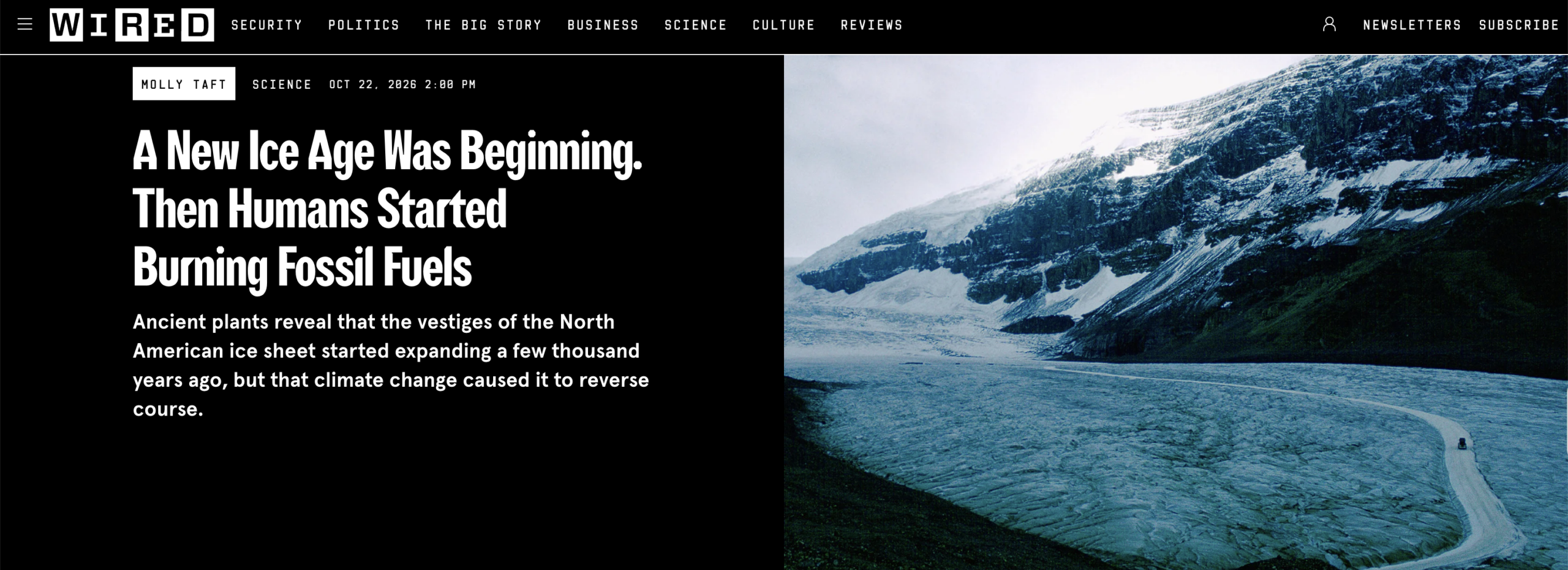

National Geographic: ‘These polar bears are getting fatter as sea ice melts. What’s going on?’ – The finding offers a small window of hope for a polar bear population vulnerable to the effects of climate change. … But researchers in Svalbard, Norway, found something unexpected about their polar bear population. When sea ice levels decreased around the archipelago, the bears got fatter, they report in a new study in the journal Scientific Reports.
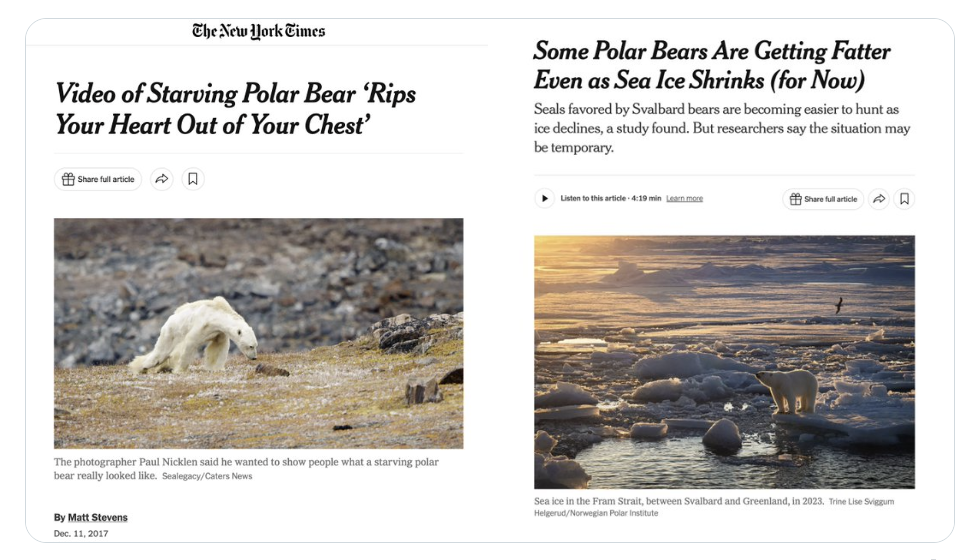
Jan 29, 2026: NYT: Some Polar Bears Are Getting Fatter Even as Sea Ice Shrinks – Seals favored by Svalbard bears are becoming easier to hunt as ice declines, a study found. –

By Eric Niiler – The population of polar bears in Norway’s Svalbard archipelago has improved over the past 27 years despite predictions that melting sea ice would make it harder for them to find food. Researchers on Svalbard, between mainland Norway and the North Pole, compared the body condition index, a measurement of weight and fat content of the polar bears, with the rate of sea ice melting in the surrounding Barents Sea. Over a 27-year period, they found to their surprise that the polar bears were actually gaining weight as the ice receded.
“When I started, if you asked me what do you think will happen, I would assume they would be struggling and they would get leaner, skinnier and maybe you would see effects on reproduction and survival,” said Jon Aars, senior scientist at the Norwegian Polar Institute and author of the study, which was published on Thursday in the journal Scientific Reports. “That was wrong.” The Svalbard polar bear population has remained stable at around 2,650 animals, while the number of ice-free days has increased by 100 since the study period began. Dr. Aars said some of the polar bears are now eating reindeer and walrus, whose populations have increased since they have been protected from hunting. Others are taking advantage of denser congregations of ringed seals, which gather on remaining patches of sea ice, or eating new foods like bird eggs.
But wait… Climate activists and the media have been promoting the claim for decades that ‘global warming’ would result in skinny polar bears!
Flashback 2017: NYT: Video of Starving Polar Bear ‘Rips Your Heart Out of Your Chest’ – Last week, Mr. Nicklen, his group SeaLegacy and National Geographic published photos and videos from the encounter. They showed the world the polar bear, stranded on iceless land, its white coat dirtied, its body emaciated, its movements labored. And when the world saw, millions recoiled in heartbroken horror. … Inexcusable,” wrote one commenter on Instagram…“What,” several asked, “can we do?” Experts and environmentalists say the broad answer — however controversial and nuanced it may be — is to reduce the present levels of global greenhouse gas emissions in order to curb global warming.

2015: Photographer of ‘horribly thin’ polar bear hopes to inspire climate change fight
2018: National Geographic admits skeletal polar bear-global warming link ‘went too far’ – One of the world’s most respected publications says the reasons for an individual polar bear’s apparent starvation are impossible to ascertain, after originally attributing them to climate change.

Flasbhack 2020: CNN: ‘Polar bears are getting thinner and having fewer cubs. Melting sea ice is to blame’ – CNN — The impact of the climate crisis is becoming more and more obvious to humans and their animal neighbors. But among all species, polar bears might be some of the hardest hit. Researchers found polar bears are becoming thinner and having fewer cubs, and their declining health was tied to melting sea ice. … “Climate-induced changes in the Arctic are clearly affecting polar bears,” study author Kristin Laidre, professor of aquatic and fishery sciences at the University of Washington, said in a statement. “They are an icon of climate change, but they’re also an early indicator of climate change because they are so dependent on sea ice.” … The bears are spending less time on land and losing weight.

Show me a climate claim, I’ll show you a lie: In 2017, the NYTimes reported that global warming was emaciating polar bears. But today, we learn, it’s actually making them fatter. https://t.co/eQagtcjZxZ pic.twitter.com/KtgcGtZXFy
— Steve Milloy (@JunkScience) January 29, 2026
#
Climate Depot’s Marc Morano comments: We have known for decades that polar bears are highly adaptable to their living conditions and were not under threat from man-made ‘climate change.’ See my 2008 report on Polar Bears:
[Climate Depot Note: Morano wrote a report on polar bears and climate back in 2008, debunking this global warming threat when I was a senior staff member at the U.S. Senate Environment & Public Works Committee.
See: U.S. Senate Report Debunks Polar Bear Extinction Fears – January 30, 2008 – By Marc Morano]
Related:
Excerpt: Climate Depot founder Marc Morano blasted the media outlets perpetuating this nonsense in comments to MRC Business. “Scientists and scientific data have known for decades that ‘climate change’ was not threatening polar bears in the Arctic. The number of polar bears in the Arctic has increased dramatically in recent decades, particularly since a hunting ban was imposed.” Specifically, said Morano, “The polar bear population exploded from an estimated 5,000 in the 1960s to 30,000 or more today.” …
But this is a load of bunk, as Morano joked to MRC. “It is safe to say that polar bears are disappearing, but only from Al Gore’s books and movies!” He joked that “In Gore’s 2006 film, he made the polar bear a poster child for global warming, but fast forward to his 2017 film and book sequel, and Gore did not even mention them.” Scientists have testified before Congress that “polar bears have survived several historic episodes of much warmer temperatures over the last 10,000 years, and they have adapted,” Morano noted. In essence, polar bear adaptation to a changing climate isn’t even a new thing.
Morano argued that what the new study does, if anything, is reveal “some insight into one of the many ways these bears have adapted.” …
But the seemingly nuttier bits of climate change tomfoolery continuously oozing out of the media eco-sphere shouldn’t be expected to fade away, Morano said. “When current reality fails to alarm, the climate activists will continue to make scarier and scarier (unfounded) predictions of the future.”
[Climate Depot Note: Morano wrote a report on polar bears and climate back in 2008, debunking this global warming threat when I was a senior staff member at the U.S. Senate Environment & Public Works Committee. See: U.S. Senate Report Debunks Polar Bear Extinction Fears – January 30, 2008 – By Marc Morano]
#
https://www.nature.com/articles/s41598-025-33227-9
- Published:
Scientific Reports volume 16, Article number: 2182 (2026)
Abstract
Polar bears are only found in Arctic areas with sufficient access to sea ice and seals on which they prey. Studies have highlighted negative effects on condition and demographics in areas where sea ice cover is declining due to warmer climate, but condition of the Barents Sea polar bear population have not been examined yet. Loss of sea ice rate has been considerably higher here than in other areas with polar bears. We investigated variation in body condition index (BCI) among 770 adult bears, 1188 captures, in March-May 1995–2019, in Svalbard, Norway (western part of the Barents Sea). We assessed how intrinsic (female reproductive state, age) and both males and females, BCI declined until 2000, but increased afterwards, during a period with rapid loss of sea ice. In models including sea ice metrics and climate (Arctic Oscillation), there was no support for the predicted negative effect of warmer weather and habitat loss. This indicates a complex relationship between habitat, ecosystem structure, energy intake, and energy expenditure. Increases in some prey species, including harbour seals, reindeer, and walrus, may partly offset reduced access to seals. Our findings underline the importance not to extrapolate findings across populations.
Introduction
Climate change has impacted species and ecosystems worldwide, e.g. with a shift in species distribution1,2. Over the past decades, the increase in air temperature has been two to four times higher in the Arctic, depending on time span and season, compared to the global average3,4,5,6. This change has impacted Arctic ecosystems in diverse ways, with climate winners and climate losers, both in the terrestrial and the marine environment7. Loss of sea ice habitat in the high Arctic has been of particular concern, given the unique ecosystem and the sea ice dependent endemic species that are particularly vulnerable. Of mammals, those include several seal species, narwhal (Monodon monoceros), beluga (Delphinapterus leucas) bowhead whales (Balaena mysticetus), and polar bears (Ursus maritimus)8,9.
The Barents Sea (BS) area has experienced even greater temperature rises than other Arctic regions over the past few decades, with increases of up to around 2 °C per decade in some parts of the region10. This area, which is home to one of the 20 recognized polar bear populations (https://www.iucn-pbsg.org/), has also lost sea ice habitat at a rate of four days/year between 1979 and 2014, more than twice as fast as any of the other areas hosting polar bear populations11,12.
Sea ice loss has had major impacts on BS polar bear space use and diet, while significant negative effects on reproduction and survival are minor so far (see below). Bears captured in the Svalbard area (Norwegian part of the BS area) have two main space use strategies (ecotypes) with some bears being “local”, never leaving the Svalbard area. Other bears follow the sea ice, as it retreats in spring, and migrate hundreds of kms, often between the Russian archipelago Franz Josef Land and Svalbard, or north-east to the ice edge. Bears following that strategy have been termed “pelagic”13. The BS polar bears have been studied during an annual monitoring program including capture since 1987, with captures in the Svalbard area. The population was protected in 1973, and it increased significantly in size the following decades14,15. The total BS population was estimated at between 1900 and 3600 bears in 200415, and may, based on a higher number of bears at the ice edge in 2015 than in 2004 (where the majority of bears are pelagic), have increased since then16. The number of local bears (about 240–260 individuals) seemed to be rather stable16. Negative effects on reproduction that may be explained by loss of sea ice habitat or correlated to climate are indicated for the oldest adult females17, but in general the population seems healthy16,www.mosj.no/en/indikator/fauna/marine-fauna/polar-bear.
…
“We assessed how intrinsic (female reproductive state, age) and both males and females, BCI declined until 2000, but increased afterwards, during a period with rapid loss of sea ice. In models including sea ice metrics and climate (Arctic Oscillation), there was no support for the predicted negative effect of warmer weather and habitat loss.”