Wrong Again PBS, UN Is Pushing Another False Climate Crisis Report
By Anthony Watts
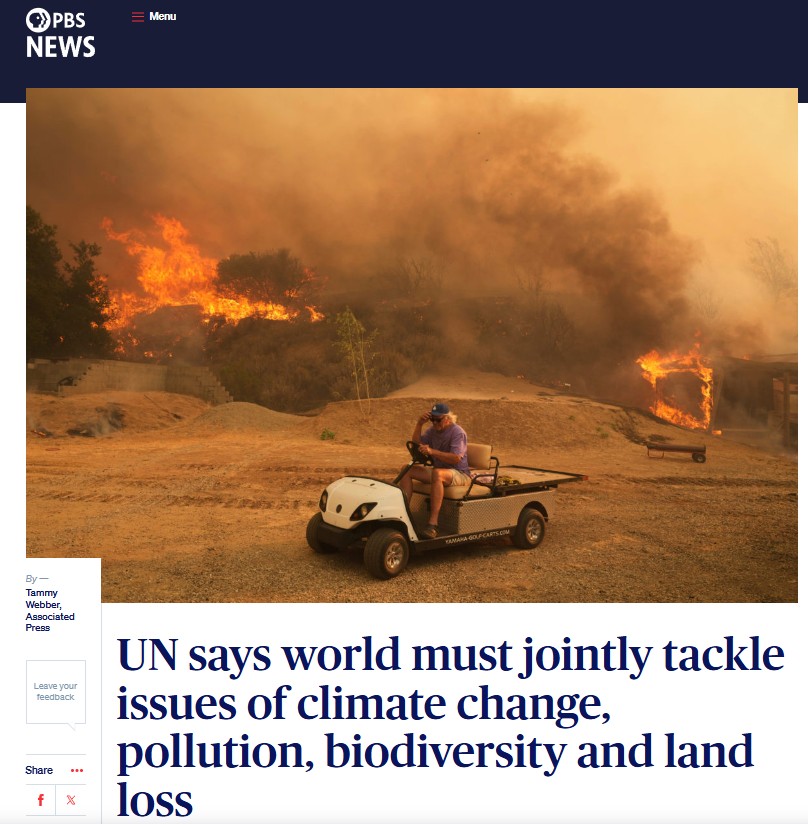
A recent story on PBS NewsHour, “UN says world must jointly tackle issues of climate change, pollution, biodiversity and land loss,” by Tammy Webber of the Associated Press (AP), reports on a new UN “Global Environment Outlook” that repeats the false assertion that the Earth is nearing a global tipping point that can only be avoided through “unprecedented change” and trillions of dollars in new spending to phase out fossil fuels. These assertions are bogus, lacking any basis in data or observable evidence. In fact, the UN has a long track record of failed disaster predictions tied to climate change, going all the way back to 1989, which PBS ignores.
Webber writes, “experts have warned that the world is nearing a tipping point on climate change, species, and land loss and other harms,” quoting Bob Watson, lead author of the UN report saying, “[i]t has to be done rapidly now because we’re running out of time.” Where have we heard that before? Oh yes, the last UN state of the planet report, and the one before that, and the one before that going back to the 1980s.
The story and report further assert that climate change is “contributing to wilder weather extremes, including more intense storms, drought, heat, and wildfires,” and that only a rapid, global transition away from fossil fuels can prevent catastrophe.
A history lesson is in order. This is not the first time the UN has announced that “we’re running out of time.” In 1989, 36 years of global warming ago, the UN Environment Programme’s Noel Brown told the Associated Press that “entire nations could be wiped off the face of the Earth by rising sea levels” if global warming was not reversed by the year 2000, predicting up to three feet of sea-level rise by then, massive coastal inundation of Bangladesh and Egypt, and a wave of “eco-refugees.”
More than three decades later, each of these predictions have proven, not just false, but wildly inaccurate. Climate at a Glance’s “Sea Level Rise” documents long-term tide-gauge records and NASA satellite data showing global sea level rising at about 1.2 inches per decade, with, at best, a modest acceleration since the nineteenth century. Nor have we seen the millions of “climate refugees” that the UN forecast. The Maldives are still above water, Bangladesh has more people than ever, and the “10-year window” to avert disaster has been rolled over so many times it could qualify as a wrecked vehicle.
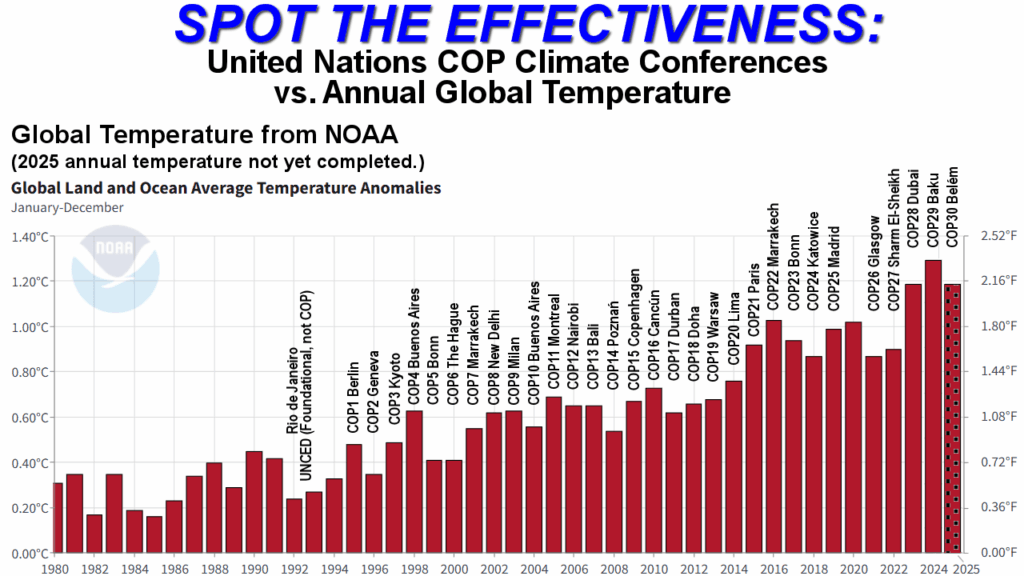
PBS/AP never mentions this failed track record. Nor does it acknowledge that the UN has now presided over 30 Conferences of the Parties (COPs) without changing the basic trajectory of global emissions or global temperature as seen in figures 1 and 2 below.
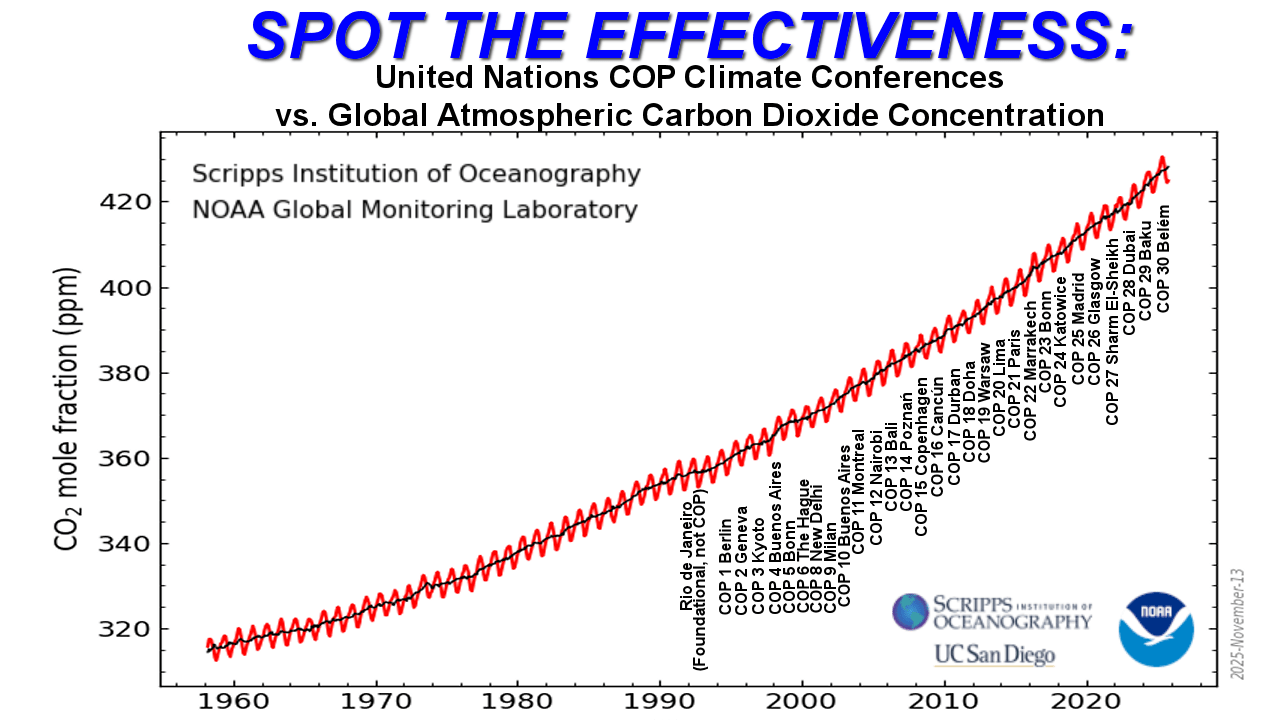
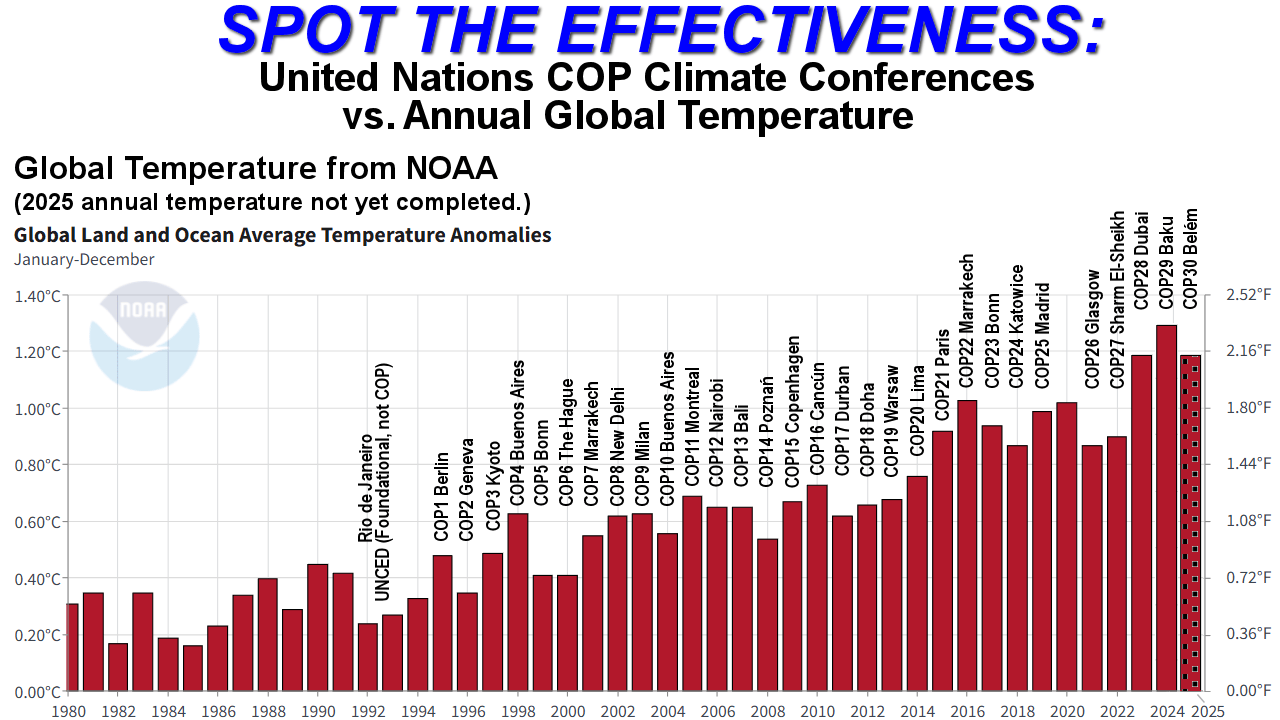 Figure 2. Plot of all U.N. Climate Conferences from 1992 to 2025 with global annual temperature. Base graphic from NOAA, annotation by A. Watts Source: https://www.ncei.noaa.gov/access/monitoring/climate-at-a-glance/global/time-series/globe/land_ocean/tavg/12/12/1980-2024?filter=true&filterType=binomial
Even sympathetic analysts concede that the UN’s 2015 Paris Climate Agreement has not delivered; as Climate Realism noted in “Paris Agreement: Dead at 10 (James Hansen was right),” former NASA scientist James Hansen called the Paris Agreement “a fraud” and “worthless words” because there is “no action, just promises,” a verdict the subsequent decade has largely confirmed. When you hold 30 summits and emissions still hit a record high in 2024, as PBS reports, that is not success; it is one more in a long-list of failed efforts to match the repeatedly failed predictions.
The article also exaggerates what the observational climate record actually shows about “wilder weather extremes.” The Intergovernmental Panel on Climate Change (IPCC) Sixth Assessment Report (AR6) finds increased confidence only for certain types of extremes (such as hot extremes and heavy precipitation in some regions), while concluding there is low or limited confidence in global increases in many others, including hurricanes, floods, and droughts.
Climate at a Glance’s entries on “Deaths from Extreme Weather” and “Temperature-Related Deaths” highlight a crucial fact PBS never mentions: over the past century, climate-related deaths have plummeted by more than 95 percent, even as global population has quadrupled and temperatures have risen. Independent analyses, such as HumanProgress’ review of disaster mortality, show climate-related deaths falling from about 485,000 per year in the 1920s to fewer than 20,000 per year in the 2010s, a drop of more than 99 percent on a per-capita basis, as seen in their graph below.
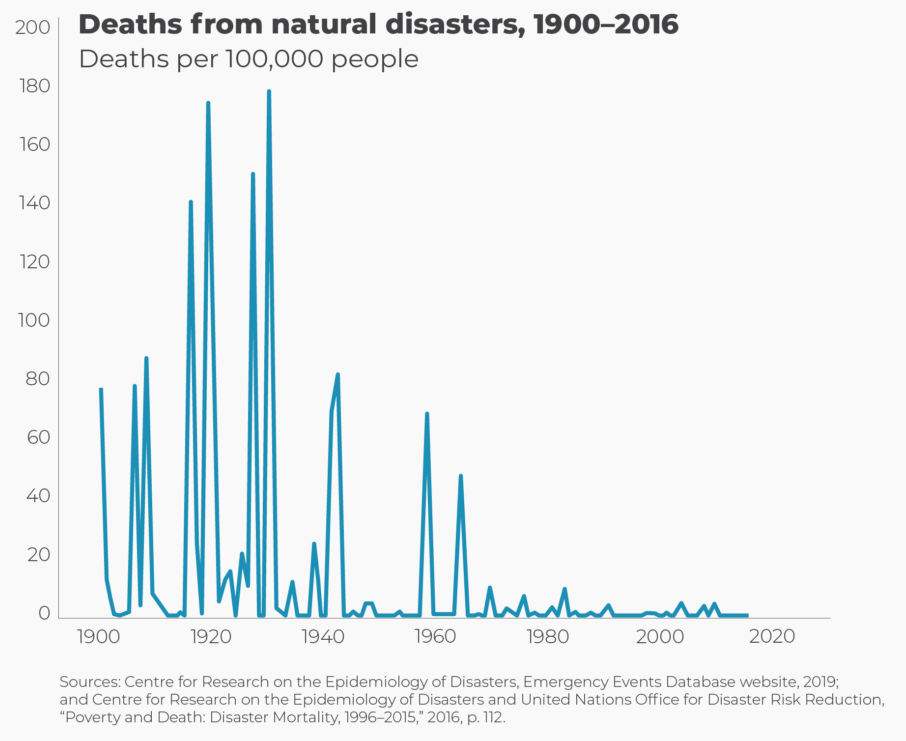
That is not what “running out of time” looks like.
PBS/AP further blur the lines between measured science and political advocacy by repeating claims that we are on track for 2.4°C of warming by 2100 and that only an $8 trillion per-year transition away from fossil fuels can save us. These numbers are not the product of thermometers, tide gauges, or crop statistics; they are the output of flawed, not fit-for-purpose, economic and climate models built on long chains of assumptions about future technology, behavior, and policy. The UN’s AR6 report warns that modeled “pathways” entail large uncertainties, with global outcomes depending on highly speculative socio-economic scenarios. Treating these projections as inevitabilities rather than conditional “if-then” exercises is advocacy, not reporting.
PBS/AP also glosses over the fact that many of the harms it lists—land degradation, biodiversity loss, pollution—have causes and remedies largely independent of climate policy. Deforestation in the Amazon, soil depletion in parts of Africa, or plastic pollution in rivers are neither a cause of nor result of global warming, and won’t be solved by net-zero carbon dioxide emissions. By insisting that “if we don’t fix climate change, we’re not going to be able to fix these other issues,” as one quoted scientist puts it, PBS effectively uses legitimate environmental concerns as leverage for unrelated, highly speculative climate actions.
What the article and the UN report completely ignore is the role that affordable, reliable energy, overwhelmingly fossil fuels, has played in making human societies more resilient to environmental hazards. Mechanized agriculture, synthetic fertilizers, modern flood defenses, air conditioning, and rapid disaster response all depend on dense, on-demand energy. That is why climate-related deaths as documented by Climate at a Glance have collapsed over the past century. Yet the UN prescription, uncritically endorsed by PBS/AP, is to rapidly phase out the very energy sources that lifted billions from abject poverty, based on a track record of predictions that have repeatedly failed to materialize.
Climate Realism has chronicled this pattern for years. “UNFCCC Climate Report Lies About Its Own Science” points out how UN political bodies routinely make sweeping claims about “intensifying destruction” that are not supported by the UN’s own scientific assessments, which identify little or no change in most types of extreme weather events and trends in natural disasters. In “The IPCC’s 1990 Predictions Were Even Worse Than We Thought”, Climate Realism reviews the early IPCC forecasts of rapid warming and sea-level rise and shows how they overshot reality. Despite this, every new report is marketed as the “most comprehensive ever” and used to justify more urgent demands for unprecedented, wrenching, transformational remaking of the world’s economy and governing institutions.
PBS/AP could have told its audience that the UN has now spent more than three decades issuing countdowns to catastrophe, from the 1989 “10-year window” to the Paris Agreement’s 1.5°C target to the current call for $8 trillion a year in climate spending, and that after 30 COP conferences emissions and temperatures have followed essentially the same trajectory they would have without the meetings. These outlets could have asked whether having a perfect record of failed predictions merited continued confidence that the UN would now get their predictions right, or whether the UN’s past performance might justify skepticism concerning its current disaster claims. Instead, PBS presents the latest UN report as if the institution has no history of predictions or as if its previous predictions have been accurate.
By omitting the long trail of failed UN climate pronouncements, ignoring the dramatic decline in climate-related deaths, and treating speculative model outputs as inevitable futures, PBS and the Associated Press badly mislead their audience concerning the true state of the Earth. A truly public-minded broadcaster would carefully scrutinize the UN’s record and available data rather than uncritically regurgitate its latest false alarm report.