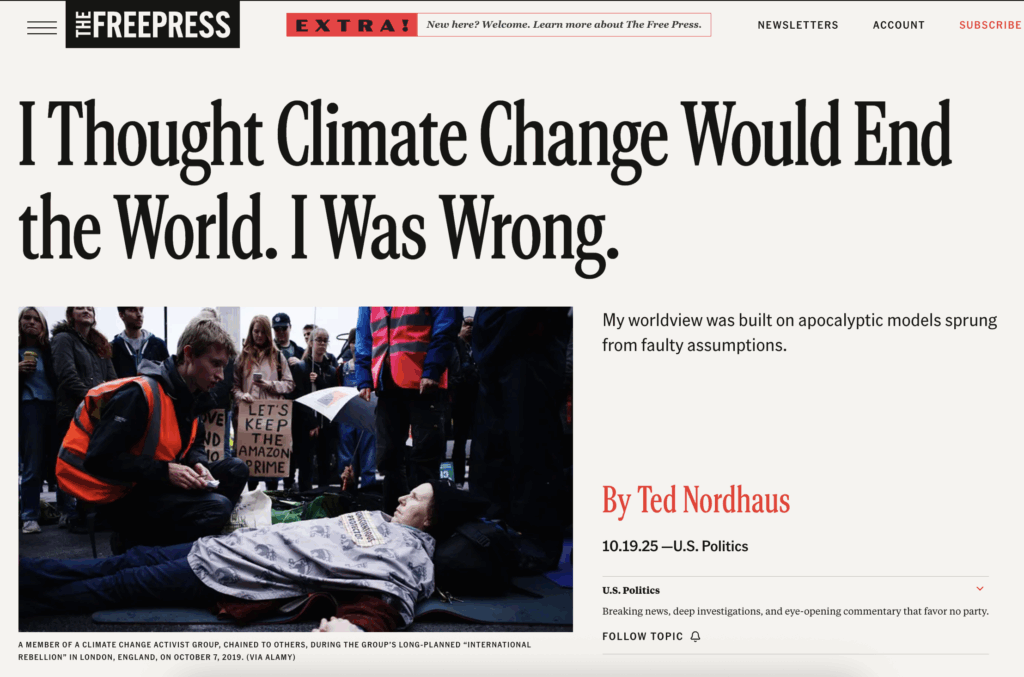
https://www.thefp.com/p/i-thought-climate-change-would-end?utm_source=substack&utm_medium=email
By Ted Nordhaus
Excerpt:
I used to argue that if the world kept burning fossil fuels at current rates, catastrophe was virtually assured.
“The heating of the earth,” Michael Shellenberger and I wrote in our 2007 book, Break Through, “will cause the sea levels to rise and the Amazon to collapse and, according to scenarios commissioned by the Pentagon, will trigger a series of wars over the basic resources like food and water.”
I no longer believe this hyperbole.
At the time, I, like most climate experts, thought that business-as-usual emissions would lead to around five degrees of warming by the end of this century. That assumption was never plausible. It assumed high population growth, high economic growth, and slow technological change. But fertility rates have been falling, global economic growth slowing, and the global economy decarbonizing for decades.
Nor is there good reason to think that the combination of these three trends could possibly be sustained in concert. High economic growth is strongly associated with falling fertility rates. Technological change is the primary driver of long-term economic growth. A future with low rates of technological change is not consistent with high economic growth. And a future characterized by high rates of economic growth is not consistent with high rates of population growth.
As a result, most estimates of worst-case warming by the end of the century now suggest three degrees or less. But as the consensus has shifted, the reaction among much of the climate science and advocacy community has not been to become less catastrophic. Rather, it has been simply to shift the locus of catastrophe from five to three degrees of warming.
This is all the more confounding given that the good news extends well beyond projections of long-term warming. Despite close to 1.5 degrees of warming over the last century, global mortality from climate and weather extremes has fallen by more than 96 percent on a per-capita basis. The world is on track this year for what is almost certainly the lowest level of climate-related mortality in recorded human history. Yes, the economic costs of climate extremes continue to rise, but this is almost entirely due to affluence, population growth, and the migration of global populations toward climate hazards: mainly cities in coastal regions and floodplains.
So the far more interesting question is not why my colleagues and I at the Breakthrough Institute have revised our priors about climate risk, but why so many progressive environmentalists have not.
In the late 2000s, the climate advocacy community figured out that framing climate change as a future risk would not prove politically sufficient to transform the U.S. and global energy systems in the way that most believed necessary. And so the movement set about attempting to move the locus of climate catastrophe from the future to the present, framing extreme weather events not only as harbingers for future catastrophes, but as fueled by current climate change.
But this narrative conflicts with existing evidence, including data collected by political scientist and former environmental studies professor Roger Pielke Jr. His work, going back to the mid-1990s, showed again and again that the normalized economic costs of climate-related disasters, when adjusted for wealth and economic growth, weren’t increasing, despite the documented warming of the climate.
The reason for my shift in opinion wasn’t only that Pielke had produced strong evidence that undermined a key claim of the climate advocacy community. It wasn’t even witnessing Pielke’s cancellation, which was brutal. It was, rather, that I came to understand why you couldn’t find a climate change signal in the disaster loss data, despite close to 1.5 degrees of warming over the last century.
There are two linked factors. First, what determines the cost of a climate-related disaster is not just how extreme the weather is. It is also how many people and how much wealth is affected by the extreme weather event, and how vulnerable they are to that event. Over the same period that the climate has warmed by 1.5 degrees, the global population has more than quadrupled, per-capita income has increased by a factor of 10, and the scale of infrastructure, social services, and technology that protects people and wealth from climate extremes has expanded massively. These latter factors overwhelm the climate signal.
The amount of warming that is conceivable even in plausible worst-case scenarios is not remotely consistent with the sorts of catastrophic outcomes that I once believed in.
Second, anthropogenic climate change is a much smaller factor at the local and regional scale than natural climate variability. Some climate scientists have pointed to anomalously high surface and ocean temperatures as evidence that warming may be accelerating, perhaps even faster than models have suggested. But even in the case where climate sensitivity proves to be relatively high, additional anthropogenic warming is an order of magnitude less than the oscillations of natural variability.
…
There is no evidence whatsoever that 35 years of increasingly dire rhetoric and claims about climate change have had any effect on the rate at which the global energy system has decarbonized. In fact, by some measures, the world decarbonized more quickly over the 35 years prior to climate change’s emergence as a global concern than it has in the 35 years since.
There are lots of good reasons to support cleaner energy without threatening the public with climate catastrophe. But the climate movement is actually after something different than that—a rapid and complete reorganization of the global energy economy over the course of a few decades. And there is no good reason to do that absent the specter of catastrophic climate change.
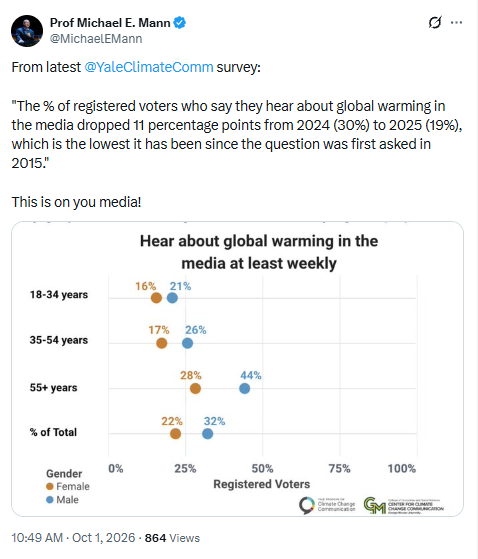
And so that is what the climate movement and its supporters in academia, the media, and center-left political parties have offered for a generation. The insular climate discourse on the left may be cleverer than right-wing dismissals of climate change, but it is no less prone to issuing misleading claims, ignoring countervailing evidence, and demonizing dissent. What has resulted is a contemporary climate movement that is deeply out of touch with popular sentiment.
A version of this piece was originally published in The Ecomodernist.