No, Space.com, Cutoff of Satellite Sea-Ice Data Won’t Make Any Difference
Excerpt:
Sea ice has long-been a poster child for climate alarmism, but as we’ve discussed extensively at Climate Realism, and Climate at a Glance here, here, and here, it’s a flawed and noisy proxy for climate change. First off, Arctic sea ice, while lower than its 1979-2000 average, has not vanished as predicted. Since the notable low in 2007, Arctic sea ice extent has stabilized at a new, lower plateau, fluctuating year to year but showing no consistent downward spiral toward an “ice-free Arctic” summer, as seen in Figure 1 below.

This stabilization is despite endless model-based forecasts and dire predictions from Al Gore.
For example, Arctic sea ice has remained stable for nearly 20 years. Meanwhile, Antarctic sea ice tells an even more inconvenient story. Contrary to models predicting ice loss in a warming world, Antarctic sea ice has shown periods of growth, particularly in recent years. Further, in 2014, Antarctic sea ice reached a new record high extent. This growth directly contradicts the narrative that a warmer planet universally melts sea ice, exposing the oversimplification of tying ice extent to global temperature.
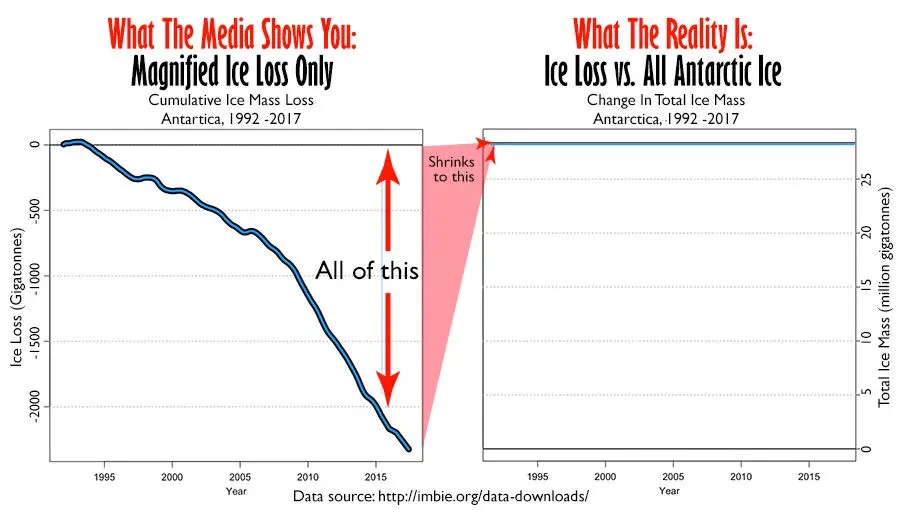
But even worse, as has been pointed out at Climate at a Glance, even the losses of Antarctic ice are insignificant in the much bigger picture of total ice in Antarctica.

Graphs originally by Willis Eshenbach, adapted and annotated by Anthony Watts.
Why is sea ice such a shaky climate proxy?
As we’ve long argued, it’s influenced by far more than just temperature. Wind patterns, ocean currents, and natural variability like the Arctic Oscillation play massive roles. For instance, note how changes in wind patterns affect Antarctic sea ice. In Antarctica, changes in atmospheric circulation, not just temperature, drive ice variability. Add to that the fact that sea ice data is riddled with measurement challenges: sensor calibration issues, satellite drift, and algorithm tweaks can all skew results. The Space.com article’s claim that losing SSMIS data blinds us to climate change ignores these complexities and assumes sea ice is a straightforward barometer of climate change, which it’s not.
Tracking daily sea ice provides, at best, a rough indication of what’s happening in the polar regions, heavily filtered by natural variability and technical limitations. For actual climate science, this metric tells us less about the climate than about the limitations of our models and the persistent urge to find a simple answer to a complex system. The scientific value is, therefore, minimal—especially when compared to the breathless importance often assigned to it.