https://www.ft.com/content/9c7560ec-a220-4150-a35e-a79db70c0c07
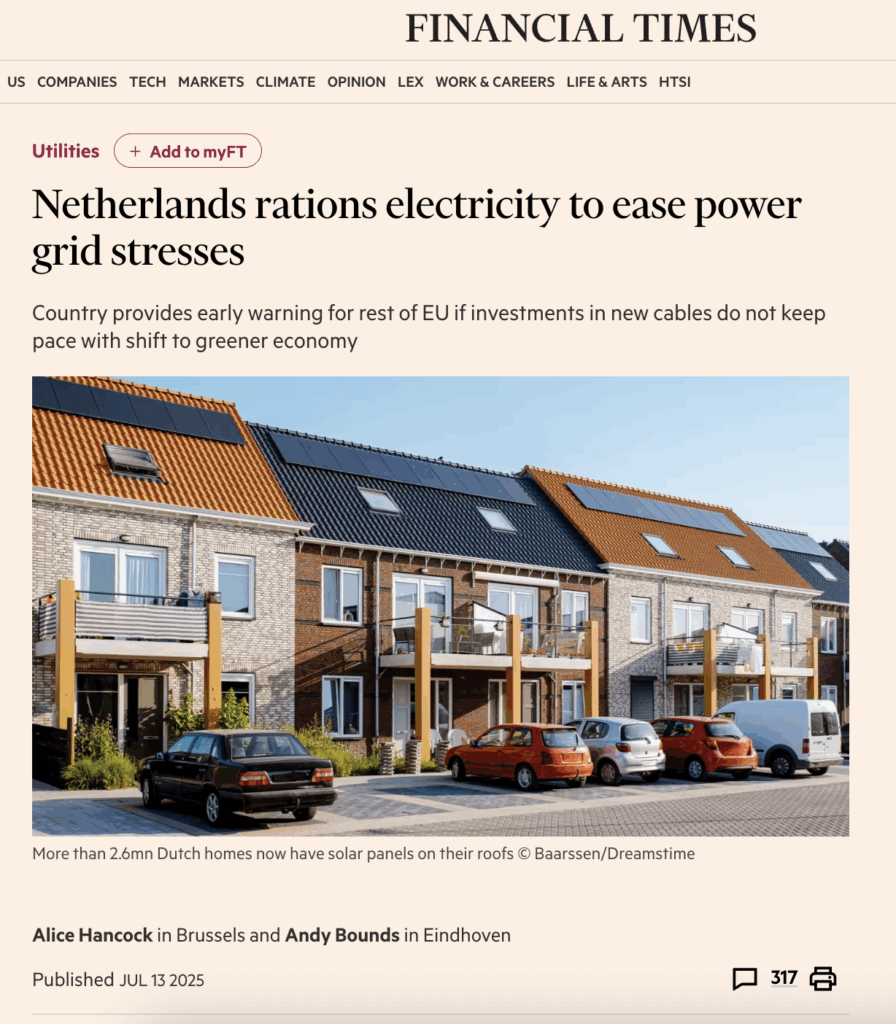
Country provides early warning for rest of EU if investments in new cables do not keep pace with shift to greener economy
By Alice Hancock in Brussels and Andy Bounds in Eindhoven
Published JUL 13 2025
Thousands of businesses and households are waiting to connect to the Dutch grid, forcing network operators to ration power in an early indicator of what other European countries are likely to suffer as the speed of electrification increases.
More than 11,900 businesses are waiting for electricity network connections, according to Netbeheer Nederland, the association of Dutch grid operators. On top of that are public buildings such as hospitals and fire stations as well as thousands of new houses.
Dutch officials and companies said lengthy waits for connections were holding up economic growth and could force businesses to rethink their investment plans. Despite efforts to invest in new cables and substations, new connections in some areas of the country will only become available in the mid-2030s, according to network operators.
Although the bottlenecks in the Netherlands are particularly acute, analysts say it is a harbinger of what is likely to occur in other EU countries, as the speed of electrification increases to meet the bloc’s ambitious decarbonisation targets.
“There is congestion in other countries”, but other countries should “definitely” see the Dutch example as a warning, said Zsuzsanna Pató, power team lead at the Brussels-based energy NGO RAP.
A Dutch official acknowledged: “It’s nowhere near as bad anywhere else.”
The Netherlands is among the countries in Europe to have moved fastest to electrify critical parts of the economy after it in 2023 ended production at its giant onshore gasfield, Groningen. More than 2.6mn Dutch homes now have solar panels on their roofs, Netbeheer Nederland figures show. Companies also accelerated their move away from gas after the EU’s energy price crisis in 2022.
The country had been so used to relying on its gas resources that power grid upgrades had not kept pace, its national power grid operator, Tennet, said.
To provide the grid capacity required, the Dutch government estimates the level of investment needed in cables and new substations to be in the region of €200bn to 2040.
Some of that can be funded through the sale of Tennet’s section of the German power grid to private investors, which is valued at about €20bn, according to officials involved in the talks. But much of the rest will have to be covered by the amortisation of assets, with consumers fronting the cost.
The Netherlands already has some of the highest electricity costs in western Europe because of the grid bottlenecks. Monthly prices are, for example, roughly €30 per megawatt hour higher than they are in France this year, according to data from the think-tank Ember.
To cover the necessary investment, tariffs are expected to increase each year until 2034 by an average of between 4.3 and 4.7 per cent in real terms, a presentation from Tennet said.
To free up capacity, Tennet and regional grid operators have started to offer contracts to households that discount electricity used at non-peak times, such as between 11am and 3pm, and other flexible contracts that allow users to pay for electricity in time blocks.
From April 1, operators could offer contracts where large industrial users are barred from using their connections at all during certain busy hours in exchange for lower tariffs.
The Hague has also put out a “more conscious use of energy” advertising campaign across TV and social media that asks consumers to charge bikes and cars outside of the 4pm-to-9pm peak, when the grid comes under greatest strain.
But local leaders are still worried that their regions will lose investment if the queues for connections endure.
“Everything is going electric and electricity infrastructure needs to grow massively everywhere,” said Jeroen Dijsselbloem, mayor of Eindhoven.
…
Eefje van Gorp, spokesperson for Tennet, said that other countries should beware. “Belgium is in trouble. The UK is in trouble. In Germany there’s lots of trouble because in Germany all the wind is in the north and the demand is in the south.”
Related:
Going Dutch: Half the time you pay for electricity, half the time you pay to not have electricity.
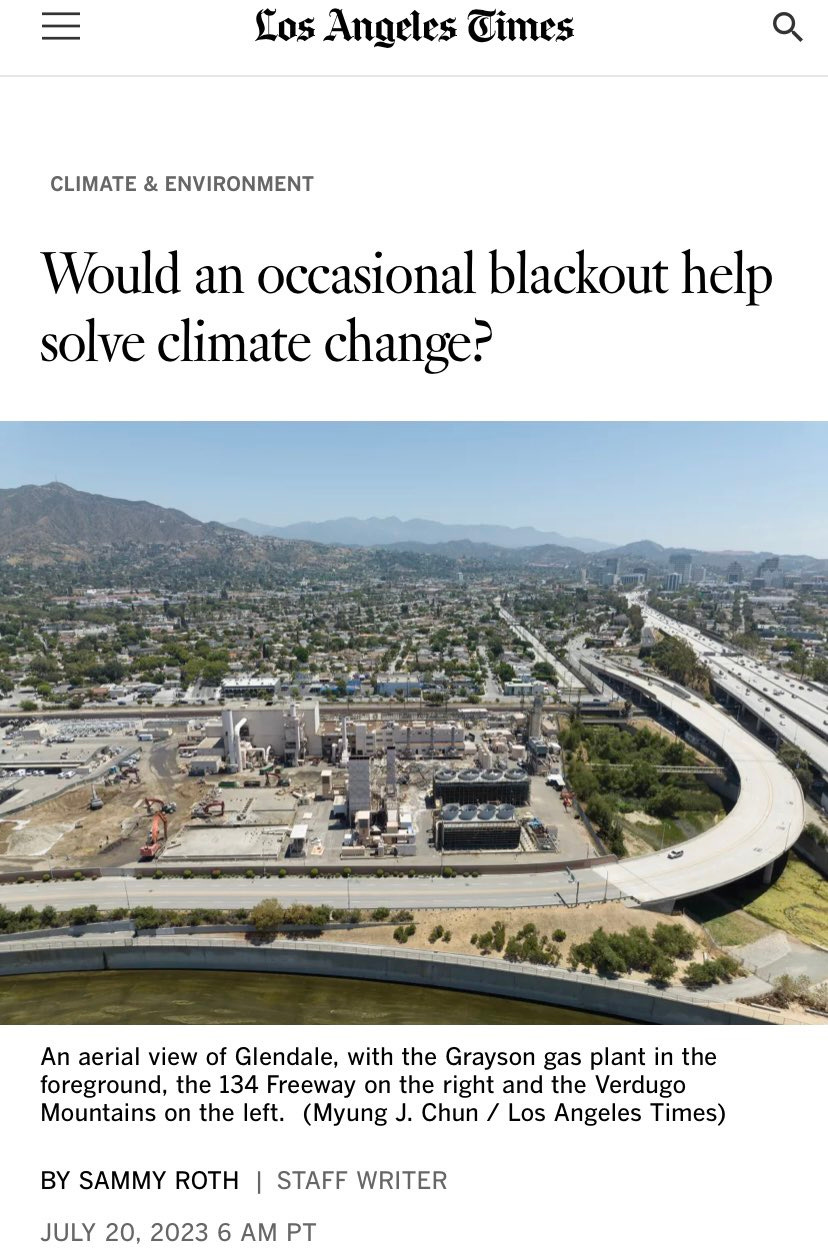
LA Times says quiet part out loud: ‘Would an occasional blackout help solve climate change?’ – ‘We might not have a choice’ – July 23, 2023
Green New Deal in Action! ‘Businesses in Spain have to keep summer air conditioning above 80 degrees F under new govt rules’ – August 11, 2022
Washington Post’s is concerned that this power shortage “threatens to stifle the transition to cleaner energy, as utility executives lobby to delay the retirement of fossil fuel plants and bring more online.”