
New York Times reveals how ‘consensus’ is deceptively created by medical & climate science: Suppressing COVID lab leak theory required ‘circling the wagons & vilifying anyone who dared to dissent’

NYT Columnist Zeynep Tufekci: “So the Wuhan research was totally safe, and the pandemic was definitely caused by natural transmission — it certainly seemed like consensus. We have since learned, however, that to promote the appearance of consensus, some officials and scientists hid or understated crucial facts, misled at least one reporter, orchestrated campaigns of supposedly independent voices and even compared notes about how to hide their communications in order to keep the public from hearing the whole story.” …
“For scientists and public health officials, circling the wagons and vilifying anyone who dared to dissent might have seemed like a reasonable defense strategy. That’s also why it might be tempting for those officials or the organizations they represent to avoid looking too closely at mistakes they made, at the ways that, while trying to do such a hard job, they might have withheld relevant information and even misled the public.”
For a video takedown of NYT’s COVID ‘consensus’ see The Jimmy Dore Show: NYTimes Admits Covid Was A Pack Of LIES!
COVID & Climate – No Dissent Tolerated
“Climate change skeptics have seen this type of crushing of dissent for decades when it comes to ‘climate change.’ Whether you support COVID lockdowns equates to whether you support the UN Paris Pact or Green New Deal in the climate world. If you oppose mandatory masks, that is like not believing in the alleged ‘97% consensus’ on climate. Can the government ‘control” a virus equates to can government ‘control’ the climate. The COVID/Climate connection runs deep.” – Marc Morano reacting to Stanford University’s Michael Levitt’s facing cancel culture over COVID.
Cheers! Bloomberg columnists: ‘Years of Climate Action Demolished in Days’ By Trump – ’82 actions across 20 govt bodies…in 1st 52 DAYS’ – ‘Climate Onslaught’ – Unleashed ‘climate demolition’

82 ACTIONS ACROSS 20 GOVERNMENT BODIES DURING HIS FIRST 52 DAYS IN OFFICE
Watch: Energy Sec. Wright: ‘Net Zero by 2050 is just nonsense. It’s an activist thing, & it’s a top-down, big government justification to do mostly anti-human things’
.@SecretaryWright: “Net Zero by 2050 is just nonsense. It’s an activist thing, and it’s a top-down, big government justification to do mostly anti-human things… we will follow the math and the science and be honest about the tradeoffs here… If you could reduce greenhouse gas… pic.twitter.com/QIylk9HOBP — Rapid Response 47 (@RapidResponse47) March 20, 2025
NRDC: ‘Average human exhales about 2.3 pounds of carbon dioxide on an average day’ – Human ‘exhale almost three billion tons of carbon dioxide annually’
NRDC: The average human exhales about 2.3 pounds of carbon dioxide on an average day. (The exact quantity depends on your activity level—a person engaged in vigorous exercise produces up to eight times as much CO2 as his sedentary brethren.) Take this number and multiply by a population of 7 billion people, breathing away for 365.25 days per year, and you get an annual CO2 output of 2.94 billion tons. International carbon dioxide emissions from fossil-fuel combustion for 2008 topped 34.7 billion tons. So the human race breathes out about 8.5 percent as much carbon as we burn.
Experts are quick to point out that this figure is meaningless, since human respiration is part of a “closed loop cycle” in which our carbon dioxide output is matched by the carbon dioxide taken in by the wheat, corn, celery, and Ugli fruit that we eat. …
The amount of carbon that a human breathes out is exactly equal to the amount of carbon he takes in minus the amount of carbon that contributes to the person’s body mass. This means that the human body—like all animals—is a very modest carbon-sequestration device.
Cheers! The Trump Effect Goes Global! ‘Anti-green sentiment’ growing worldwide – Austria, Belgium, Ireland, Germany, France, Italy, Argentina & others — booting out ‘progressive climate policies’

The Trump Effect goes global! Insider Mag: “Anti-green sentiment worldwide… After returning to the Oval Office, Donald Trump’s first order of business was to pull the U.S. out of various environmental and energy efficiency initiatives. Right-wing populists gaining ground across Europe hold similar views. … If populists successfully halt the world’s progress towards a “green” […]
Reuters now admits total climate fiasco! ‘The pursuit of net zero carbon emissions has been a resounding failure. Despite trillions of dollars spent on renewable energy, hydrocarbons still account for over 80% of the world’s primary energy’

Feb 27 (Reuters Breakingviews) – The pursuit of net zero carbon emissions has been a resounding failure. Despite trillions of dollars spent on renewable energy, hydrocarbons still account for over 80% of the world’s primary energy and a similar share of recent increases in energy consumption, according to The Energy Institute. Coal, oil and natural gas production are at record highs. Emissions of greenhouse gases continue to rise inexorably. The financial markets were already losing confidence in the energy transition before Donald Trump returned to the White House. A more realistic approach to climate policy is urgently needed.
…
Solar and wind power have grown to a mere 3.5% of primary energy production. The levelised cost of renewable energy – which measures of the net present value of electricity produced over a plant’s lifetime – has declined sharply over the years. But this has not resulted into lower electricity prices. In fact, as the share of the energy mix provided by renewables has risen, electricity prices have tended to increase. That’s because wind and solar power are intermittent. Since storing energy in batteries is uneconomic, traditional sources of power are still needed as backup, which is expensive.

…
Targets for reducing greenhouse gas emissions are measured on territorial production. This incentivises countries to switch from domestic manufacturing to importing energy intensive goods, often from countries such as China and India, whose factories are largely powered by coal-powered electricity. Thus, the reduction in an individual country’s emissions can lead to an increase in global emissions.
…
The energy expert Vaclav Smil has likened the costs of the planned energy transition to those incurred by a nation fighting total war for decades on end. … Energy transitions, as Smil has pointed out repeatedly, take a very long time. There have been successful earlier shifts – from wood to coal, coal to oil, and oil to natural gas. Each was accomplished by market forces rather than government fiat.
Trump drops a truth bomb on Green energy – ‘Jan 2025 may begin a long decline for green energy & a return to sensible energy policy’
https://www.cfact.org/2025/01/28/trump-drops-a-bomb-on-green-energy/ By Steve Goreham President Trump has long been a supporter of traditional energy. During his campaign, he spoke negatively about electric vehicles, wind, and other renewable energy sources. But in his first day in office, the new president began a historic shift in US energy policy, away from green energy and back to hydrocarbon […]
CNN analyst: Americans are NOT making connection between climate & wildfires – Polling shows ‘Americans are really no more worried about climate change than they were nearly 35 years ago’
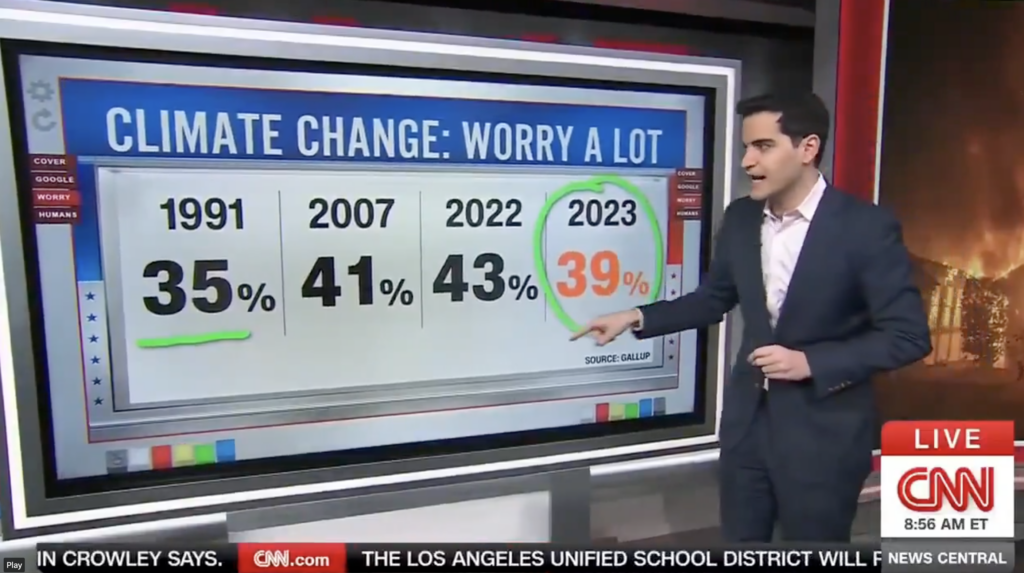

CNN’s Harry Enten: “So despite all these extreme weather events, Americans are really no more worried about climate change than they were now nearly 35 years ago. There is just no real trend line here.”
CNN’s Harry Enten: “2019: 49% – 2020: 49% – 2023: 46% – 2024 45%. That is actually down four points from where we were back in 2019. So LESS than a majority of Americans believe that humans contribute a great deal to climate change.”

‘My 40-year journey with climate change…from idealism to realism’: Former UN IPCC scientist Mike Hulme: ‘I uncritically absorbed the notion that climate change represented the pre-eminent challenge facing humanity’ – Now declares climate is ‘perhaps not the most important thing’

Mike Hulme, Professor at Cambridge University & one of the world’s most accomplished climate scientists. Hulme participated in the UN IPCC second and third assessments & was part of the Climatic Research Unit at the University of East Anglia, where he subsequently founded the Tyndall Centre for Climate Change Research at UEA. He has been at Cambridge University since 2017. … Mike’s publication record is expansive.
Prof. Hulme: “For a long period I uncritically absorbed the notion that climate change represented the pre-eminent challenge facing humanity in the twenty-first century. … I was easily convinced that the growing human influence on the world’s climate would be a reality that all nations would increasingly need to confront, a reality to which their interests would necessarily be subservient and that would be decisive for shaping their development pathways. For more than half of these 40 or so years, it seemed to me self-evident that relations between nations would forcibly be re-shaped by the exigencies of a changing climate.
But now, in the mid-2020s, I can see that I got this the wrong way round. … Too often the language, rhetoric, and campaigning around climate change remains wedded to a world that no longer exists. … Rather than geopolitics having to bend to the realities of a changing climate, the opposite has happened. … In short, this optimism was fueled by the rise of globalism; thinking strategically about climate change was caught-up in this zeitgeist. … Climate is not the only thing that is changing through our lifetimes, and perhaps not the most important thing. …
By 2007, the illusion under which I had been working—that geopolitics would bend to the force of concern over climate change—was already ending. The Kyoto Protocol, signed in 1997, ratified in 2004, had yielded next to nothing in terms of emissions reductions. … And the denouement came in December 2009 at COP15, billed as ‘the most important meeting in human history’. During a few days in a wintery Copenhagen, China’s growing political and economic muscle was firmly exercised, the impotence of the EU’s climate diplomacy revealed, and the limits of late twentieth century internationalism exposed.
The curtain finally came down on Sarewitz’s so-called “plan” during the (northern) 2009/10 winter of climate discontent. In November 2009, the western world was blind-sided by the Climategate controversy over leaked emails between corresponding scientists, and in the early months of 2010 its confidence in climate science further undermined by several challenges to the IPCC’s trust and credibility. …
So this has been my 40-year journey with climate change, initially from idealist to pragmatist, and now from pragmatist to realist. It is not a particularly hopeful story-arc, but then why should I, or anyone else, ever think that climate change was going to offer one?…Climate is not the only thing that is changing through our lifetimes, and perhaps not the most important thing. …
I now see the need for a deeper reading of political realism and power, that goes beyond seeing science as a coercive force that trumps geopolitics, beyond appeals to a superficial cosmopolitanism. To use the language of Jason Maloy at Louisiana University, climate change is neither an emergency or a crisis; it is a political epic, “a process of collective human effort that features gradual progression through time, obscure problem origins, and anticlimactic outcomes.”
The best that we can say is that the world will continue slowly to decarbonize its energy system and, at the same time, the Earth will continue slowly to warm. And societies will continue to adapt to evolving climate hazards in new ways, as they have always done, with winners and losers along the way.
Fed scientist: ‘L.A. Fires Not Climate Change’ – Studies & data show ‘climate’ not linked to California wildfires
Wildfires: US Geological Survey scientist Jon Keeley: ‘L.A. Fires Not The Result Of Climate Change’ – Scrubland plant ‘fires have been around for at least 20 million years. What’s changed is we have people on the landscape’ 2021 Study found: ‘100% of all [Santa Ana] fires are the result of human ignitions, either intentionally or […]