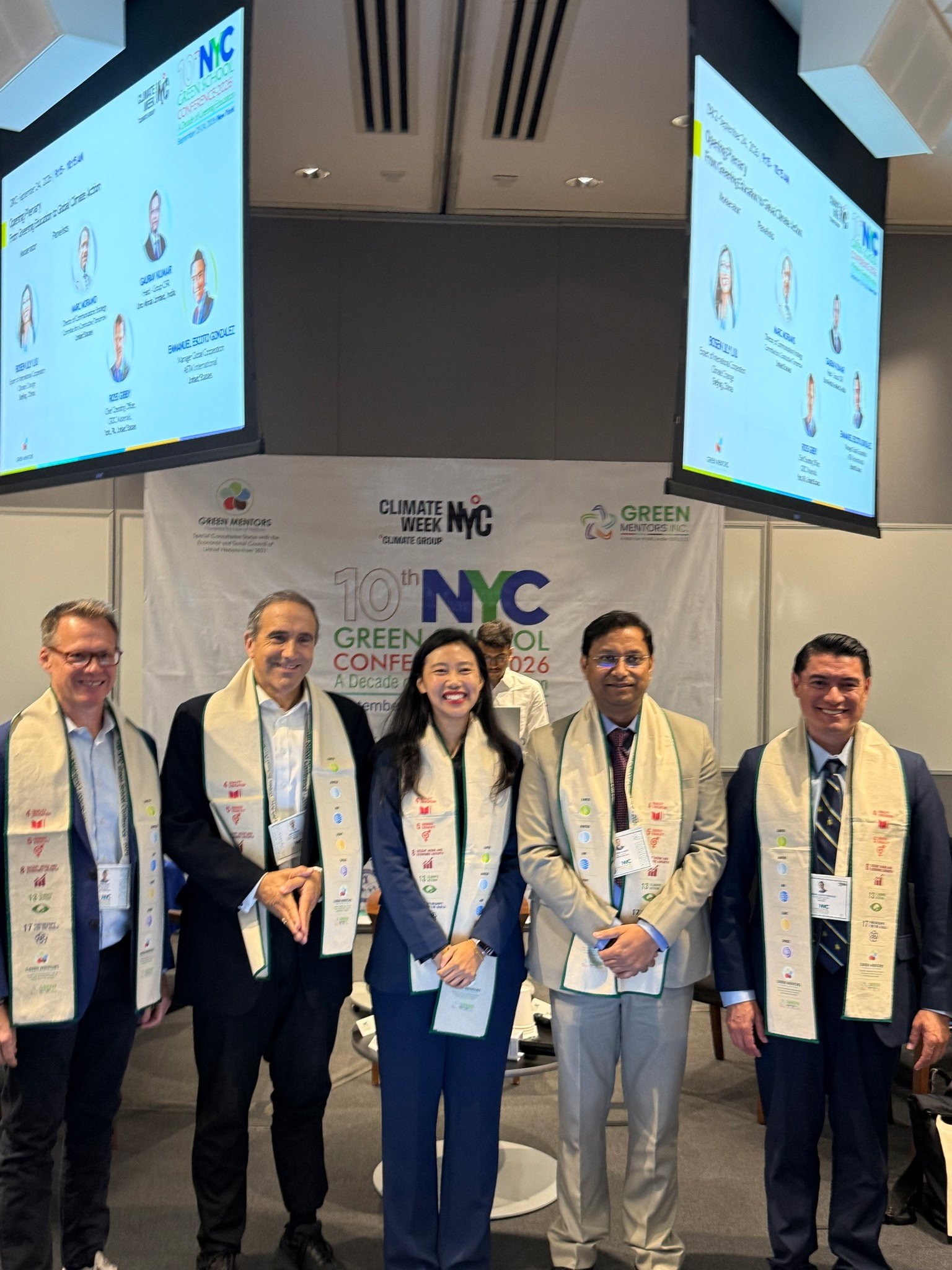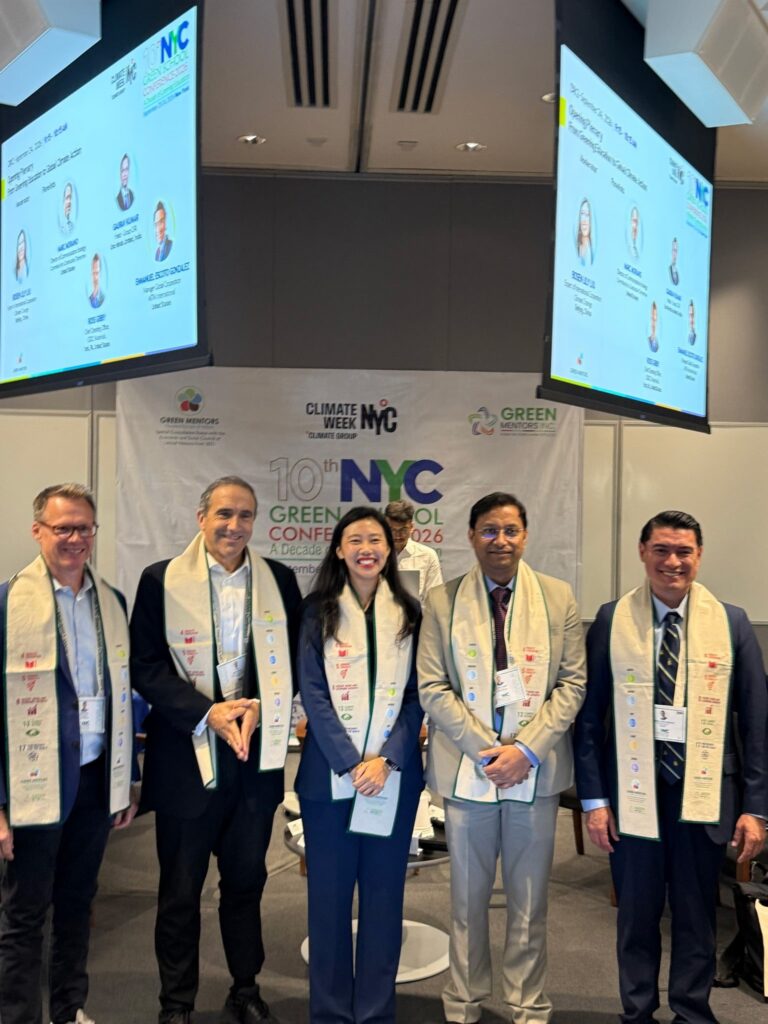
UN’s NYC Climate Week – NYU Green School Conference – Sept 24, 2026
Marc Morano: My name is Marc Morano, and I’m the Communication Director for the Committee for a Constructive Tomorrow, CFACT. I also publish the website called Climate Depot.

I’ve testified at Common Core hearings throughout the states. We have a collegiate division that has over 50 chapters and thousands of kids across the country. I speak on campus. I’ll be speaking at the University of Tennessee next month, and I plan to bring a different viewpoint today because I want to talk about the element of fear in education that they instill in kids, and I think it’s been severely overdone and counterproductive.
And some of my PowerPoint, some of my examples will be that I’m also registered NGO with the United Nations; I go to every UN climate summit. I shouldn’t say everyone I’ve been to, like, 23 of the last 26; I’ll be going to Turkey; I was in Brazil. Last year I was in Azerbaijan; I went to Argentina in 2004 and to Bali, Indonesia, in 2007; I went to Kenya in 2006, so I covered that climate beat with the United Nations.
I’ve worked for the Senate Environment and Public Works Committee, so again, all the different perspectives today

…
I worked in the Senate Environment and Public Works Committee, and I come from a skeptical view that students should be educated to drive climate action; I think we should focus more on diversity of viewpoints. The value of debate is allowing dissent and not forcing a specific viewpoint, and not instilling fear in students.
I wanted to share a few examples I’ve dealt with over my 2 decades, going back to the U.S. Senate, to re-evaluate how we have kids coming out of college and high school full of climate fears.
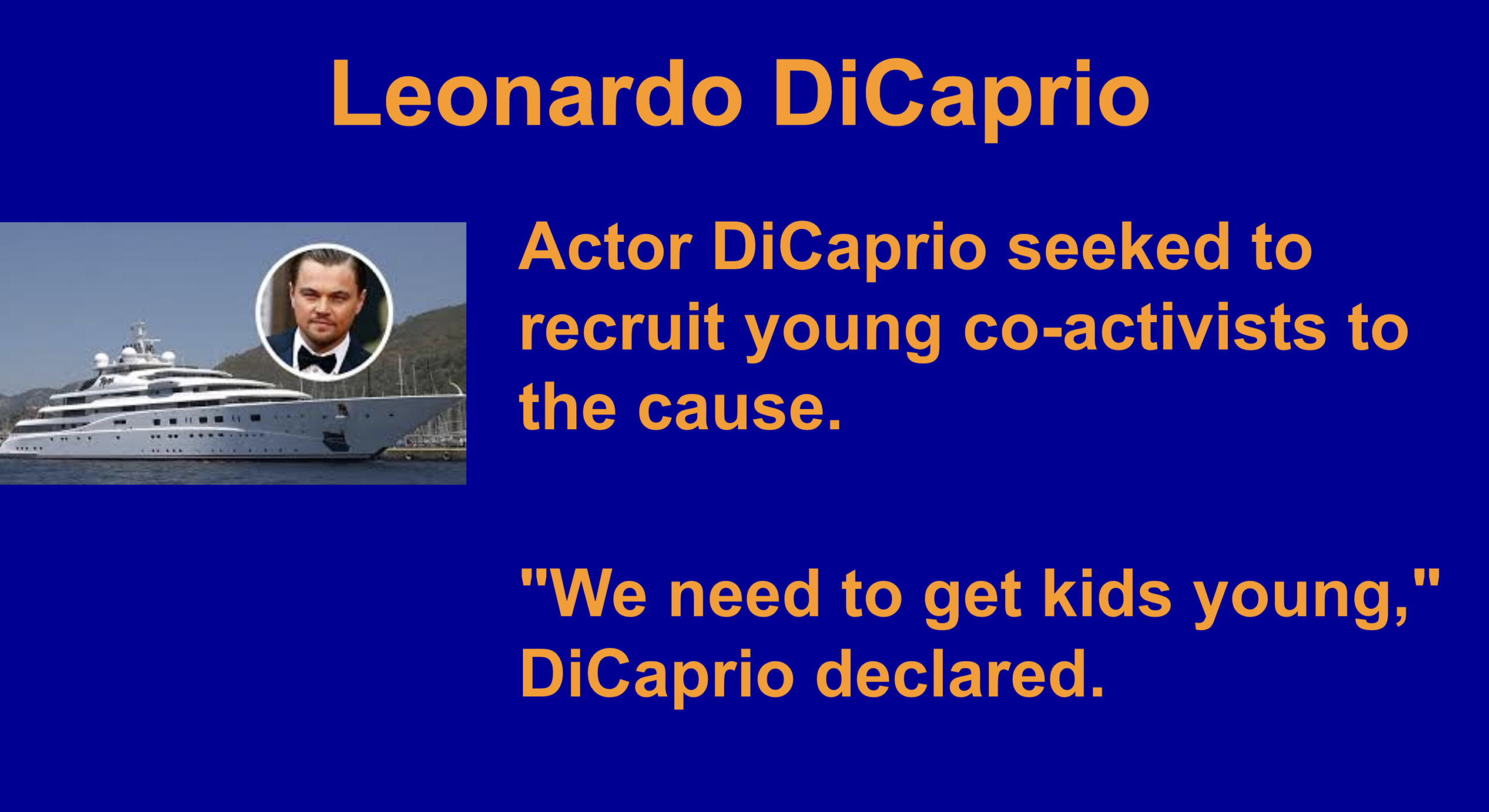
Leonardo DiCaprio has made many climate films, and a lot of them aimed at young people and his philosophy was, ‘we need to get kids young’ in order to turn them into climate activists.
Al Gore’s producer, Laurie David has said, ‘we want you to grow up to be activists’, that is her message, and I think this has been a flaw approach because what happens is you get these overly aggressive, scared, passionate kids, which you think are great. But then as time goes on, their passion fades, and I think fear-based motivation is not sustainable.
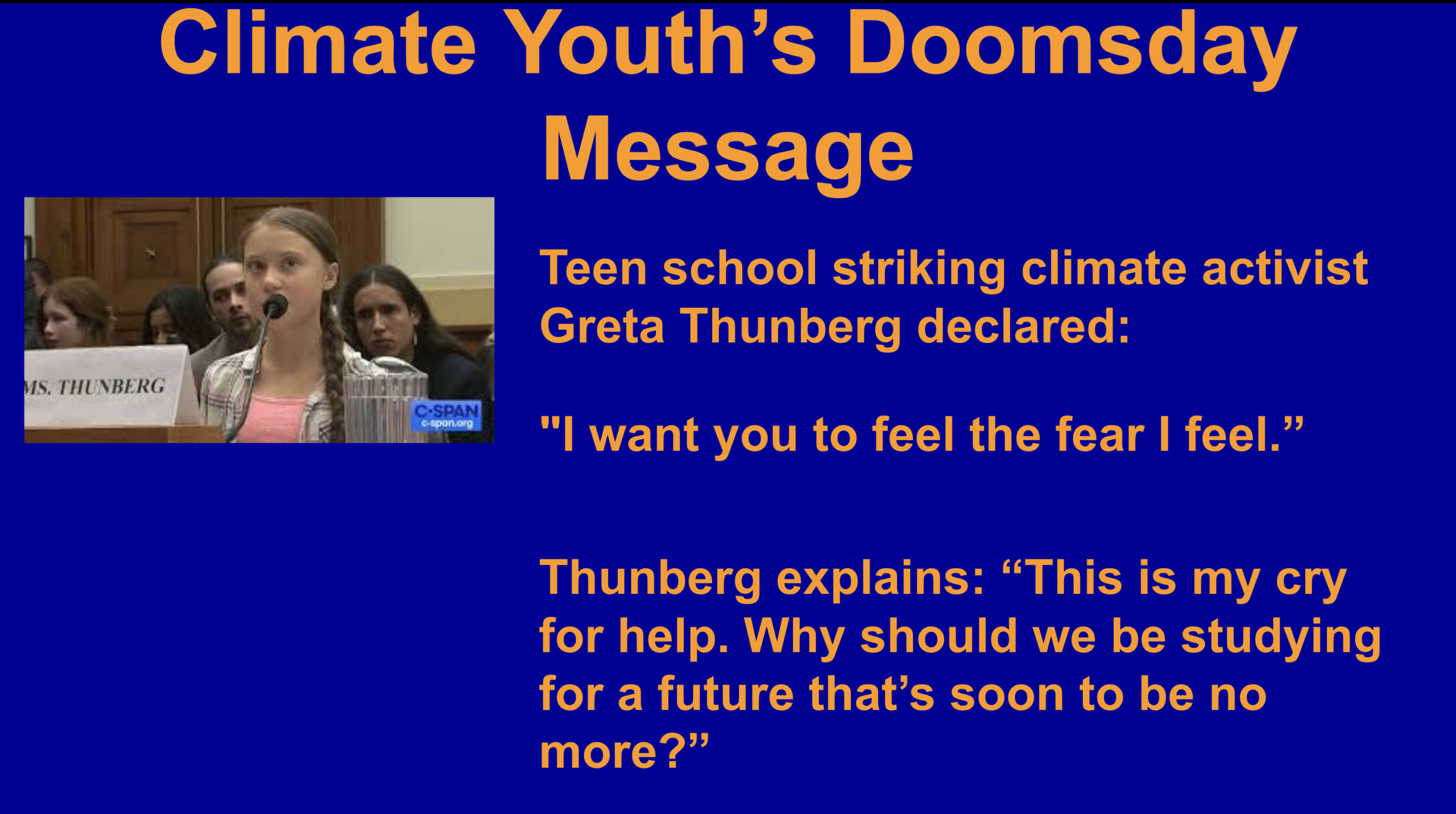
Greta Thunberg, the hero of youth activism, and the education system that did the school strike said, ‘I want you to feel the fear I feel. This is my cry for help. Why should we be studying for a future that’s soon to be no more.’
This is my biggest beef with the climate establishment in terms of education and the young; I don’t think fear should play this role in schools. It’s widespread.
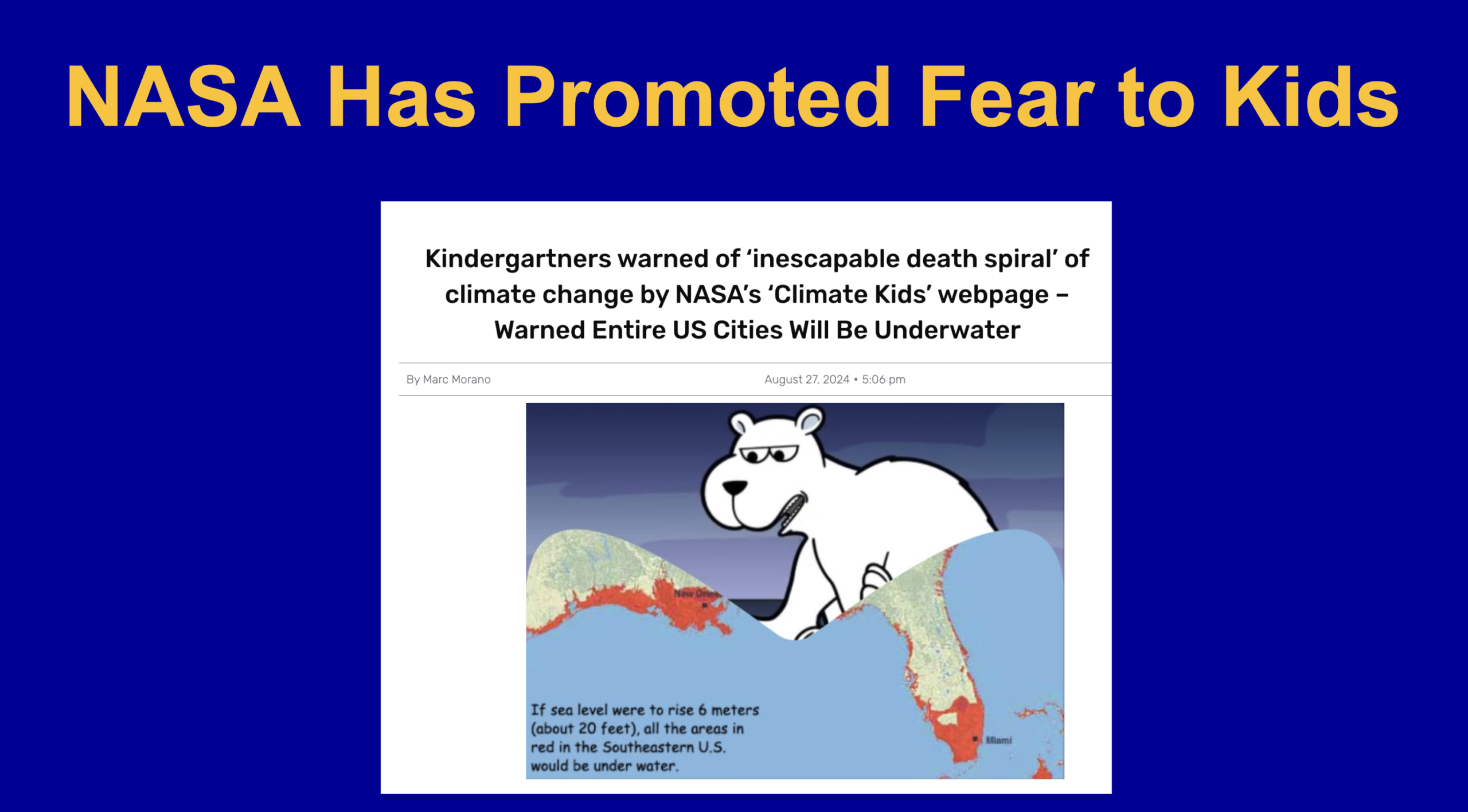
NASA, the U.S. space agency, featured a website where kindergarteners were warned of an inescapable death spiral of climate change on the Climate Kids website. This is only from 2024, just 2 years ago. NASA wrote that entire U.S. cities will be underwater, and they had little kids’ cartoons; they go after elementary school kids.
Youth climate activist, this is Teen Vogue’s Jamie Margolis: ‘It doesn’t matter how talented you are, how many dreams we have. The reality is we’ve. Been committed to a planet that’s collapsing.”
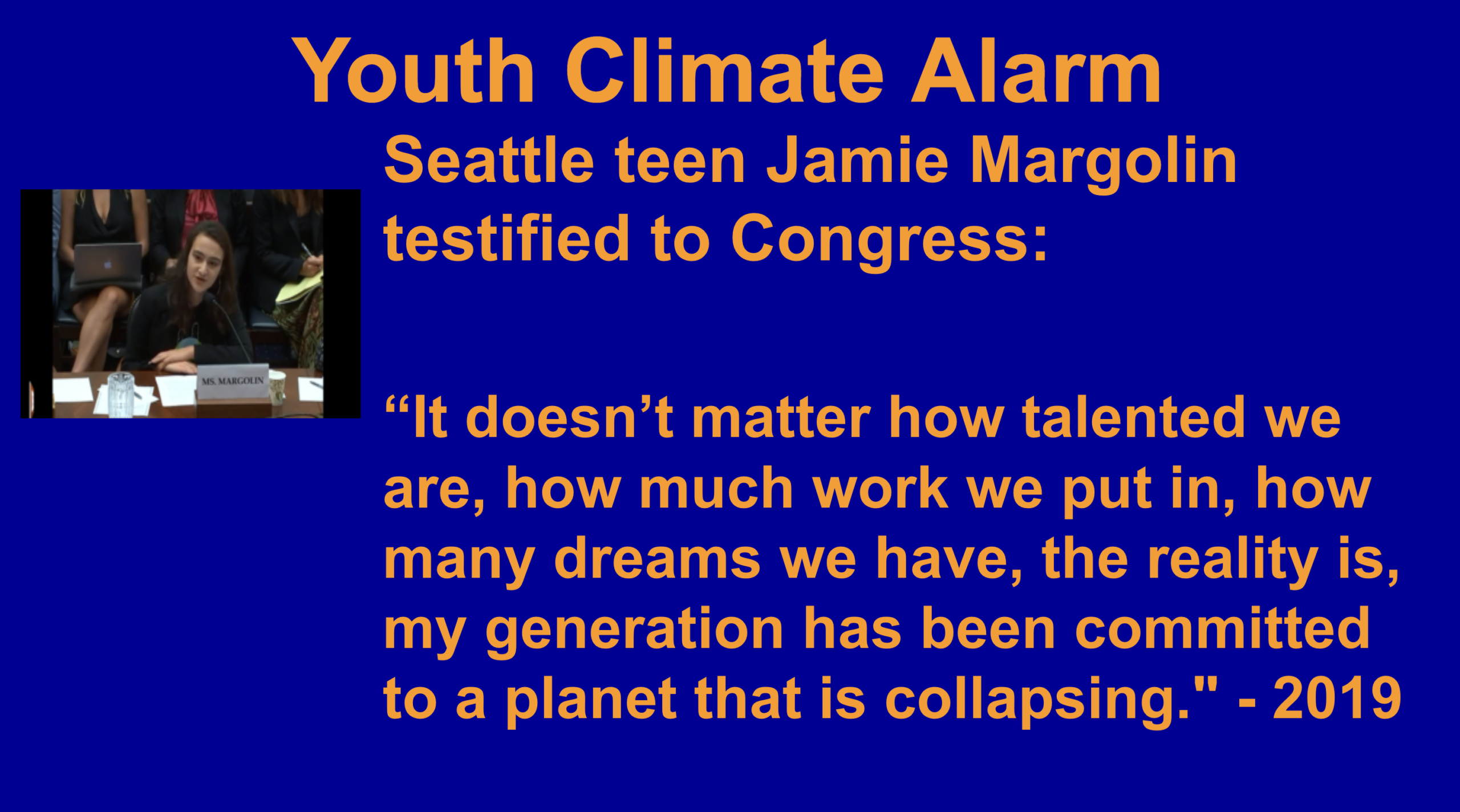
I would argue this messaging is counterproductive.
A UK teachers’ guide for 5 to 14-year-olds urged them to take personal action. They said the students need to ‘mitigate climate change and focus on the Earth’. The authors suggest lyrics like: the Earth is getting warmer, oceans are rising. ‘We know about the dangers and must be changes. The future is in our hands.’
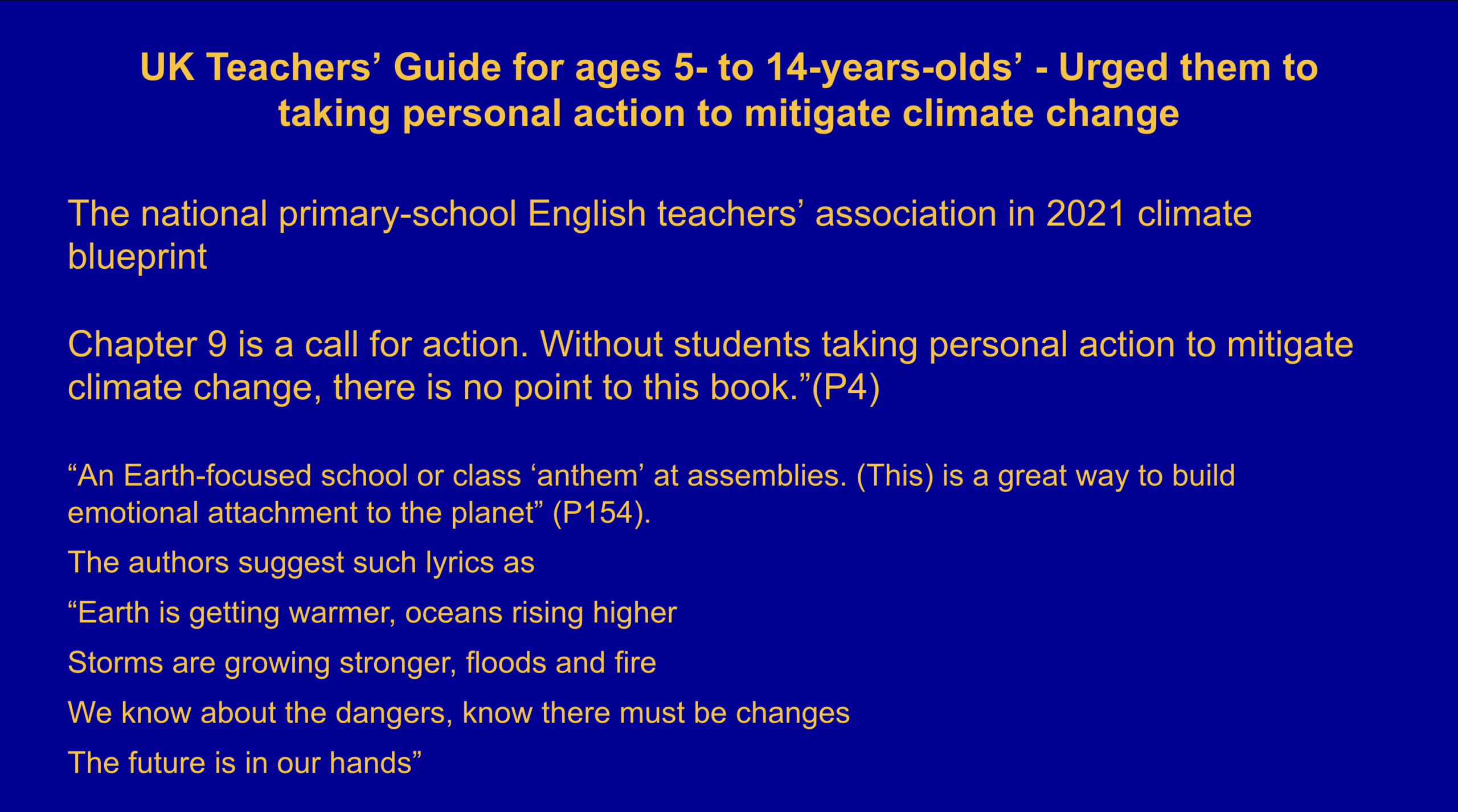
The last line is very concerning, because we’re talking about 5-14-year-olds; it puts this pressure on them, and that pressure to essentially save the planet. And it implies their parents ruined the planet and they have to save it. Then the students get recruited to these climate lawsuits.
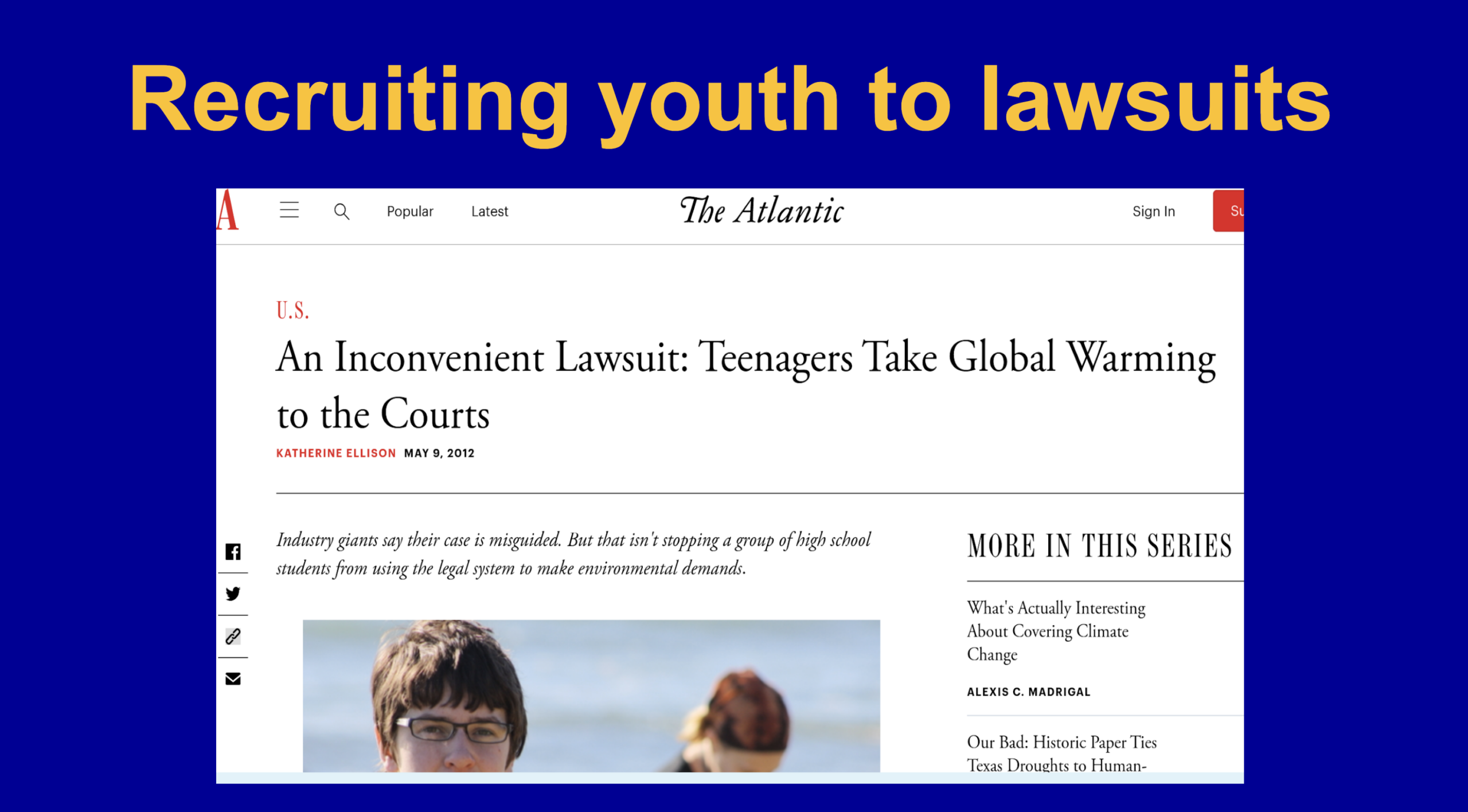
And these lawsuits, I know, it sounds great to many. All these kids are activists, and they’re fighting the establishment. But the problem is they’re in high school, they’re in elementary school, and they’re being told that their future has been ruined, and they need to sue governments and corporations to ensure their future. It’s a burden on them.
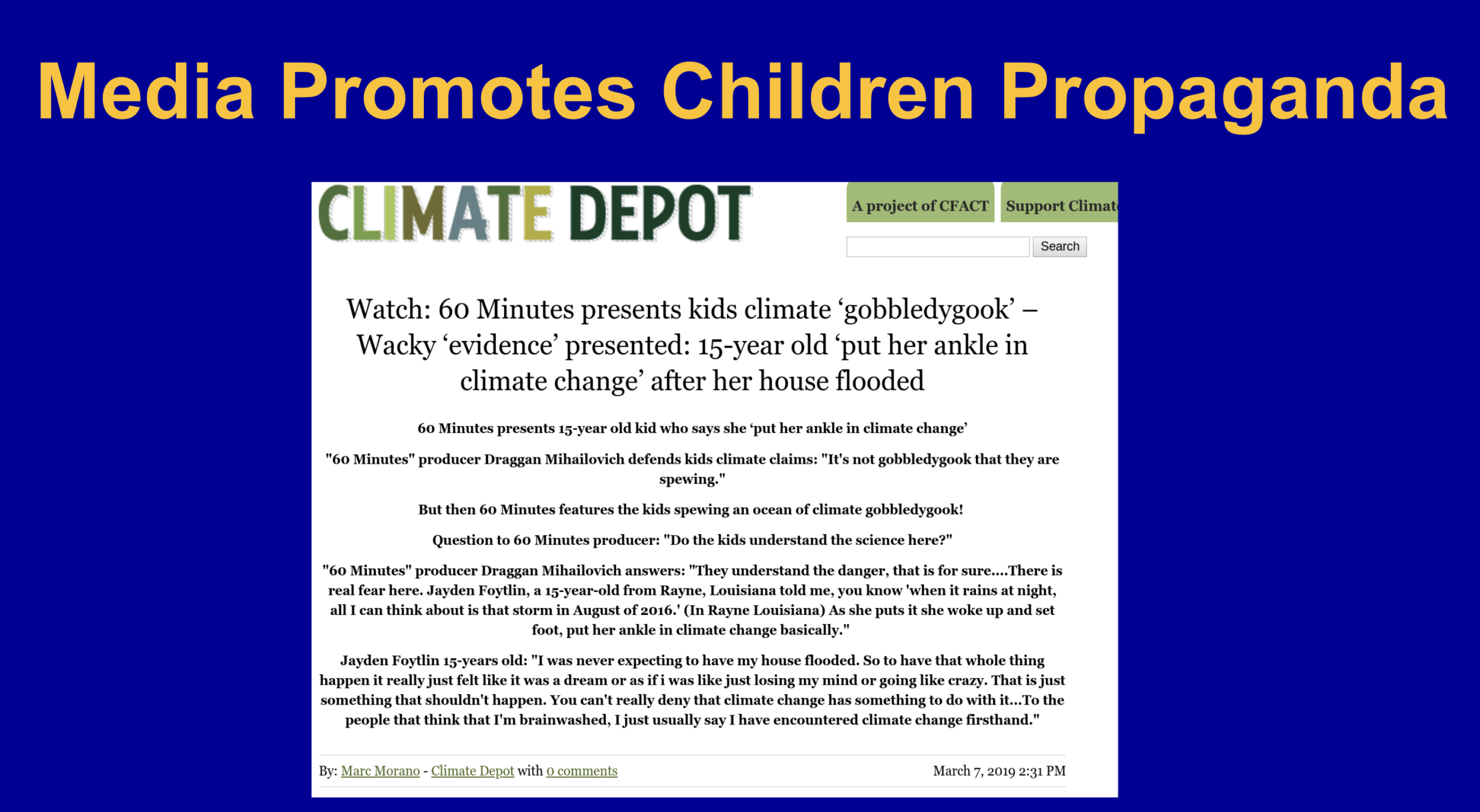
60 Minutes presented kids suing the government, and the program claimed what the kids were saying was not ‘gobbledegook’. But the show presented climate evidence like this: ‘a 15-year-old put her ankle in climate change.’ This is all part of this whole lawsuit.
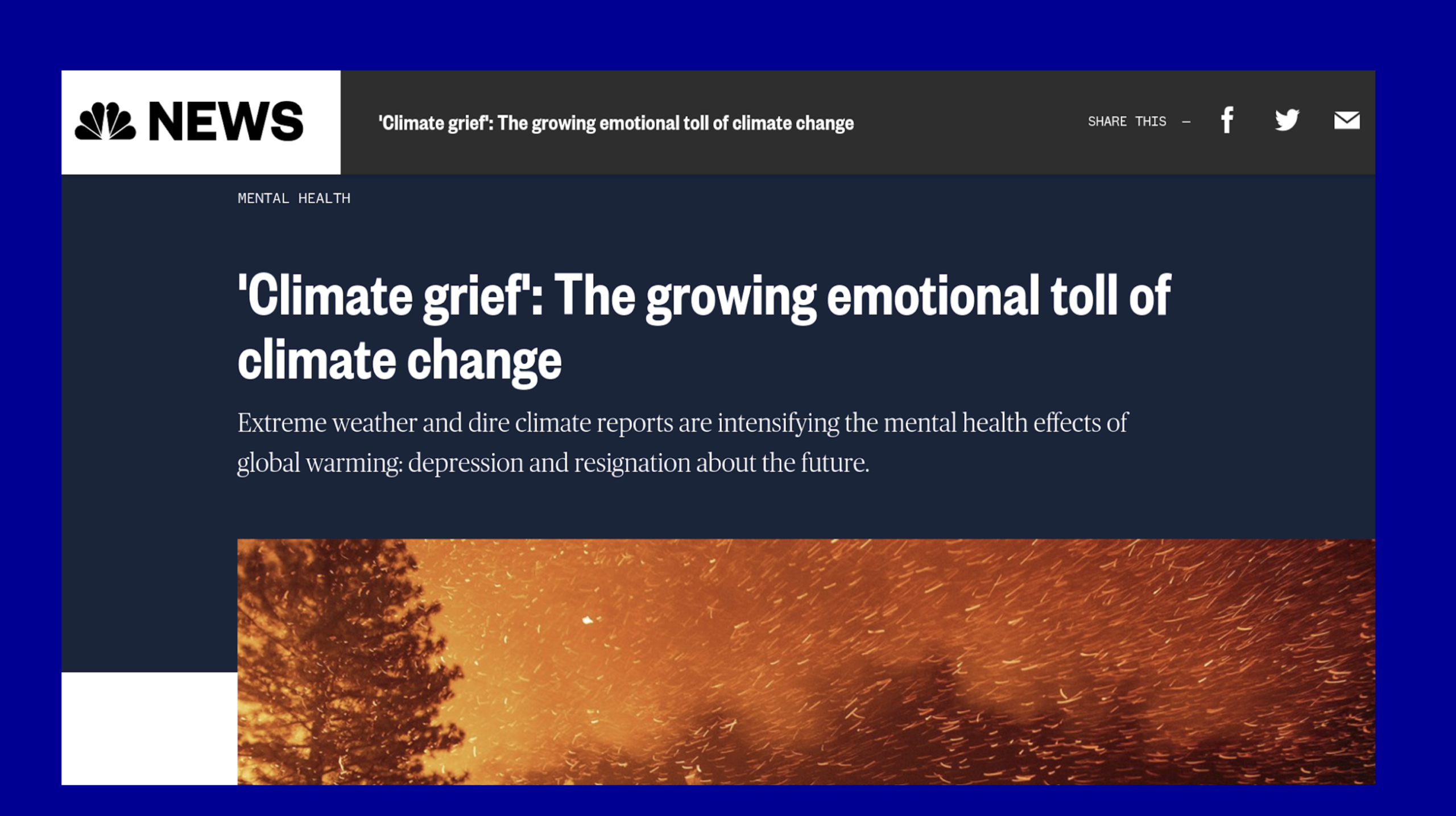
So this student/kid agenda has been really pushed. NBC News is reporting about ‘climate grief’, the growing emotional toll.
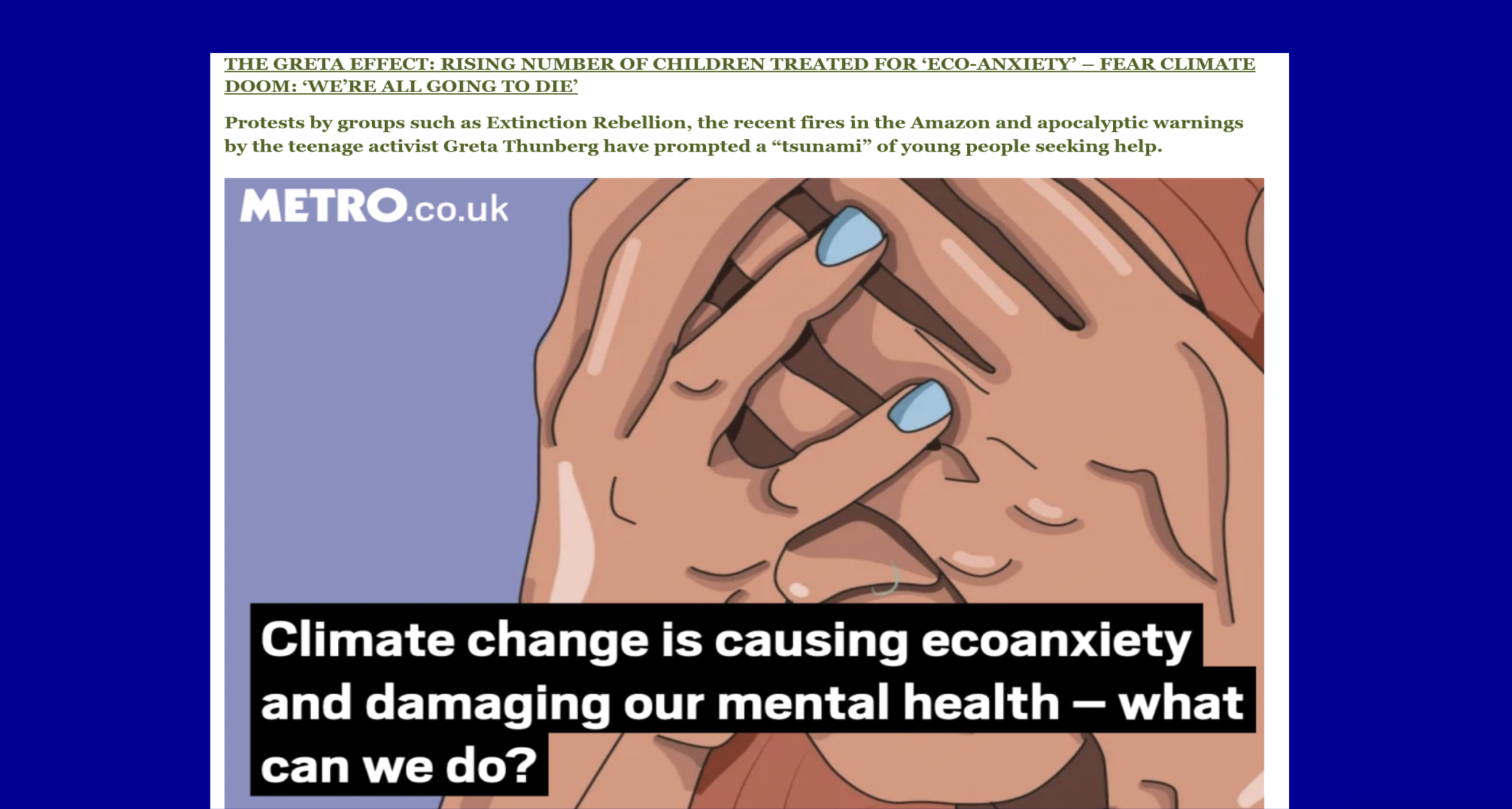
The Washington Post quoted a 9-year-old girl who said, ‘I’m afraid to die because of climate change’, and the Metro UK newspaper reported climate change is causing panic, anxiety, and damaging our mental health. Global warming caused an increase in ‘ecological grief’.
This is an actual peer-reviewed academic paper published in the journal Nature in 2018. A small but growing number of scholars are suffering from ecological grief — it’s becoming increasingly common. Now, I just think this is what needs to stop.

This is a teenager suffering from climate anxiety, and of course, they want you to act now, a lot of these kids are speaking out.
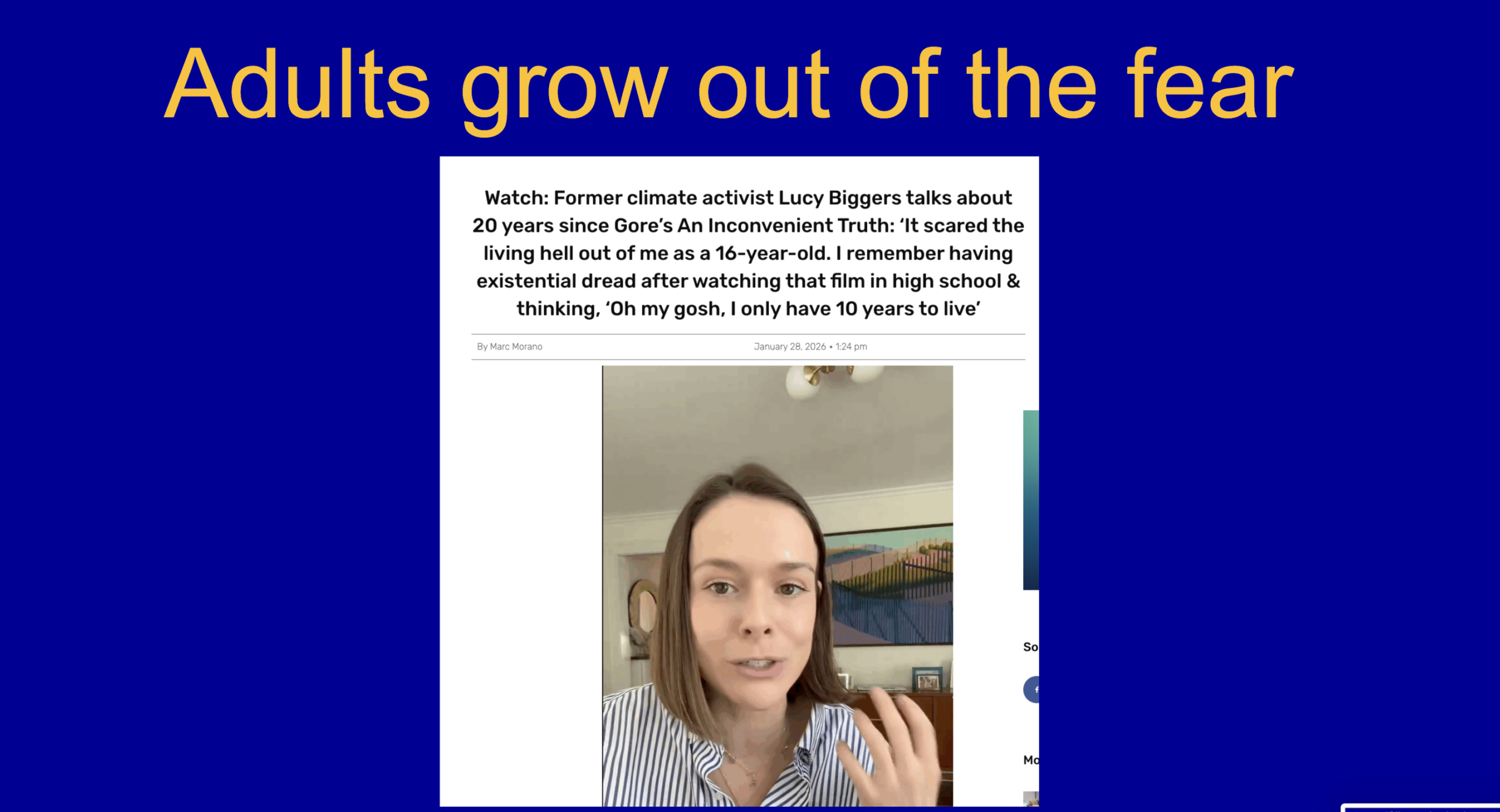
This is — she’s in her 30s, this is Lucy Biggers, she said, ‘Climate change scared the living hell ever. When she saw Al Gore’s film, she had existential dread watching the film.’
We detailed kids who watched Al Gore’s movie 4 times in four different classes, and the big thing I would argue is there’s no climate dissent allowed in most of schools or academia.
So a kid is taught that there’s no dissent, no debate on these issues. And they’re told that this is the way it is.
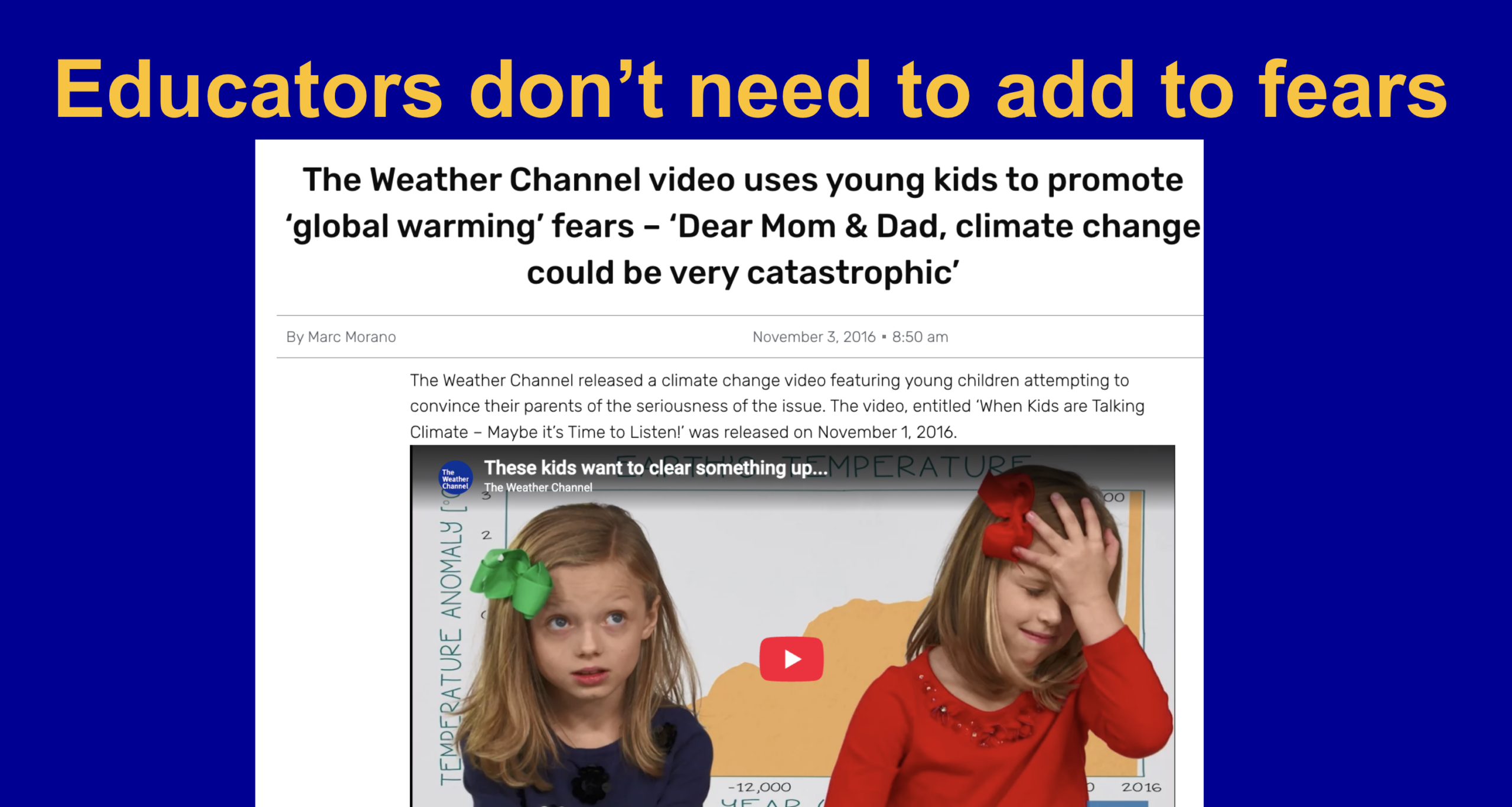
Whether Channel did the same thing, video using kids. ‘Dear Mom and Dad, climate change could be catastrophic.’
NBC News: ‘College students getting emotional about climate change; it’s making young people distressed.’
So I just wanted to start out with that. And to say, you need to do diversity of opinion in academia. You need debate, you need less fear, and you need to let kids have critical thinking skills. Thank you.
Morano’s intro ended.
Moderator: “It’s a very fear-driven presentation to start with, but ending with a very positive remark that there’s something that education social can do. Thank you so much, Marc.
…
Marc Morano: I think the biggest thing is one of the biggest things with college is you want to show a diversity of viewpoints. When I was working in the U.S. Senate Environment & Public Works Committee, these scientists reached out to our office who were skeptical of climate change, and they were just giving horror stories of how academia was crushing them and not allowing dissent or debate.
And actually the same thing happened during COVID. So I think students need to know that a teacher’s not going to be canceled for saying the wrong thing. Number one, that gives them the idea that academia is a safe space that allows discussion and you’re not canceled. And this suppression of dissent happened to a lot of professors, even renowned professors who were against the sort of Anthony Fauci lockdown technique during COVID.
The exact same sort of stifling of debate happened in climate, but I think with kids you want to show them debate is healthy. If you look at Gallup polling on environmental issues, climate is always ranked dead last as a concern every year by Americans. So I think the biggest thing you want to do with kids is teach them about the environment, teach them about the first Earth Day and about how much the Earth has improved since then.
We’ve radically decreased air pollution and water pollution, and at the same time we have seen huge economic growth and had a huge population increase.
The progress on cleaning up the environment since the first Earth Day is a huge success story that should instill hope in students and instill practical solutions for pollution cleanup. I would argue students need to see a diversity of speakers come to speak to them with differing views on issues. I would also try to avoid some of the jargon like sustainable development that the UN promotes, Agenda 2030. I think they become very sort of narrow activists who are in a little niche world that the rest of their students can’t even relate to or understand what they’re talking about; it’s got to be a sort of way forward.
And to answer the other question, if I can’t just real quickly tie that in the trade-offs and the balances are a huge issue. To replace toilets with bidets to get rid of toilet paper. The problem with all of that is you have to look at the big picture on these issues. Even if you look at EVs.
Everyone says their EV is ‘green’. Well, there was an engineering estimate. It takes half a million pounds of materials dug up from the Earth to make one 1000 pound Tesla EV battery, which is then transported on a diesel ship, which is then plugged into a grid, that is roughly 70 to 80%dependent on fossil fuels, depending on where you live, to recharge that battery.
So there’s always a trade-off. I think we had to get away from this is ‘green’. This is not green, and you look at the overall big picture.
…
Marc Morano: One of the things, at our organization, Committee for Constructive Tomorrow, we’re very grassroots, so our cooperation is working with local communities. And there’s actually been a lot of our activists who oppose offshore wind on the coast. Recently, in New Jersey. We have people protesting an offshore wind, because they don’t like what it’s doing to whales, and we have cooperation with local communities, as they need them and the grassroots. I think that is one of the most important things. I mean, all the other stuff’s important too, technology and cooperating with corporations and organizations. But the grassroots is where everything sort of begins and ends.
…
Marc Morano: I did stories on sustainable forestry; at one point, doing an Amazon rainforest report, I interviewed professors, and they could tell me within 7 years, using these sustainable forestry techniques where it’s not slash-and-burn techniques or clearcutting but a slice of trees here or a slice of trees there. Within 7 years, you couldn’t distinguish between the logged forest and the unlogged forest because plants and animals regenerated.
That’s the kind of hopeful message, instead of fear-based, that I think we should be pushing, and when you look at technology, whether you’re talking about endangered species, we know how to save endangered species. The success rate is incredible to the point where now you have battles about whether a species should be delisted, in case it could be a Wolf or something else, and agriculture, where there become too many of a species.
And this is a very important point I’m about to make: showing kids a hopeful message that even fossil fuels or coal plants have dramatically increased pollution standards in the past 50 years since the first Earth Day, 60 years ago.
I guess almost, and I think the biggest mistake that activists should avoid is getting the UN or someone like Al Gore, making environmental issues political left, right, or Democrat, Republican, conservative, liberal — all of that makes it a niche issue because you’re going to have people who are repulsed immediately.
I think this is one of the biggest mistakes with the UN. The UN politicizes the hell out of climate change to the point where they do all the tipping points; it just turns off half of the audience immediately.
So if you focus on a technology aspect and improving the environment across the board, cleaning up oceans, cleaning up pollution.
#