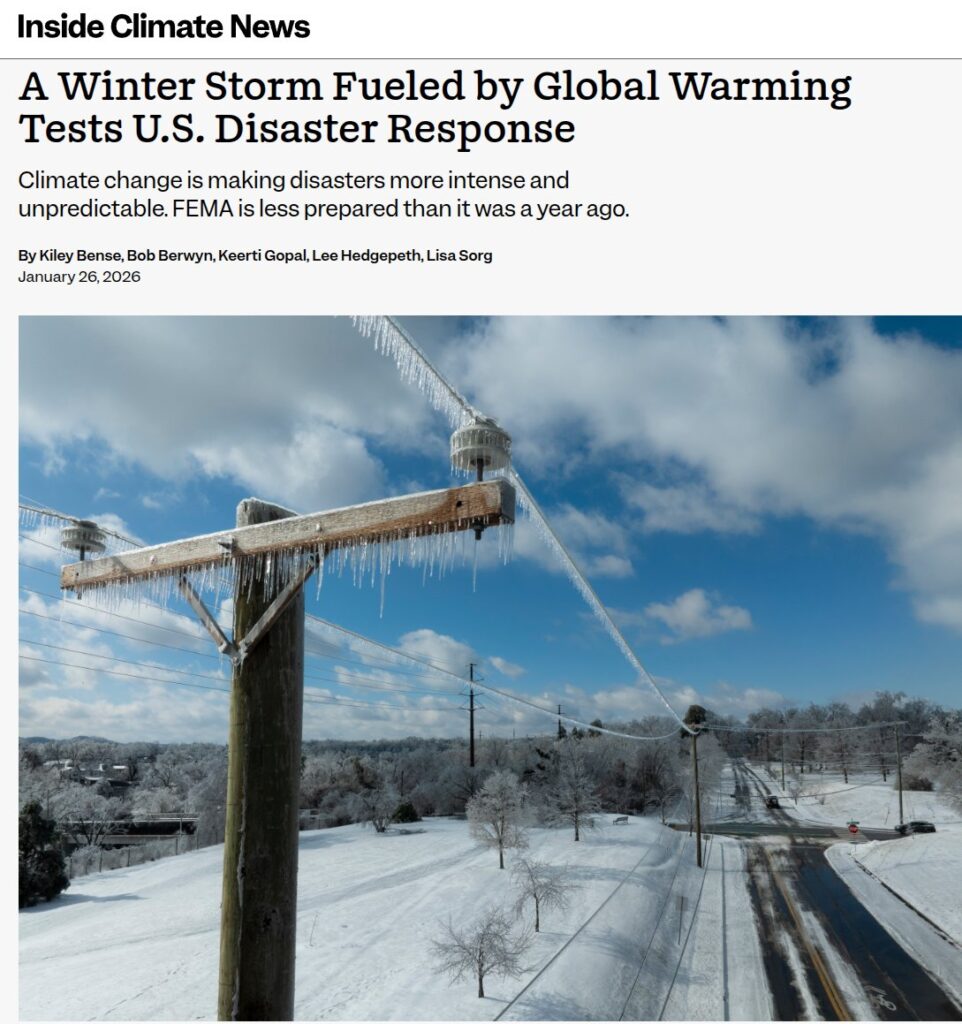
A Winter Storm Fueled by Global Warming Tests U.S. Disaster Response
By Kiley Bense, Bob Berwyn, Keerti Gopal, Lee Hedgepeth, Lisa Sorg
‘Climate change is making disasters more intense and unpredictable’
Excerpt:
On Friday, Trump posted on social media about the storm and cold snap, asking followers, “WHATEVER HAPPENED TO GLOBAL WARMING???”
In fact, scientists say, global warming has reshaped the atmospheric engine in ways that can make winter storms and extreme cold outbreaks more disruptive than ever.
Rapid Arctic warming and melting, stronger and more intense ocean heat waves, increased atmospheric moisture and more frequent disruptions of the stratospheric polar vortex are all factors “contributing to the extreme winter weather unfolding across the U.S. this week,” Jennifer Francis, an atmospheric scientist and senior scientist at the Woodwell Climate Research Center in Falmouth, Massachusetts, said via email.
More than a foot of snow fell across the U.S. from Arkansas to Massachusetts, with some places seeing nearly two feet. Ice blanketed much of the South, bringing down tree limbs and knocking out power from Texas to North Carolina.
At least 20 people were killed during the storm, and thousands are navigating power loss, dangerous travel conditions and freezing temperatures. More than 600,000 homes and businesses were without power as of Monday afternoon.
Emergency management experts and government officials warned that the situation is still unfolding, particularly in Southern states impacted by ice. Falls, traffic accidents, hypothermia and carbon monoxide poisoning are among the possible threats in the storm’s aftermath.
…
How Climate Change Reshapes Winter
Scientists agree that human-caused warming has changed the way air and energy move around the planet in complex and interrelated ways that influence outbreaks of extreme winter weather.
The current cold wave is not happening in isolation, but in a fundamentally altered climate system. At a basic level, the oceans are warmer and the atmosphere holds more moisture than 50 or 100 years ago. Both fuel stronger storms, including nor’easters, which have intensified significantly in recent decades, according to a 2024 study.
Nor’easters spin up along the East Coast, drag subtropical moisture from the south and pull frigid polar air from the north. Both their maximum wind speeds and hourly precipitation rates have increased since 1940, said University of Pennsylvania climate scientist Michael Mann, a co-author of the paper.
That research, he said via email, for the first time was able to quantify the changes. He warned that “more intense storms, with greater amounts of snowfall” are to be expected, even as the planet warms.
“Stronger storms, as they spin, pull up more warm air on one side and pull more cold air down on the other side, so we see both warm and cold temperature extremes associated with them,” he said.
Along with warmer oceans and a wetter atmosphere, global warming has also reduced Arctic sea ice by nearly a third since the 1980s, which is enough to change the path of the jet stream, the wavy, fast-moving river of air that separates cold Arctic air from warmer air to the south.
Extreme cold events are usually linked to big north-south bends in that flow, said Francis, the Woodwell Climate Research Center scientist, who is known for her research on rapid Arctic warming and its influence on mid-latitude weather patterns.
Right now, the jet stream is bulging far north over the western U.S. while plunging deep south over the east, allowing Arctic air to spill unusually far south. The pattern is becoming more common as the Arctic warms faster than the rest of the planet, weakening the temperature contrast that normally keeps the jet stream straighter and faster.
…
Historic cold and snow caused by an overheated atmosphere.
https://t.co/ELbaphusmS pic.twitter.com/4kFRm8eH8b
— Tony Heller (@TonyClimate) January 27, 2026
Related:
New York Times: Global Warming Caused the Winter Storms – Or Something Like That – January 28, 2026
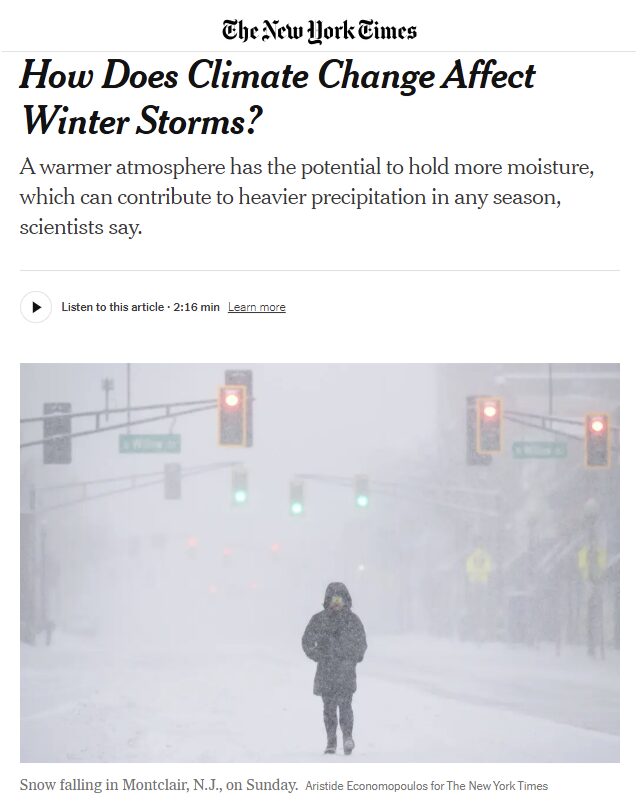

Global warming, a theory that explains any outcome!
New York Times: Global Warming Caused the Winter Storms – Or Something Like That – January 28, 2026