https://www.politico.com/newsletters/politico-nightly
“A summit supposed to stop the planet burning, halted by an actual inferno, reinforced the sense that things are almost cosmically stacked against the global climate conferences…”
By KARL MATHIESEN
Excerpt:
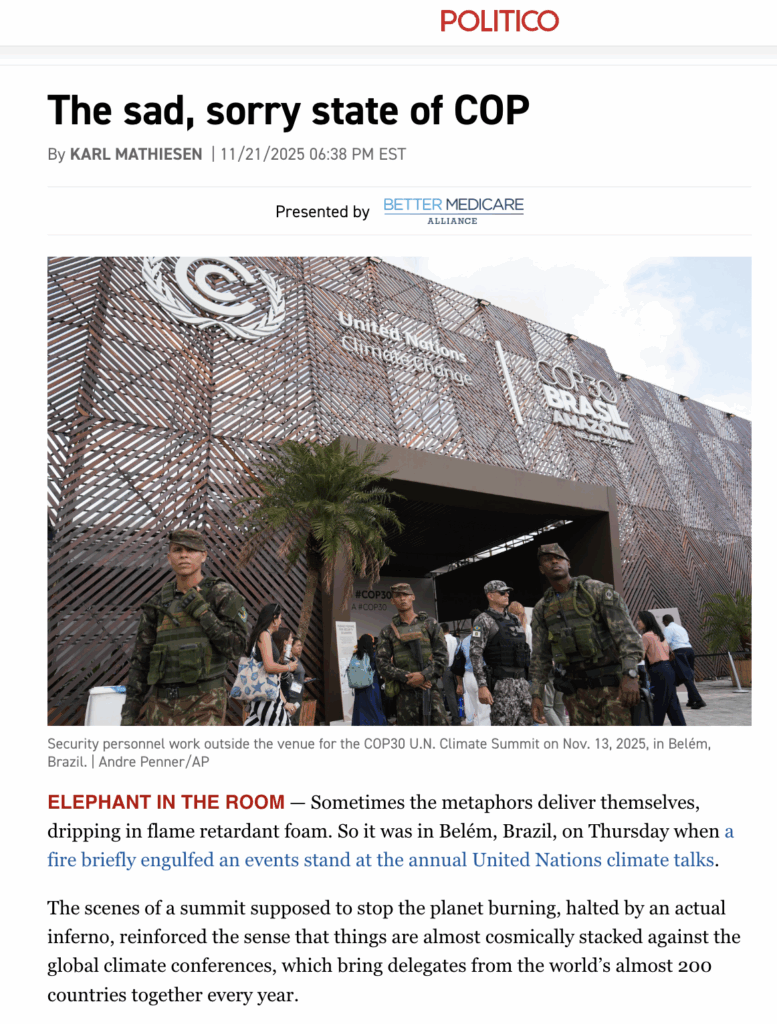
ELEPHANT IN THE ROOM — Sometimes the metaphors deliver themselves, dripping in flame retardant foam. So it was in Belém, Brazil, on Thursday when a fire briefly engulfed an events stand at the annual United Nations climate talks.
The scenes of a summit supposed to stop the planet burning, halted by an actual inferno, reinforced the sense that things are almost cosmically stacked against the global climate conferences, which bring delegates from the world’s almost 200 countries together every year.
“What the fuck are we even doing here?” asked a European government official, nursing a caipirinha at a riverside bar halfway through the two-week conference held in a city on the banks of the Amazon delta.
It’s a question increasingly being asked at U.N. climate talks. But it was perhaps more true of this edition, COP30, than any of its predecessors in the 33-year history of the international talks.
The meetings have typically been used for three key purposes: to set new international law; to act as a huge clean energy trade fair; and to serve as a barometer signaling to investors how much politicians are likely to back green policies in the coming years.
But the process is running out of laws to negotiate. The landmark Paris Agreement is done — despite Donald Trump pulling the United States out. Which leaves the trade fair, where companies come to make deals and meet potential new contacts. Fine. And then there’s the vibe check.
That last part is what countries have struggled with during the past two weeks. What true signal about the state of the world could the conference produce when there were zero delegates in attendance from the U.S., the world’s largest economy and oil and gas producer?
Countries entered the talks on the back of a series of underwhelming announcements of new climate plans. A third of the countries ignored the requirement completely. It was the job of this conference to address that deficit. But little of substance took place.
At this conference, which was still locked in vitriolic final throes on Friday evening as talks moved past their scheduled end, the U.S. absence allowed a group of emerging economies that includes Brazil, Russia, India, China and South Africa — known as the BRICS —to team up with petrostates, isolating the more green-oriented European Union and refusing to countenance even a reiteration of past deals to end fossil fuels.
It felt, delegates said, like part of a larger power shift. Where confident rising powers trod over the interests of a divided West. “This is a BRICS COP,” a European diplomat said.
…
But if the U.N. summits can’t even showcase the best of what is happening on the ground and instead the message is one of ambivalence, then it’s little wonder that most investors simply ignore the final outcomes at the U.N. climate talks these days.
Many are calling for these talks to take on a much more practical dimension. “We’re at a bit of a turning point on what happens at COPs,” said Jennifer Morgan, Germany’s former climate envoy. The conferences needed to bring the businesses and investors from the clean tech sector closer into the talks, she said, so there would be “the real doers engaging more with the actual policy makers.”
…
But these talks quickly got bogged down by the refusal of the wealthy countries at the talks to commit to increasing their level of financial support to help poorer countries deal with their own environmental problems. Without the diplomatic heft and experience of the Americans, there was no country that could break down the resistance from Saudi Arabia, China or India.
In lieu of fixing climate change, COP30 pivoted to another goal: Defending multilateralism. Which sounded a lot like agreeing to anything, just to project a sense that the show would go on — a soft repudiation of the U.S. president’s derision for the climate “con job” and his attempts to jolt the world back towards fossil fuels.
The disregard is mutual. Throughout Thursday, an unflattering statue of Donald Trump — a U.N. head of state — stood unmolested by the guards at the gates of the U.N. venue.
This process faces at least three more years of talks without the elephant in the room. It will need to change — or become further detached from reality.
…