This is HUGE.
It is the first comprehensive government scientific report to challenge the conventional narrative surrounding the climate change issue in a very long time, perhaps ever.
I cannot underscore enough how big of a deal this is. https://t.co/0G75r94LS2
— Chris Martz (@ChrisMartzWX) July 29, 2025
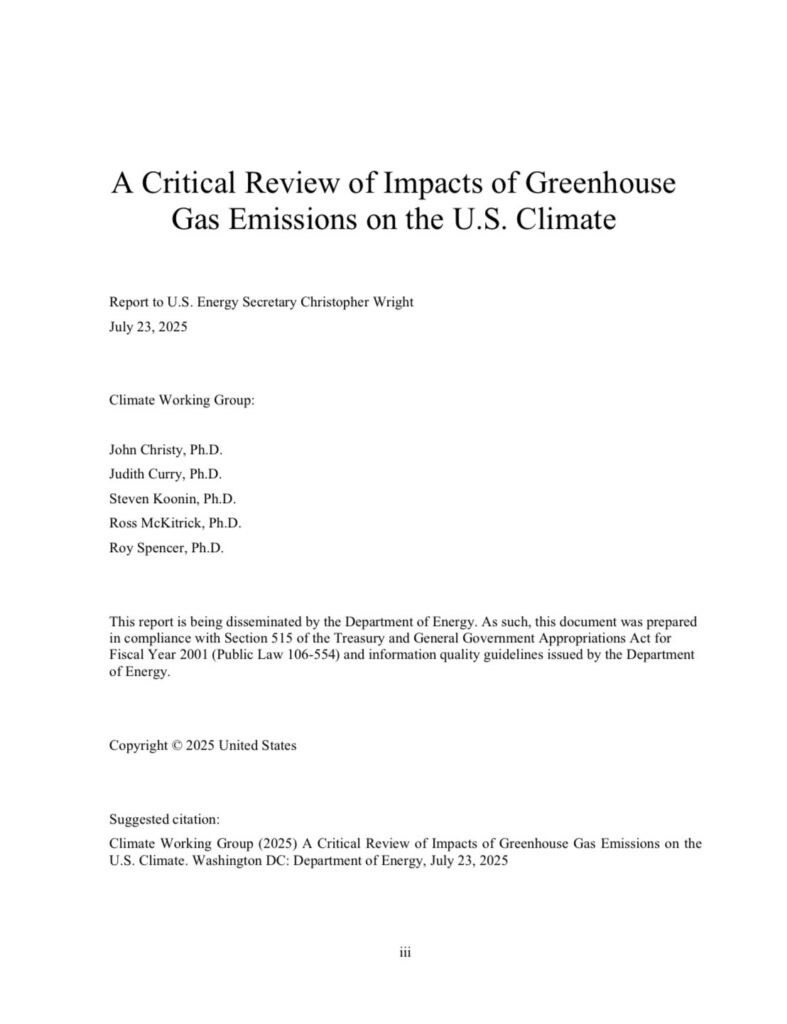
The U.S. Department of Energy (DOE) has published a new climate assessment report:
A Critical Review of Impacts of Greenhouse Gas Emissions on the U.S. Climate
Key findings:
1️⃣ Carbon dioxide- (CO₂-) induced warming appears to be less damaging economically than commonly believed
2️⃣ Aggressive mitigation strategies could be more harmful than beneficial.
3️⃣ U.S. policy actions are expected to have undetectably small direct impacts on the global climate and any effects will emerge only with long delays.
The report is authored by the DOE’s Climate Working Group (CWG):
Dr. John Christy, Dr. Judith Curry, Dr. Steven Koonin, Dr. Ross McKitrick and Dr. Roy Spencer.
#
https://www.energy.gov/topics/climate
Among the key findings, the report concludes that carbon dioxide (CO2) -induced warming appears to be less damaging economically than commonly believed, and that aggressive mitigation strategies could be more harmful than beneficial. Additionally, the report finds that U.S. policy actions are expected to have undetectably small direct impacts on the global climate and any effects will emerge only with long delays.
The report was developed by the 2025 Climate Working Group, a group of five independent scientists assembled by Energy Secretary Chris Wright with diverse expertise in physical science, economics, climate science and academic research.
Summary
This report:
- Reviews scientific certainties and uncertainties in how anthropogenic emissions of CO2 and other GHGs have affected, or will affect, the Nation’s climate, extreme weather events, and metrics of societal well-being.
- Assesses the near-term impacts of elevated concentrations of CO2, including enhanced plant growth and reduced ocean alkalinity.
- Evaluates data and projections regarding long-term impacts of elevated concentrations of CO2, including estimates of future warming.
- Finds that claims of increased frequency or intensity of hurricanes, tornadoes, floods, and droughts are not supported by U.S. historical data.
- Asserts that CO2-induced warming appears to be less damaging economically than commonly believed, and that aggressive mitigation policies could prove more detrimental than beneficial.
- Finds that U.S. policy actions are expected to have undetectably small direct impacts on the global climate and any effects will emerge only with long delays.
Selected Highlights from report excerpted by Climate Depot:
- “Claims of increased frequency or intensity of hurricanes, tornadoes, floods, and droughts are not supported by U.S. historical data”
- “U.S. tide gauge measurements in aggregate show no obvious acceleration in sea level rise beyond the historical average rate”
- “Solar activity’s contribution to the late 20th-century warming might be underestimated”
- “Excessively aggressive mitigation policies could prove more detrimental than beneficial”
- “U.S. policy actions are expected to have undetectably small direct impacts on the global climate”
- “Carbon dioxide (CO2) differs in many ways from the so-called Criteria Air Pollutants. It does not affect local air quality and has no human toxicological implications at ambient levels. It is an issue of concern because of its effects on the global climate.”
- “CO2 enhances photosynthesis and improves plant water use efficiency, thereby promoting plant growth.”
- “Global greening due in part to increased CO2 levels in the atmosphere is well-established on all continents.”
- “Most ocean life evolved when the oceans were mildly acidic. Decreasing pH might adversely affect corals, although the Australian Great Barrier Reef has shown considerable growth in recent years.”
- “Wildfires are not more common in the U.S. than they were in the 1980s. Burned area increased from the 1960s to the early 2000’s, however it is low compared to the estimated natural baseline level.”
- “U.S. wildfire activity is strongly affected by forest management practices.”
- “Heatwave activity in the U.S. reached a peak in the 1930s”
This is the Trump administration summary of “climate science.” The President and I summarize it as “hoax,” but you may require more words. Here they are. https://t.co/xDOvifmO8k pic.twitter.com/9WU40MGQlY
— Steve Milloy (@JunkScience) July 29, 2025