No company better illustrates the abrupt reversals and, as critics see it, the moral elasticity around DEI than Target Corp. After George Floyd was killed by police officers 4 miles from the company’s Minneapolis headquarters in May 2020, the retailer wholly committed itself to the cause of diversity, equity and inclusion, announcing millions of dollars in donations to organizations supporting racial justice and social equity, and unveiling programs to increase its hiring of Black employees and spend more than $2 billion with Black-owned businesses. “I recognize it’s time to take it to another level,” Chief Executive Officer Brian Cornell said at the time.
But this year, Target changed course. Already buffeted by criticism for featuring LGBTQ pride-themed merchandise in its stores, and then for capitulating to conservative groups by removing it, the company scaled back its DEI programs and suspended its minority-hiring goals and investments in minority-owned companies. A memo to employees from its chief community impact and equity officer cited the need to remain in step “with the evolving external landscape”—in other words, with the anti-DEI rhetoric and presidential orders pouring forth almost daily from the administration of Donald Trump.
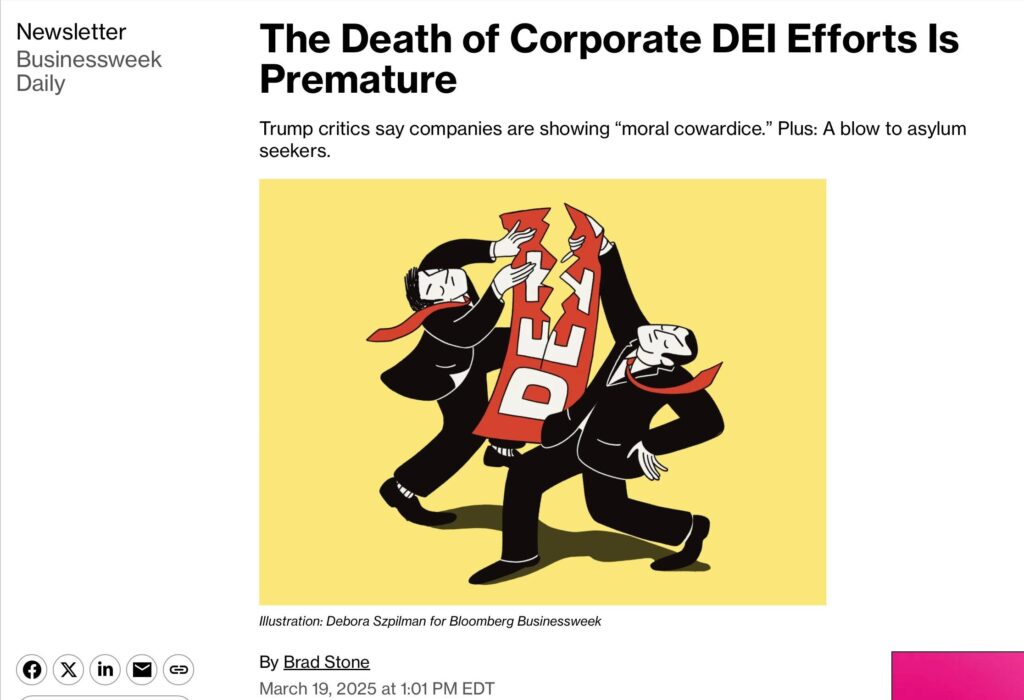
Target is hardly alone when it comes to changing its tune on DEI. Since Jan. 21, when President Trump signed an executive order calling DEI “dangerous, demeaning and immoral,” companies have treated it like a dietary fad suddenly found to pose mortal health risks. Among those pulling back: Alphabet and Charles Schwab removed DEI references from their annual reports, and McDonald’s abandoned targets for diversity within its executive ranks. As part of its broader rightward shift, Meta Platforms Inc. ended programs to consider diverse candidates for open roles as well as all equity and inclusion training for employees. Walmart Inc. said it would no longer consider race or gender when granting supplier contracts and would eliminate its use of the term “Latinx.” Goldman Sachs Group Inc. scotched a program requiring the companies it guides through initial public offerings to have at least one female and two diverse board members, saying the policy had already served its purpose.
A few companies have defended their DEI practices, Costco Wholesale Corp. and Cisco Systems Inc. among them. Some are continuing the work they still deem important but are doing it more quietly and using different terminology, to better conform to Trump’s edicts. But many others “are very aggressively saying, ‘We didn’t mean it,’” says Stacey Abrams, the former Georgia state representative and Democratic gubernatorial candidate and founder of the advocacy organization American Pride Rises. “That is moral cowardice. They are saying no to the very people who make their companies work.”